
Data Science Vs Artificial Intelligence
Data Science and Artificial Intelligence (AI) are closely related fields but serve distinct purposes. Data Science focuses on collecting, analyzing, and interpreting vast amounts of data to uncover patterns and insights, often using statistical methods. It relies heavily on tools like data visualization and machine learning algorithms.
On the other hand, AI involves creating systems that can perform tasks typically requiring human intelligence, such as problem-solving and decision-making. While data science provides the foundation for AI by supplying clean, structured data, AI uses this data to train models and make predictions, leading to intelligent, automated actions across various industries.
Table of Contents
- What is Data Science?
- What is Artificial Intelligence?
- Data Science vs Artificial Intelligence vs Machine Learning: How Do They Connect?
- Core Differences Between Data Science and AI
- Career Paths and Roles
- Future Trends in Data Science and AI
What is Data Science?
Data Science is the field focused on extracting insights and actionable knowledge from both structured and unstructured data. It combines a variety of techniques from statistics, mathematics, programming, and domain expertise to analyze and interpret complex datasets. By using advanced algorithms, Data Science enables organizations to uncover hidden patterns, predict trends, and make data-driven decisions that enhance operational efficiency and strategic planning.
In today’s data-driven world, Data Science is a multidisciplinary field that plays a pivotal role in various sectors, including healthcare, finance, marketing, and technology. It provides the foundation for innovations such as personalized recommendations, predictive analytics, and automated decision-making processes, which are increasingly becoming crucial for business success.
Key Components of Data Science
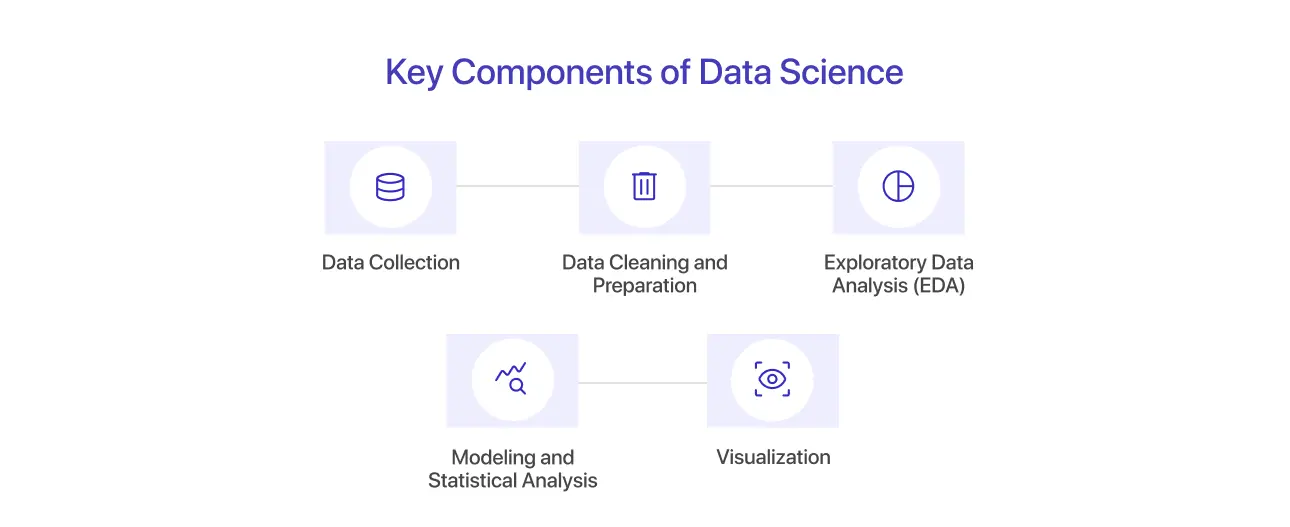
- Data Collection: This is the process of gathering raw data from a wide variety of sources, such as databases, sensors, social media, and IoT devices. The quality and comprehensiveness of the collected data directly influence the accuracy of insights.
- Data Cleaning and Preparation: Raw data often contains inconsistencies, missing values, and errors. Data cleaning and preparation involve transforming this data into a usable format and ensuring it is accurate, complete, and ready for analysis.
- Exploratory Data Analysis (EDA): In this phase, data scientists explore and analyze data sets to discover patterns, trends, and anomalies. EDA is an essential step in understanding the underlying structure of the data before building any models.
- Modeling and Statistical Analysis: Building predictive models using machine learning algorithms and statistical techniques is central to Data Science. These models can forecast future events or classify data into various categories, providing valuable insights for decision-making.
- Visualization: One of the final steps involves representing findings in comprehensible formats like charts, graphs, and interactive dashboards. Data visualization helps stakeholders understand complex results and makes it easier to visualize data and communicate insights effectively.
Applications of Data Science
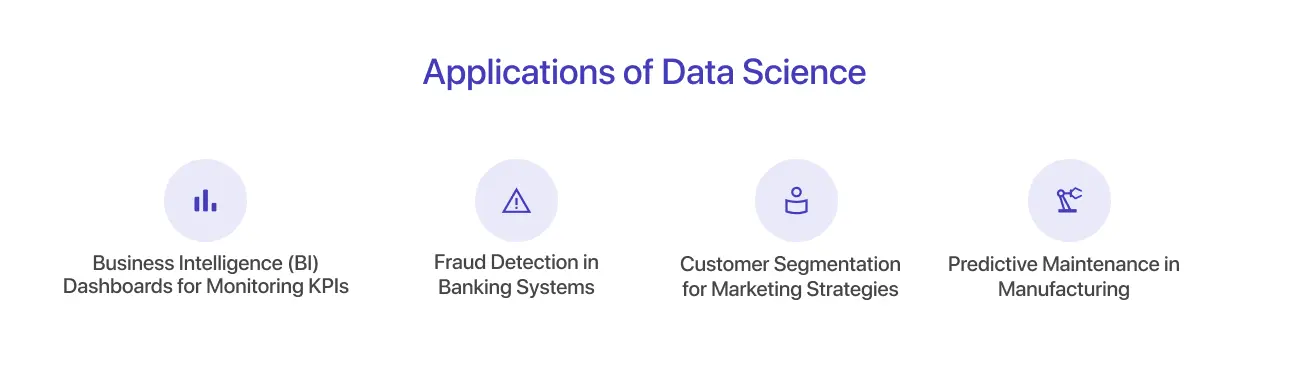
- Business Intelligence Dashboards for Monitoring KPIs: Data Science is instrumental in developing BI dashboards that track key performance indicators (KPIs) in real-time, providing businesses with actionable insights to improve performance.
- Fraud Detection in Banking Systems: Data science analyzes transaction data and user behaviors to detect suspicious activities and potential fraud in real time, safeguarding financial institutions and customers.
- Customer Segmentation for Marketing Strategies: Data Science enables companies to segment their customer base based on behaviors, preferences, and demographics. This segmentation helps tailor marketing strategies to target the right audience with personalized content.
- Predictive Maintenance in Manufacturing: By analyzing sensor data from machines and equipment, Data Science predicts when maintenance is required, preventing breakdowns and optimizing the performance of manufacturing systems.
What is Artificial Intelligence?
Artificial Intelligence (AI) refers to the simulation of human intelligence in machines that are programmed to perform tasks such as learning, reasoning, problem-solving, and decision-making. Unlike traditional software, which follows pre-programmed instructions, AI systems are designed to adapt and improve from experience over time. By leveraging large amounts of data, AI can identify patterns, make predictions, and carry out complex tasks without human intervention.
AI is transforming industries by automating routine tasks, improving customer experiences, and enabling more sophisticated decision-making processes. It spans multiple subdomains, from machine learning to robotics, and is at the forefront of technological advancements reshaping sectors like healthcare, finance, and logistics. Understanding how AI is changing the world is crucial for leveraging its potential effectively.
Data science in the next years will align closely with the future of AI, driving innovation through real-time analytics and predictive modeling. These advancements will enhance collaboration between data scientists and AI systems, empowering businesses to address complex challenges and unlock new opportunities in an increasingly data-driven world.
Key Components of Artificial Intelligence
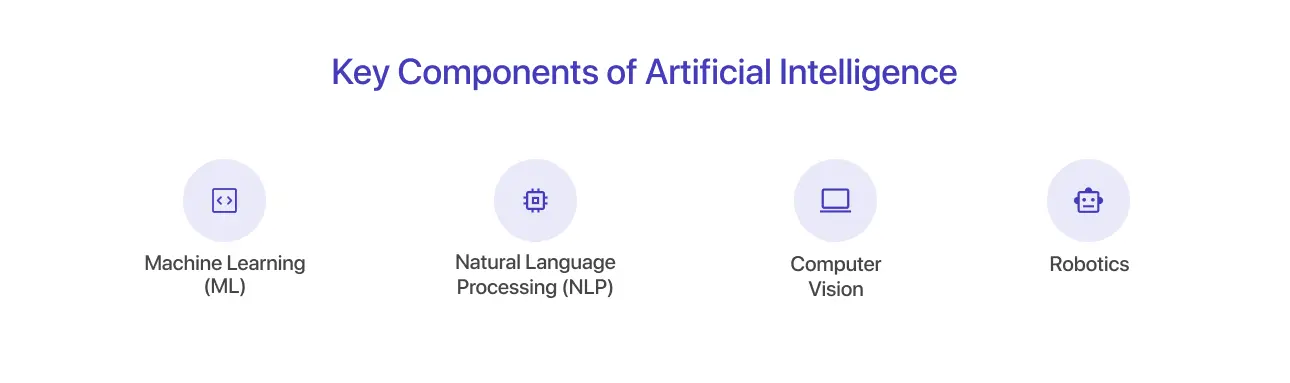
- Machine Learning (ML): A subset of AI that focuses on advanced data analytics with AI, enabling algorithms to learn from data. Unlike traditional programming, where specific instructions are written for every task, ML allows systems to recognize patterns and make decisions based on past data without being explicitly programmed for each scenario.
- Natural Language Processing (NLP): NLP enables machines to understand, interpret, and generate human language. From chatbots to real-time language translation, NLP is a crucial component of AI that allows for seamless interaction between machines and humans.
- Computer Vision: This branch of AI involves interpreting and analyzing visual data from the environment. It is used in applications like facial recognition, object detection, and autonomous vehicles, enabling machines to make decisions based on visual inputs.
- Robotics: Robotics combines AI with mechanical engineering to create machines capable of performing complex actions. These robots are used in various industries, including manufacturing, healthcare, and even space exploration, to perform tasks that would otherwise be dangerous or repetitive for humans.
Applications of AI
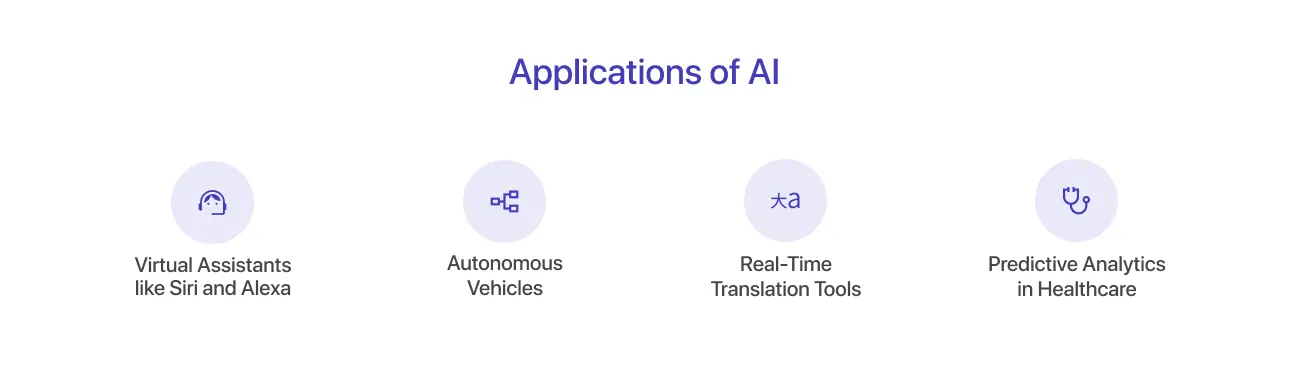
- Virtual Assistants like Siri and Alexa: AI-powered virtual assistants have become integral parts of everyday life, helping users manage tasks, answer questions, and control smart devices through voice commands.
- Autonomous Vehicles: AI plays a crucial role in enabling self-driving cars to navigate roads, make decisions in real time, and adapt to changing conditions without human intervention.
- Real-Time Translation Tools: AI-powered translation services allow people to communicate across different languages in real-time, making global interactions smoother and more efficient.
- Predictive Analytics in Healthcare: AI is used to analyze patient data, predict health outcomes, and assist healthcare providers in making more accurate diagnoses and treatment plans, improving patient care.
Data Science vs Artificial Intelligence vs Machine Learning: How Do They Connect?
The terms Data Science, Artificial Intelligence (AI), and Machine Learning (ML) are often used interchangeably, but they each serve different functions in the tech landscape. While they are interconnected, understanding their differences can help businesses and professionals navigate the evolving world of data and automation.
- Data Science vs AI: Data Science focuses on extracting insights from data using statistics, visualization, and analytics, whereas AI is about creating machines that can learn, reason, and make decisions. AI relies on the structured data provided by Data Science to function effectively.
- Artificial Intelligence vs Data Science: AI aims to develop intelligent systems that automate decision-making, while Data Science enables businesses to analyze patterns and trends to improve those decisions. Essentially, Data Science provides the “what” and “why,” while AI focuses on the “how.”
- Data Science vs Artificial Intelligence vs Machine Learning: Machine Learning acts as a bridge between Data Science and AI. ML models learn from data (processed by Data Science) and improve over time, forming the backbone of many AI applications. While Data Science finds meaningful patterns in raw data, AI uses those patterns to make predictions and automate tasks.
From predictive analytics to self-driving cars, businesses today are using AI vs Data Science strategies to optimize operations and enhance user experiences. Whether it's fraud detection in banking, recommendation systems in streaming services, or virtual assistants like Siri, these fields work together to drive innovation.
By understanding how Data Science vs Artificial Intelligence vs Machine Learning complement each other, professionals can leverage their strengths to build smarter, data-driven solutions.
Core Differences Between Data Science and AI
|
Aspect |
Data Science | Artificial Intelligence |
|
Definition |
A field focused on extracting knowledge and insights from structured and unstructured data. | A field dedicated to developing intelligent systems that can perform tasks that typically require human intelligence. |
|
Primary Goal |
To analyze, interpret, and visualize data to support decision-making. | To create machines that can learn, reason, and make autonomous decisions. |
|
Techniques Used |
Statistical models, machine learning, data mining, data visualization. | Deep learning, neural networks, reinforcement learning, expert systems. |
|
Nature of Work |
Data collection, cleaning, processing, analysis, and visualization. | Building algorithms and models that mimic cognitive functions like learning and problem-solving. |
|
Data Dependency |
Highly dependent on historical data for analysis and predictions. | Can operate with minimal data through heuristics, logic, or predefined rules. |
|
Programming Languages |
Python, R, SQL, SAS, Julia. | Python, Java, C++, Lisp, Prolog. |
|
Key Tools & Libraries |
Pandas, NumPy, Matplotlib, Scikit-learn, Tableau, Power BI. | TensorFlow, PyTorch, Keras, OpenCV, DeepMind, IBM Watson. |
|
Skillsets Required |
Data wrangling, exploratory data analysis, statistical modeling, database management, and data visualization. | Programming, neural network design, deep learning frameworks, and natural language processing (NLP). |
|
Mathematical Foundations |
Statistics, probability, linear algebra. | Linear algebra, calculus, optimization, probability. |
|
Automation Level |
Low to moderate—focuses on insights rather than automation. | High—focuses on developing self-learning and autonomous systems. |
|
Use Cases |
Fraud detection, business intelligence dashboards, customer segmentation, sales forecasting. | Self-driving cars, image, and speech recognition, personalized recommendations, predictive maintenance. |
|
Industry Applications |
Healthcare, finance, marketing, e-commerce, social sciences. | Robotics, healthcare AI, autonomous vehicles, smart assistants. |
|
Decision-Making Capability |
Supports human decision-making by providing data-driven insights. | Enables machines to make independent decisions with minimal human intervention. |
|
Future Scope |
Expansion in data-driven decision-making across industries. | Increasing automation, cognitive computing, and AI-driven applications. |
Career Paths and Roles
Roles in Data Science
- Business Intelligence Developer: Creates dashboards for data visualization and performance tracking.
- Data Analyst: Focuses on interpreting data to provide actionable insights.
- Data Engineer: Builds and maintains the infrastructure for data processing.
Roles in AI
- Machine Learning Engineer: Develops models and systems that require real-time monitoring dashboards.
- AI Product Manager: Ensures AI solutions meet business objectives, often using wireframes to visualize user interfaces.
- Data Scientist: Designs experiments and dashboards for monitoring model outcomes.
Future Trends in Data Science and AI
In the coming years, data analytics and data science are poised for transformative advancements, with artificial intelligence (AI) at the forefront of this evolution. As data volumes continue to surge, the need for sophisticated analytics tools becomes paramount, enabling businesses to derive actionable insights swiftly. Data scientists will increasingly leverage advanced tools capable of real-time analysis of vast datasets, facilitating quicker and more informed decision-making.
Predictive analytics is set to become more precise, empowering businesses to anticipate trends and make proactive decisions. The integration of data science with fields like the Internet of Things (IoT) and automation will usher in more personalized services and streamlined processes. Generative AI, a subset of AI, is opening new avenues by enabling machines to create content such as images, music, and text, revolutionizing industries like entertainment, marketing, and healthcare.
This progression presents both challenges and opportunities, particularly concerning ethical considerations and the implications of automation. As AI technologies advance, they hold the potential to address complex global issues, from climate change to medical research, by offering innovative solutions at scale. In this dynamic landscape, understanding the distinctions in the Data Science vs. Artificial Intelligence debate becomes crucial for effectively harnessing their capabilities.
Recent data underscores the rapid adoption of AI among organizations. A 2024 report indicates that 72% of companies have integrated AI into at least one business function, reflecting a significant increase in AI utilization across various sectors.
Moreover, professionals in sectors like legal, tax, accounting, and anti-fraud anticipate that AI could save them hundreds of hours annually. A report by Thomson Reuters indicates that these professionals could save up to four hours weekly through AI, translating to 200 hours per year. This time could be redirected towards strategic work, innovation, and professional development.
Conclusion
While interconnected, Data Science and Artificial Intelligence (AI) have distinct roles and applications. Data science in the next years will focus on leveraging more automated processes and advanced analytics to unlock deeper insights from ever-expanding datasets. Understanding the differences between these fields helps organizations deploy the right tools and strategies. Dashboard wireframing emerges as a vital process in both domains, fostering communication, speeding up prototyping, and enabling effective collaboration.
How AI is changing the world is evident in its ability to revolutionize industries by automating workflows and enhancing decision-making. As these fields evolve, dashboard wireframing's role will only grow, integrating with advanced tools to meet the needs of data-driven teams. Organizations that embrace these practices will be better positioned to harness the power of Data Science and AI, staying ahead of the curve as the future of technology unfolds.
Frequently Asked Questions
Data Science focuses on analyzing data to uncover insights, while AI aims to simulate human intelligence for decision-making.
Data Science enables automation by developing models that analyze patterns, predict outcomes, and optimize processes without manual intervention.
Industries like healthcare, finance, retail, and manufacturing benefit significantly from AI-driven data analytics for improved decision-making and efficiency.
By analyzing customer behavior, preferences, and feedback, businesses can use Data Science to personalize experiences and enhance customer satisfaction.
AI and Data Science complement each other. AI uses data-driven models to make decisions, and Data Science leverages AI for deeper analytics.
Prompt it. Wireframe it with Mokkup.ai.