
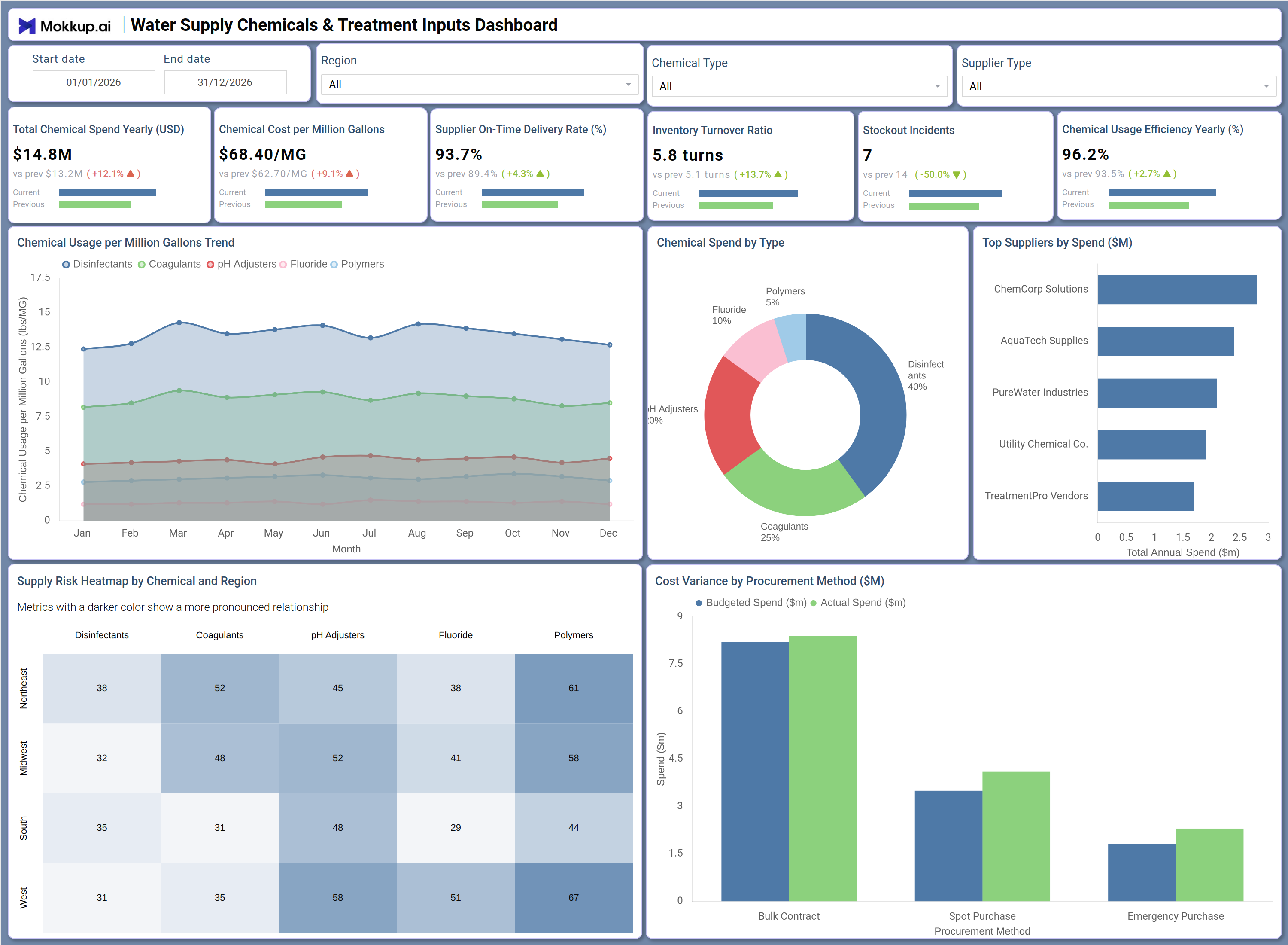
What is a Water Supply Chemicals & Treatment Inputs Dashboard?
The Water Supply Chemicals & Treatment Inputs Dashboard is a structured analytics template built for water utilities, municipal treatment operators, and public works teams that manage the chemical and treatment input side of water supply operations. This water supply chemicals treatment inputs dashboard centralizes visibility over demand trends, source-level drought exposure, supply adequacy margins, and capital project statuses, giving operations managers and planners the information they need to make procurement and treatment decisions with confidence.
Teams responsible for water treatment chemical dosing tracking and supply chain coordination can monitor forecast accuracy alongside actual consumption to identify gaps before they affect service delivery. As a water treatment KPI dashboard template, it provides a repeatable framework for tracking performance across regions, sources, and seasons without rebuilding reports from scratch.
How to Create a Water Supply Chemicals & Treatment Inputs Dashboard
You don’t need to build your report from scratch, just start with a ready-to-use Water Supply Chemicals & Treatment Inputs dashboard template from Mokkup. Add in your data and export it however you like. Here’s how to do it:
1. Create or Log in to Your Mokkup Account
Start by signing up on Mokkup.ai using your email. If you already have an account, just log in, and you'll be good to go.
2. Choose and Customize Your Dashboard Template
Find the Water Supply Chemicals & Treatment Inputs Dashboard template in the Templates section. Use the drag-and-drop editor to adjust KPIs, edit filters, or add elements based on your data.
3. Export to Your BI Tool
Once your dashboard wireframe is ready, use the BI Tool Export feature to send it directly to Power BI or Tableau for further analysis and enhancements. You can also download the dashboard as a PDF, PNG, or JPEG, embed it on a platform, or invite your team to collaborate.
Note: This is a Pro template. You'll need a Pro subscription on Mokkup to use and customize this dashboard wireframe. Upgrade anytime to unlock full access.
Water Supply Chemicals & Treatment Inputs Dashboard Example
A water utility operations team opens this dashboard at the start of each planning cycle to understand where demand is trending relative to available supply. By reviewing the demand forecast versus actual consumption chart, planners can identify whether chemical treatment volumes are being scaled appropriately for seasonal peaks or if procurement needs to accelerate, a core part of water treatment chemical dosing tracking across the network. The supply adequacy margin analysis across regions like California, Texas, Southwest, Florida, and Northeast allows regional managers to prioritize treatment input allocation where shortfall risk is highest, directly supporting treatment input consumption monitoring across the utility's service area.
Teams also use the drought risk exposure breakdown by water source to understand which source types, such as groundwater, surface water, recycled water, desalination, and purchased water are carrying the most operational risk, enabling more precise chemical inventory management for water supply planning. The capital investment and capacity projects table gives decision-makers a clear view of which infrastructure upgrades are funded, permitted, or under construction, so treatment planning aligns with upcoming capacity changes across the network.
How to Analyze Data in a Water Supply Chemicals & Treatment Inputs Dashboard
Here is how you can analyze data from this dashboard:
- Filter by Region: Compare supply adequacy and treatment input performance across service areas.
- Track Demand Forecast Accuracy: Monitor forecast versus actual demand trends to identify overruns.
- Assess Drought Exposure: Review drought risk by water source to adjust procurement planning.
- Compare Regional Supply Margins: Identify regions needing operational efficiency improvements.
- Analyze Seasonal Demand Peaks: Compare peak day versus average demand to plan chemical volumes.
- Filter by Water Source: Align chemical dosing and treatment requirements with specific source types.
- Monitor Supply Adequacy Trends: Track margin performance over time to identify capacity gaps.
- Review Capacity Projects: Align procurement planning with infrastructure project timelines.
Benefits of a Water Supply Chemicals & Treatment Inputs Dashboard
The following are the benefits of using this dashboard:
- Centralized Operational Visibility: Combines supply adequacy, drought risk, and demand forecasting in one dashboard.
- Improved Chemical Tracking: Supports monitoring of treatment chemical dosing and consumption trends.
- Reduced Reporting Effort: Prebuilt KPIs simplify treatment operations reporting.
- Better Inventory Planning: Enables region-level analysis of chemical inventory management.
- Seasonal Demand Insights: Highlights peak versus average demand for operational planning.
- Integrated Infrastructure Coordination: Aligns treatment input schedules with capacity project timelines.
- Shared Planning View: Gives operations teams and planners unified visibility into supply and treatment performance.
KPIs to Track in a Water Supply Chemicals & Treatment Inputs Dashboard
The following key KPIs can be tracked by using this dashboard:
- Current Daily Demand (MGD): This water supply chemicals treatment inputs dashboard uses this metric to benchmark daily consumption against treatment capacity and input volumes.
- Supply Adequacy Margin (%): Tracks the buffer between available supply and current demand, critical for planning chemical procurement timelines and avoiding shortfall scenarios.
- Demand Forecast Accuracy (%): Quantifies how closely projected demand matches actual consumption, supporting more reliable treatment input consumption monitoring across planning cycles.
- Projected Supply Shortfall (MGD): Measures the gap between forecasted demand and available supply, key to water supply operational efficiency metrics and proactive capacity planning.
- Drought Risk Exposure (%): Evaluates the proportion of supply sourced from drought-vulnerable water types, supporting risk-adjusted chemical inventory management for water supply decisions.
- New Capacity in Pipeline (MGD): Tracks approved capacity additions across the water treatment KPI dashboard template metrics to align future treatment input requirements with infrastructure delivery.
Frequently Asked Questions
Q1. What types of organizations benefit most from this dashboard?
Water utilities, municipal water authorities, and public works departments responsible for treatment input planning and supply adequacy reporting benefit most. Regional utility managers and infrastructure planners are the primary users.
Q2. Can this dashboard track performance across multiple water source types?
Yes. The Drought Risk Exposure by Water Source chart segments performance across groundwater, surface water, recycled water, desalination, and purchased water, allowing source-specific treatment input analysis.
Q3. Is this dashboard suitable for seasonal demand planning?
Yes. The Peak Day Demand vs Average Demand by Season chart directly supports seasonal planning by comparing peak summer demand against annual averages, enabling treatment input volumes to be scaled appropriately.