
What is a Rehabilitation Nutrition Monitoring Dashboard?
A Rehabilitation Nutrition Monitoring Dashboard template is designed for clinical and administrative staff to track and improve nutritional care outcomes for patients undergoing rehabilitation. It provides a clear view of key nutrition-related metrics, including dietary compliance, protein intake, BMI trends, weight stability, hydration, and supplement adherence.
Unlike manual record-keeping, this dashboard wireframe enables healthcare teams to monitor patient progress, identify risks, and support data-driven decisions that enhance recovery and nutritional health.
How to Create a Rehabilitation Nutrition Monitoring Dashboard
You don’t need to build your dashboard from scratch—just start with a ready-to-use Rehabilitation Nutrition Monitoring Dashboard template from Mokkup. Add your data and export it in your preferred format. Here’s how:
1. Create or Log in to Your Mokkup Account
Sign up on Mokkup.ai using your email. Existing users can log in directly.
2. Choose and Customize Your Dashboard Template
Find the Rehabilitation Nutrition Monitoring Dashboard template in the Templates section. Use the drag-and-drop editor to adjust KPIs, charts, or filters based on your patient data.
3. Export to Your BI Tool
Once your dashboard wireframe is ready, export it to Power BI or Tableau for deeper analysis. You can also download it as a PDF, PNG, or JPEG, embed it on a platform, or invite your team to collaborate.
Note: This is a Pro template. You’ll need a Pro subscription on Mokkup to use and customize this dashboard wireframe. Upgrade anytime to unlock full access.
Rehabilitation Nutrition Monitoring Dashboard Example
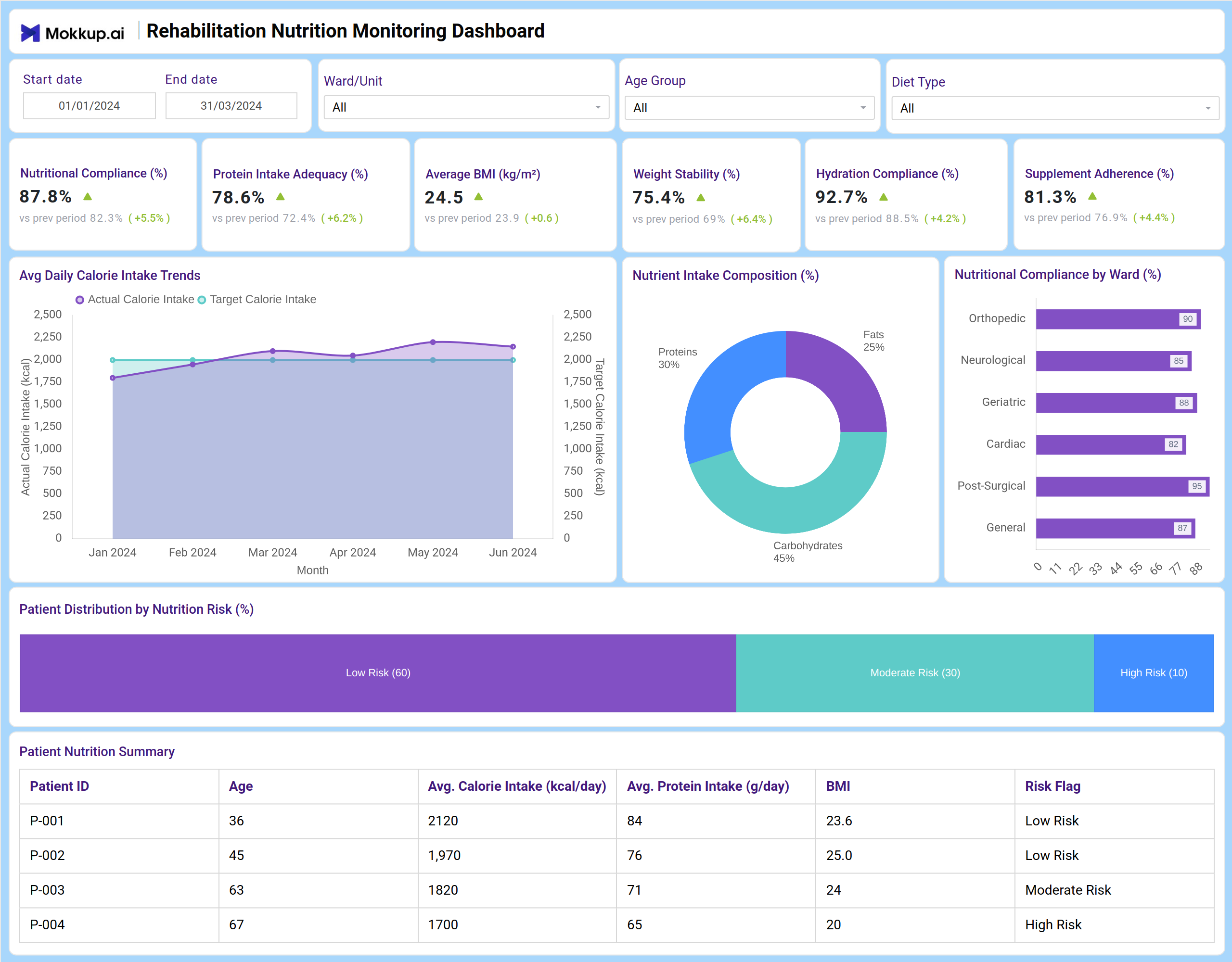
You can create a Rehabilitation Nutrition Monitoring Dashboard using a mix of KPI tiles and visualizations. At the top, KPI cards track key metrics, including Nutritional Compliance, Protein Intake Adequacy, Average BMI, Weight Stability, Hydration Compliance, and Supplement Adherence. Below, charts display trends in daily calorie intake, nutrient composition, compliance by ward, and patient distribution by nutrition risk. The dashboard wireframe serves as a tool for tracking rehabilitation nutrition metrics, enabling clinical teams to monitor both individual and group-level nutritional progress.
How to Analyze Data in Rehabilitation Nutrition Monitoring Dashboards
Here’s how rehabilitation teams can make the most of the data available on the Rehabilitation Nutrition Monitoring Dashboard:
- Track Nutritional Compliance: Monitor overall dietary adherence and compare it with previous periods.
- Assess Protein Intake: Ensure patients meet daily protein goals for muscle repair and recovery.
- Monitor BMI Trends: Track changes in average BMI to identify patients who are undernourished or at risk.
- Evaluate Weight Stability: Identify patients who have experienced significant weight loss or gain.
- Check Hydration Levels: Ensure patients maintain adequate fluid intake.
- Review Supplement Adherence: Track usage of prescribed nutritional supplements.
- Analyze Calorie Intake Trends: Compare actual daily calorie consumption to the target.
- Review Risk Distribution: Categorize patients into low, moderate, or high nutrition risk categories.
Benefits of Rehabilitation Nutrition Monitoring Dashboards
Rehabilitation nutrition dashboards help healthcare teams track and optimize patient dietary care, aligning nutrition strategies with recovery goals. By providing real-time insights, these dashboards enhance patient outcomes and facilitate streamlined clinical decision-making:
- Enhanced Nutritional Oversight: Monitor key nutritional KPIs across patient groups and wards.
- Enhanced Recovery Support: Link dietary intake to rehabilitation progress and outcomes.
- Risk Identification: Quickly identify high-risk patients who require intervention.
- Data-Driven Care Plans: Use trends to adjust diet plans and supplement strategies.
- Ward-level Insights: Compare compliance and performance across different units.
- Reporting and Compliance: Serve as a rehabilitation nutrition reporting and compliance dashboard for audits and governance.
Together, these elements help clinical teams align nutritional care with rehabilitation goals, making it easier to improve patient outcomes. That’s why many healthcare professionals refer to it as the best dashboard for rehabilitation nutrition tracking when aiming to enhance recovery through nutrition.
KPIs to Track in Rehabilitation Nutrition Monitoring Dashboards
Key performance indicators (KPIs) provide actionable insights into patient adherence to nutrition, recovery support, and the overall effectiveness of the dietary program:
- Nutritional Compliance (%): Percentage of patients adhering to prescribed diets.
- Protein Intake Adequacy (%): Share of patients meeting daily protein targets.
- Average BMI (kg/m²): Mean Body Mass Index across the patient group.
- Weight Stability (%): Proportion of patients maintaining stable weight.
- Hydration Compliance (%): Percentage of patients meeting fluid intake goals.
- Supplement Adherence (%): Share of patients consistently taking supplements.
- Calorie Intake Trends: Actual vs. target daily calorie consumption.
- Nutrition Risk Distribution: Breakdown of patients by low, moderate, and high risk.
Frequently Asked Questions
Q1. Who should use a Rehabilitation Nutrition Monitoring Dashboard?
Clinical dietitians, rehabilitation specialists, nurses, and healthcare administrators are involved in patient nutrition and recovery.
Q2. Can this dashboard help improve patient recovery?
Yes. By tracking nutrition compliance and intake metrics, care teams can tailor interventions to support faster and more effective recovery.
Q3. How does it support clinical decision-making?
It provides clear insights into patient nutrition status, trends, and risks, enabling timely and informed care adjustments.
Q4. Is this dashboard useful for compliance?
Yes. As a rehabilitation nutrition workflow and outcome analytics dashboard, it supports reporting, governance, and compliance audits.