
What is a Pediatrics Emergency & Critical Care Dashboard?
A Pediatrics Emergency & Critical Care Dashboard is a centralized tool designed for hospital leadership and clinical managers to monitor the performance of pediatric emergency and ICU services in real time, including Heads of Pediatrics, ER Clinical Directors, and Nursing Managers. It provides visibility into patient flow, clinical outcomes, resource utilization, and staff efficiency. Unlike static reports, this dashboard acts as a real-time pediatric emergency dashboard, helping institutions track wait times, mortality rates, readmissions, and critical care capacity in one place.
How to Create a Pediatrics Emergency & Critical Care Dashboard
You don’t need to build your report from scratch—just start with a ready-to-use Pediatrics Emergency & Critical Care Dashboard template from Mokkup. Add in your data and export it however you like. Here’s how to do it:
1. Create or Log in to Your Mokkup Account
Start by signing up on Mokkup.ai using your email. If you already have an account, just log in, and you’ll be good to go.
2. Choose and Customize Your Dashboard Template
Find the Pediatrics Emergency & Critical Care Dashboard template in the Templates section. Use the drag-and-drop editor to adjust KPIs, edit filters like Department, Age Group, and Shift, or add elements based on your data.
3. Export to Your BI Tool
Once your dashboard wireframe is ready, use the BI Tool Export feature to send it directly to Power BI or Tableau for further analysis and enhancements. You can also download the dashboard as a PDF, PNG, or JPEG, embed it on a platform, or invite your team to collaborate.
Note: This is a Pro template. You’ll need a Pro subscription on Mokkup to use and customize this dashboard wireframe. Upgrade anytime to unlock full access.
Pediatrics Emergency & Critical Care Dashboard Example
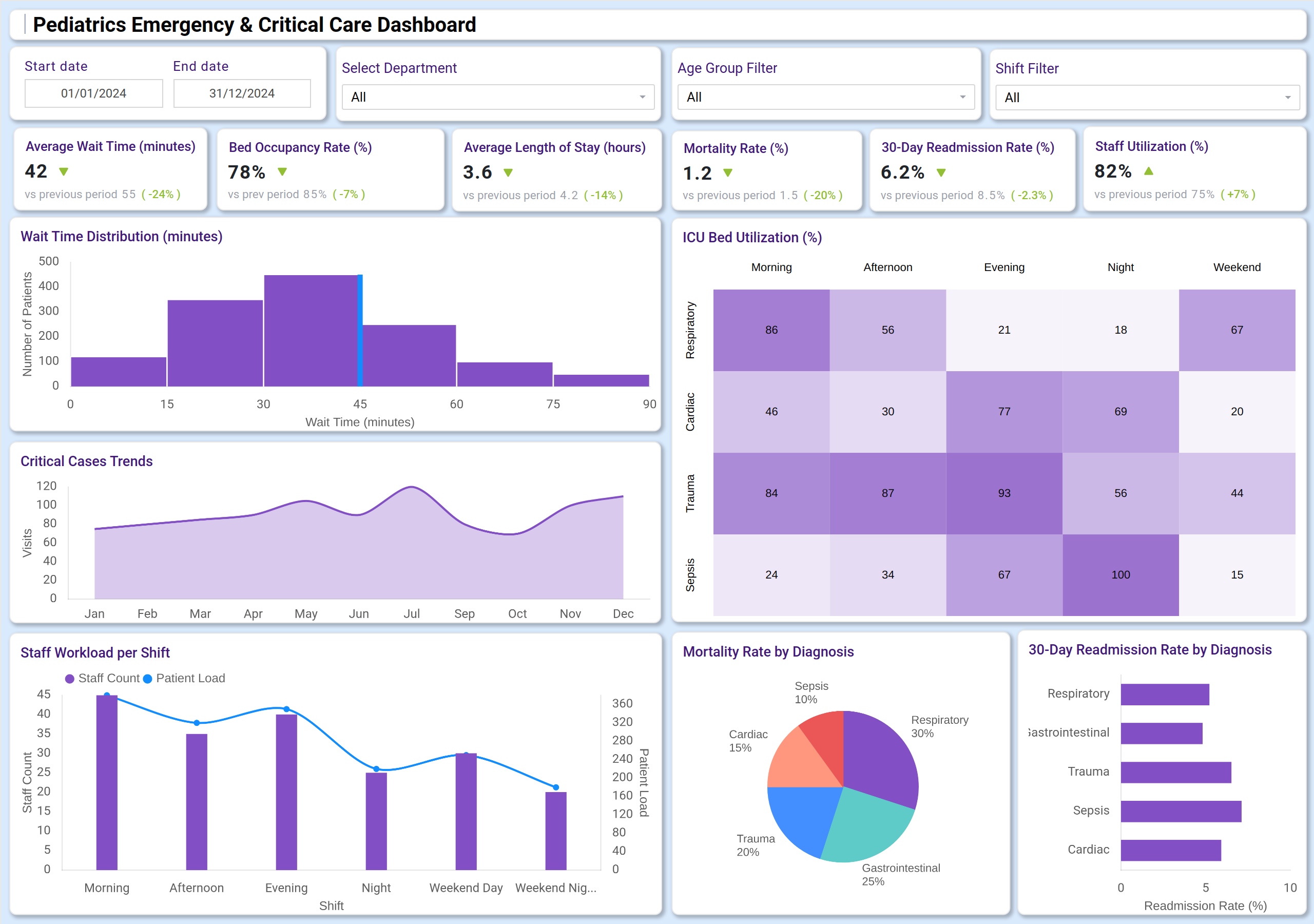
You can create a Pediatrics Emergency & Critical Care Dashboard with a mix of KPI tiles and visualizations. At the top, KPI cards track key metrics such as Average Wait Time, Bed Occupancy Rate, Mortality Rate, and 30-Day Readmission Rate. Below that, charts show the distribution of patient wait times, ICU bed utilization across different specialties and shifts, and trends in critical cases. Staff workload and diagnosis-specific outcomes are visualized to pinpoint areas for improvement. Together, this dashboard works as a dashboard for tracking pediatric critical care metrics, ensuring leadership gets both operational and clinical visibility.
How to Analyze Data in Pediatrics Emergency & Critical Care Dashboards
Here’s how hospital leaders can make the most of the data available on the Pediatrics Emergency & Critical Care Dashboard:
- Track patient flow efficiency: Monitor Average Wait Time and Length of Stay to identify bottlenecks in the ER and ICU.
- Monitor clinical outcomes: Analyze Mortality Rate and 30-day readmission rate trends to gauge the quality of care and identify areas for improvement.
- Optimize resource allocation: Analyze Bed Occupancy Rate and ICU Utilization by specialty and shift to manage capacity effectively.
- Manage staff performance: Review Staff Utilization and Workload per Shift to ensure adequate staffing and prevent burnout.
- Identify clinical hotspots: Drill into Mortality and Readmission Rates by Diagnosis (e.g., Sepsis, Respiratory) to target clinical protocols and training.
- Track performance trends: Use line charts to monitor critical case volumes over time for better preparedness and planning.
Benefits of Pediatrics Emergency & Critical Care Dashboards
- Improved clinical visibility: Real-time KPIs across patient flow, clinical outcomes, and resource utilization.
- Enhanced patient outcomes: Proactive tracking of mortality and readmission rates leads to faster interventions and improved care quality.
- Operational efficiency: Monitors wait times, length of stay, and bed turnover for better patient flow management.
- Optimized staff allocation: Tracks staff utilization and workload to ensure balanced schedules and maintain high care standards.
- Data-driven decision making: Provides evidence for resource requests, protocol changes, and capacity planning.
- Compliance & reporting: Works as a pediatric emergency reporting and compliance dashboard for audits and adherence to healthcare standards.
Together, these elements provide leadership with a comprehensive view of emergency and critical care performance, enabling them to align resources more effectively with patient needs. That’s why many clinical leaders call it the best dashboard for tracking pediatric critical care metrics when aiming to improve efficiency and clinical outcomes.
KPIs to Track in Pediatrics Emergency & Critical Care Dashboards
- Average Wait Time (minutes): Key indicator of ER efficiency and patient access.
- Bed Occupancy Rate (%): Measure of inpatient capacity and utilization.
- Average Length of Stay (hours): Efficiency metric for both ER and ICU.
- Mortality Rate (%): Critical indicator of clinical care quality.
- 30-Day Readmission Rate (%): Measures the effectiveness of care and post-discharge outcomes.
- Staff Utilization (%): Efficiency of clinical staff deployment.
- ICU Bed Utilization by Specialty: Detailed view of critical care capacity across respiratory, cardiac, trauma, and sepsis cases.
Frequently Asked Questions
1. Who should use a Pediatrics Emergency & Critical Care Dashboard?
Heads of Pediatrics, ER Clinical Directors, Nursing Managers, and hospital administrators are responsible for monitoring the performance, quality, and efficiency of pediatric emergency and critical care services.
2. Can this dashboard help improve patient outcomes?
Yes. By tracking key clinical metrics, such as mortality rate and Readmission Rate by diagnosis, leadership can implement targeted interventions to improve treatment protocols and enhance patient safety.
3. How does it support operational efficiency?
It combines patient flow metrics, such as wait time and Length of Stay, with resource data, including bed occupancy and Staff Utilization, to optimize scheduling and capacity management.
4. Is this dashboard useful for compliance?
Yes, because a pediatric critical care workflow analytics dashboard supports governance, clinical reporting, and compliance with healthcare regulations and quality audits.