
What is a Pediatrics Compliance & Safety Dashboard?
A pediatrics compliance and safety monitoring dashboard template is a healthcare analytics tool that helps hospitals track compliance performance, audit readiness, and safety standards within pediatric departments. It integrates operational, clinical, and regulatory data to assess how well a hospital adheres to established pediatric safety and quality standards. Hospitals use this pediatric hospital quality and compliance dashboard to monitor infection control, incident reporting, staff training, and CAPA (Corrective and Preventive Actions) effectiveness.
The goal is to reduce patient safety incidents, improve compliance scores, and ensure every pediatric unit, from ICU to outpatient care, follows clinical governance protocols. This dashboard wireframe provides a single view of compliance health across the hospital system, ensuring transparency and accountability in pediatric care delivery.
How to Create a Pediatrics Compliance & Safety Dashboard
You don’t need to build your report from scratch just start with a ready-to-use dashboard template from Mokkup. Add in your data and export it however you like. Here’s how to do it:
1. Create or Log in to Your Mokkup Account
Start by signing up on Mokkup.ai using your email. If you already have an account, just log in, and you’ll be good to go.
2. Choose and Customize Your Dashboard Template
Find the Pediatrics Compliance & Safety Dashboard template in the Templates section. Use the drag-and-drop editor to adjust KPIs, edit filters, or add elements based on your data.
3. Export to Your BI Tool
Once your dashboard wireframe is ready, use the BI Tool Export feature to send it directly to Power BI or Tableau for further analysis and enhancements. You can also download the dashboard as a PDF, PNG, or JPEG, embed it on a platform, or invite your team to collaborate.
Note: This is a Pro template. You’ll need a Pro subscription on Mokkup to use and customize this dashboard wireframe. Upgrade anytime to unlock full access.
Pediatrics Compliance & Safety Dashboard Example
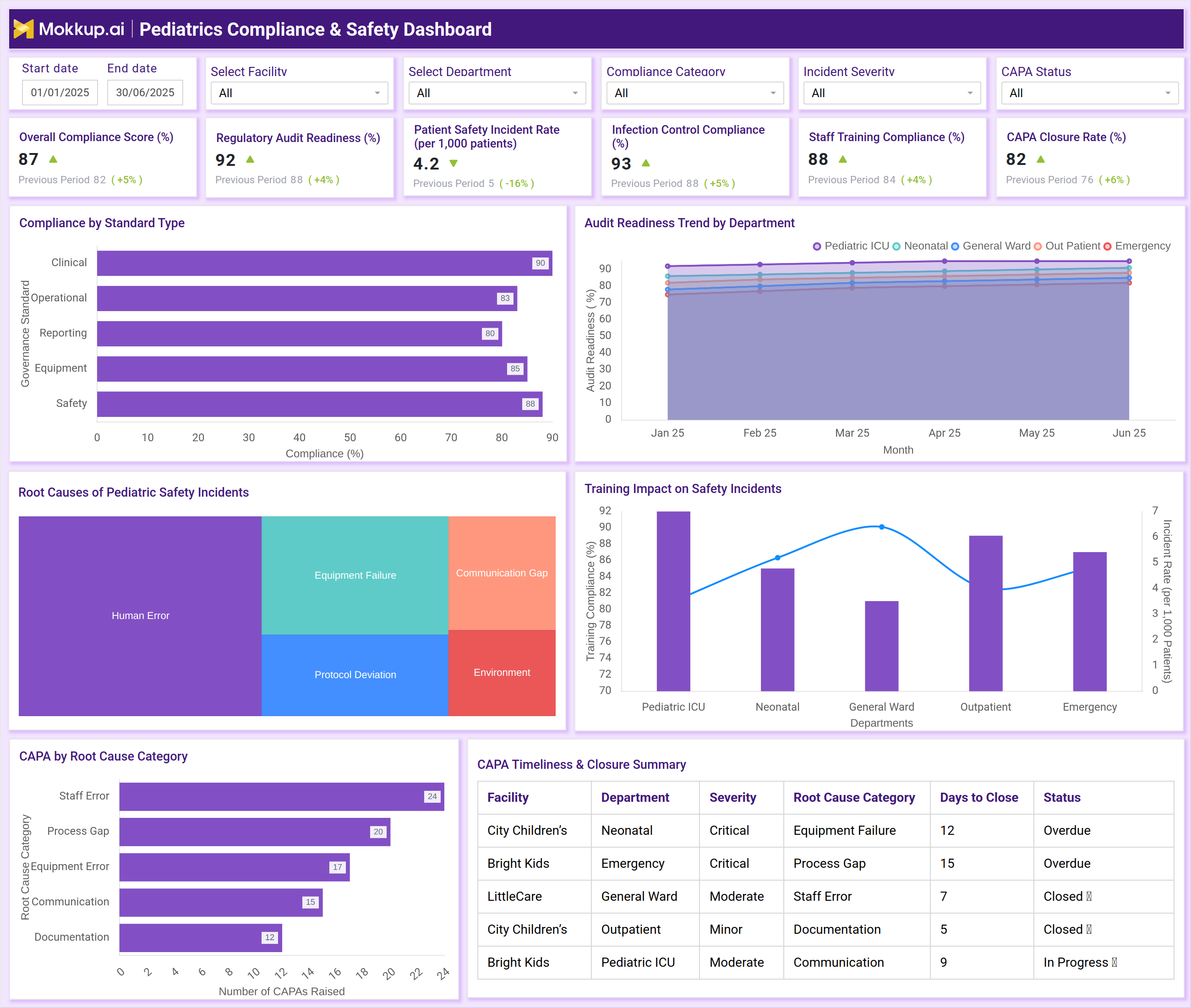
The example dashboard above displays two key aspects: Compliance Performance and Safety Monitoring Insights. The top section showcases KPIs such as Overall Compliance Score (%), Regulatory Audit Readiness (%), Infection Control Compliance (%), Staff Training Compliance (%), and CAPA Closure Rate (%). Visuals, such as the Audit Readiness Trend by Department graph, highlight how pediatric ICU, neonatal, and emergency units maintain consistent compliance levels over time. The lower section focuses on safety monitoring through the pediatric patient safety performance dashboard. It visualizes the Root Causes of Pediatric Safety Incidents, including human error, equipment failure, and communication gaps, and correlates them with the Impact of Training on Safety Incidents.
CAPA analytics further breaks down how quickly incidents are resolved, offering clarity on departmental efficiency. Together, these views provide hospital administrators with a data-driven approach to track compliance trends, identify risks, and enhance the reliability of pediatric care.
How to Analyze Data in Pediatrics Compliance & Safety Dashboard
To get a complete view of pediatric care quality, safety, and regulatory readiness, analyze the dashboard using these key focus areas:
- Monitor Overall Compliance Scores: Track improvement across clinical, documentation, and operational compliance categories.
- Assess Departmental Audit Readiness: Use trends to identify which units need additional compliance support or training.
- Review Safety Incident Rates: Analyze incident frequency per 1,000 patients to measure risk exposure.
- Evaluate Root Causes of Safety Events: Identify patterns in human error, process gaps, or equipment issues.
- Correlate Training and Safety Outcomes: Review the Training Impact chart to link staff training levels with incident reduction.
- Track CAPA Effectiveness: Measure closure rates and turnaround times to ensure timely corrective actions.
- Compare Departmental Performance: Benchmark pediatric ICU, neonatal, and general wards to prioritize high-risk areas.
- Use Real-Time Alerts: Identify overdue CAPA actions or compliance gaps through alert-driven visuals.
Benefits of Pediatrics Compliance & Safety Dashboard
A pediatrics compliance and safety dashboard centralizes governance, safety, and regulatory insights to help hospitals maintain high-quality care:
- Enhanced Patient Safety: Provides real-time tracking of clinical safety compliance and incident prevention metrics.
- Centralized Compliance Oversight: The pediatric care compliance management dashboard unifies multiple governance categories into one monitoring platform.
- Improved Audit Readiness: Enables hospitals to maintain consistent documentation and regulatory compliance.
- Faster Root Cause Resolution: Helps teams quickly analyze the underlying causes of safety events for timely interventions.
- Data-Driven Staff Training: Links compliance performance with staff training outcomes to reduce future errors.
- Continuous Quality Improvement: The healthcare compliance tracking dashboard for pediatrics supports ongoing evaluation of clinical and operational standards.
- Higher CAPA Closure Rates: Simplifies follow-up and closure tracking to ensure compliance with corrective action protocols.
- Regulatory Confidence: Strengthens accreditation and quality audit scores through measurable improvement metrics.
KPIs to Track in Pediatrics Compliance & Safety Dashboard
Track these KPIs to evaluate compliance performance, safety outcomes, and audit readiness across pediatric care units:
- Overall Compliance Score (%): Measures adherence across all clinical and operational categories.
- Regulatory Audit Readiness (%): Tracks preparedness for internal and external compliance audits.
- Infection Control Compliance (%): Evaluates compliance with infection prevention and hygiene standards.
- Staff Training Compliance (%): Monitors the percentage of staff completing required safety training.
- CAPA Closure Rate (%): Measures efficiency in resolving identified compliance or safety issues.
- Patient Safety Incident Rate (per 1,000 patients): Quantifies safety incidents and identifies high-risk patterns.
- Compliance by Standard Type: Categorizes compliance into clinical, operational, documentation, and equipment readiness.
- Root Causes of Safety Incidents: Tracks underlying issues such as human error, communication, or process deviation.
- Audit Readiness Trend by Department: Measures sustained compliance performance across pediatric units.
- Training Impact on Incidents: Correlates staff training levels with reductions in incident frequency.
Frequently Asked Questions
Q1. What is the purpose of a Pediatrics Compliance & Safety Dashboard?
It helps hospitals track pediatric compliance, manage safety incidents, and ensure adherence to healthcare quality standards.
Q2. Who uses this dashboard?
It is used by pediatric quality managers, hospital administrators, compliance officers, and department heads to monitor performance and risk.
Q3. How does it improve pediatric safety?
By integrating compliance data, incident reporting, and CAPA analysis, it reduces risks and enhances patient safety across pediatric units.
Q4. Can it track multiple hospital facilities?
Yes. The dashboard consolidates compliance data across multiple pediatric hospitals or departments for enterprise-level oversight.