
What is an Orthopedic Hospital Research & Training Dashboard?
An Orthopedic Hospital Research & Training Dashboard is a centralized tool designed for hospital lead to monitor overall research and academic performance in real time, including Medical Directors, Deans, Research Heads, Academic Coordinators, and Research Administrators. It provides visibility into research project pipelines, peer-reviewed publications, trainee involvement, grant funding, surgical exposure, training hours, and research–training integration. Unlike static reports, this dashboard acts as a real-time orthopedic academic and training performance dashboard, helping institutions track research efficiency, trainee development, and overall program effectiveness in one place.
How to Create an Orthopedic Hospital Research & Training Dashboard
You don’t need to build your report from scratch, just start with a ready-to-use Orthopedic Hospital Research & Training Dashboard template. Add in your data and export it however you like. Here’s how to do it:
1. Create or Log in to Your Mokkup Account
Start by signing up on Mokkup.ai using your email. If you already have an account, just log in, and you’ll be good to go.
2. Choose and Customize Your Dashboard Template
Find the Orthopedic Hospital Research & Training Dashboard template in the Templates section. Use the drag-and-drop editor to adjust KPIs, edit filters, or add elements based on your data.
3. Export to Your BI Tool
Once your dashboard wireframe is ready, use the BI Tool Export feature to send it directly to Power BI or Tableau for further analysis and enhancements. You can also download the dashboard as a PDF, PNG, or JPEG, embed it on a platform, or invite your team to collaborate.
Note: This is a Pro template. You’ll need a Pro subscription on Mokkup to use and customize this dashboard wireframe. Upgrade anytime to unlock full access.
Orthopedic Hospital Research & Training Dashboard Example
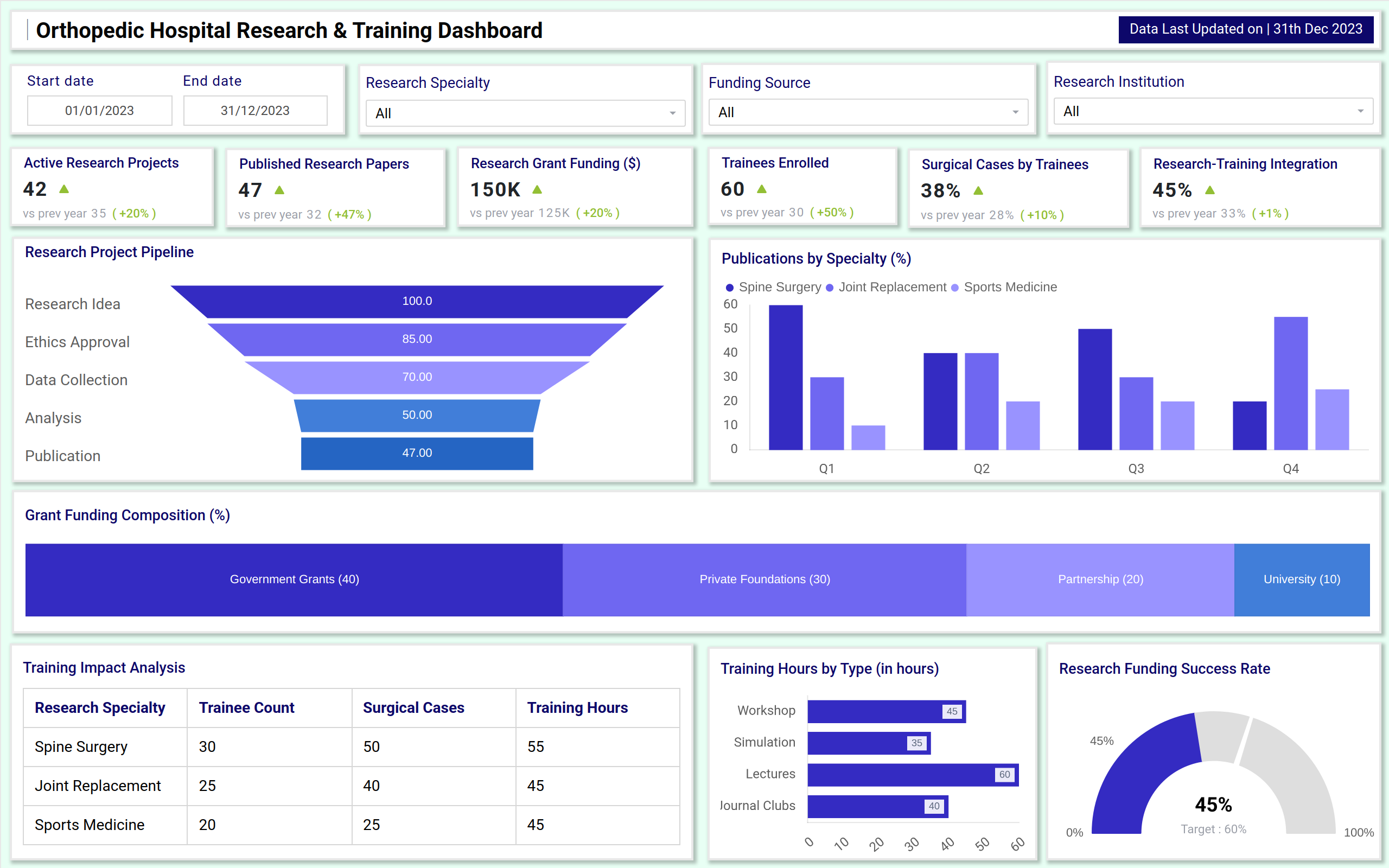
You can create an Orthopedic Hospital Research & Training Dashboard that combines KPI tiles with visualizations to track key metrics. At the top, KPI cards can show active research projects, peer-reviewed publications in the last year, total research grant funding (USD), enrolled trainees/fellows, surgical cases involving trainees, and a Research–Training Integration Index indicating trainee participation in research projects.
The KPIs, charts and tables in this dashboard highlight trends and distributions, such as a funnel chart for the research project pipeline, a gauge chart for funding success rates, bar charts for surgical cases by subspecialty, stacked bars for training hours by type, tables summarizing research specialties, surgical cases, and training hours, and a line chart for grant funding trends. Together, this dashboard provides leadership with a clear view of both academic and operational performance.
How to Analyze Data in Orthopedic Hospital Research & Training Dashboards
Here’s how hospitals can make the most of the data available on the dashboard:
- Track research productivity: Use funnel charts to compare projects as they progress through pipeline stages.
- Monitor research quality: Gauge peer-reviewed publications and impact factor against benchmarks.
- Assess trainee engagement: Analyze surgical cases and training hours per trainee by subspecialty.
- Review funding efficiency: Connect grant submissions, approvals, and success rates.
- Evaluate training programs: Compare workshops, labs, seminars, and case discussions by the number of hours delivered.
- Integrate research & training: Measure the % of trainees actively participating in research projects.
Benefits of Orthopedic Hospital Research & Training Dashboard
Here are the benefits of using this Orthopedic Hospital Research Dashboard template:
- Improved visibility: Real-time KPIs across research, training, and academic performance.
- Operational efficiency: Tracks project pipeline and trainee exposure for better resource allocation.
- Research quality tracking: Monitors publications, citations, and impact factor to benchmark performance.
- Resource planning: Connects grant funding, faculty, and lab usage to ensure optimal allocation.
- Enhanced trainee experience: Tracks training hours, surgical exposure, and research participation.
- Evidence-based program improvement: Data-driven decisions for research and academic growth.
- Compliance & reporting: Works as an academic and research reporting dashboard for audits and governance.
Together, these elements provide leadership with visibility in academic, research, and training areas, making it easier to align programs with trainee development and improve orthopedic academic performance.
KPIs to Track in Orthopedic Hospital Research & Training Dashboards
You can track the following orthopedic training KPIs for hospital research analytics:
- Active Research Projects – Total number of ongoing orthopedic research studies currently being conducted.
- Published Research Papers – Number of research studies completed and published in peer-reviewed journals.
- Research Grant Funding (USD) – Total funding received for orthopedic research projects in US dollars.
- Trainees / Fellows Enrolled – Number of orthopedic trainees and fellows currently enrolled in the hospital’s training programs.
- Surgical Cases by Trainees – Total orthopedic surgeries performed by trainees as part of their hands-on training.
- Research–Training Integration Index (% of trainees involved in research) – Percentage of trainees actively participating in orthopedic research projects.
Frequently Asked Questions
1. Who should use this dashboard?
This research-tracking dashboard can be used by Medical Directors, Deans, Research Heads, Academic Coordinators, and Research Administrators who are responsible for tracking research and trainee performance.
2. How does it support trainee development?
It combines surgical cases, training hours, and research participation metrics to monitor academic growth and skill acquisition.
3. Is this dashboard useful for compliance?
Yes. The dashboard supports accreditation, audits, and governance by tracking research, training, and academic metrics.