
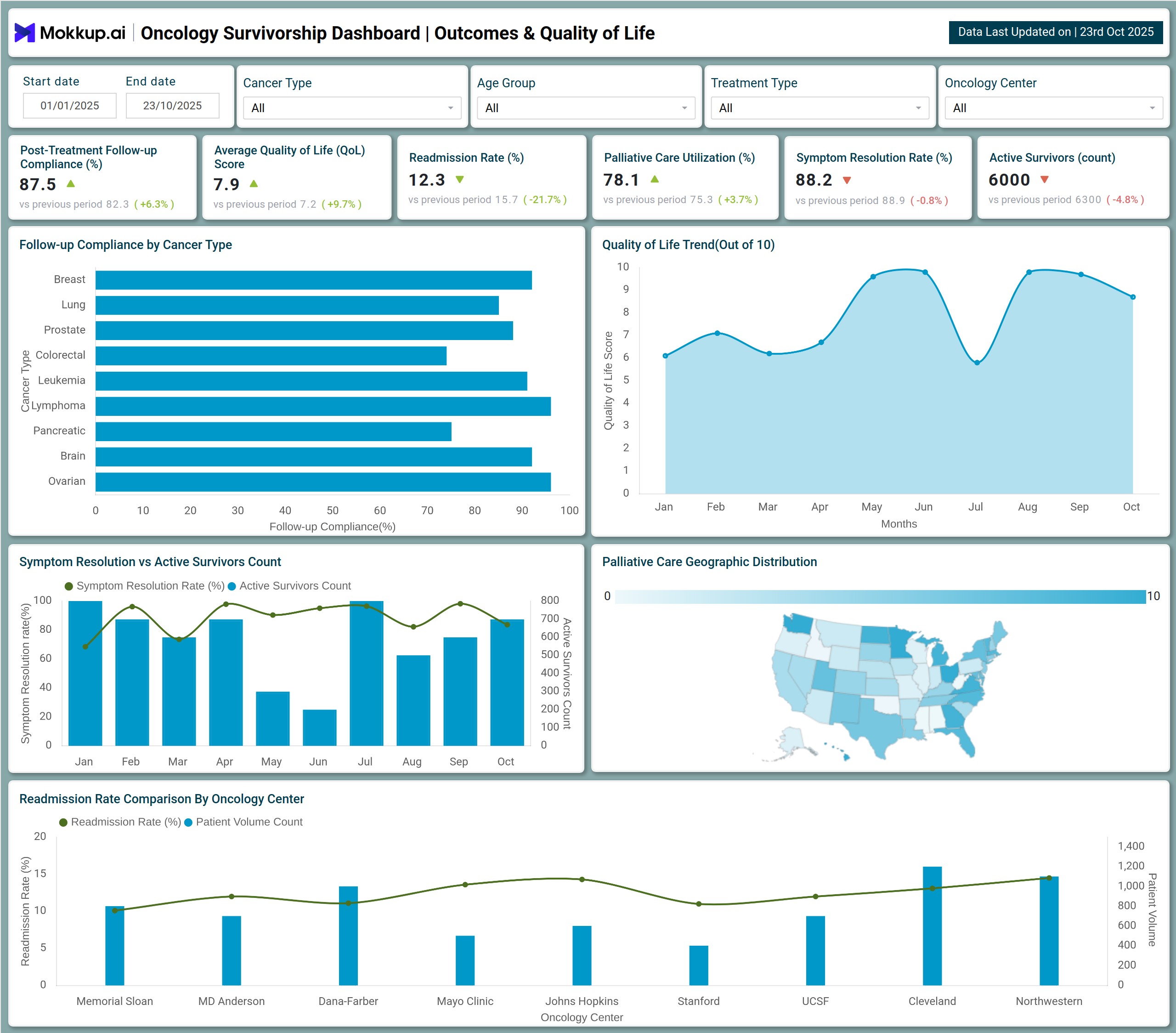
What is an Oncology Survivorship Dashboard?
An Oncology Survivorship Dashboard is a centralized platform designed to monitor post-treatment outcomes, follow-up compliance, quality of life (QoL), palliative care adoption, readmission trends, and clinical efficiency across oncology centers. It allows clinical program directors, survivorship coordinators, medical directors, and quality managers to track patient outcomes and operational efficiency in real time.
By combining clinical and operational data, this Healthcare survivorship & palliative care analytics dashboard enables targeted interventions, proactive care planning, and improved patient management, ensuring better survivorship outcomes and optimized care pathways. This clinical outcomes tracking for oncology centers tool helps identify high-risk patient cohorts, optimize follow-up scheduling, and enhance overall survivorship program performance & patient outcomes.
How to Create an Oncology Survivorship Dashboard
You don’t need to build your report from scratch-just start with a ready-to-use dashboard template from Mokkup. Add your data and export it as needed. Here’s how to do it:
1. Create or Log in to Your Mokkup Account
Start by signing up on Mokkup.ai using your email. If you already have an account, simply log in, and you’ll be all set.
2. Choose and Customize Your Dashboard Template
Find the Oncology Survivorship Dashboard template in the Templates section. Use the drag-and-drop editor to adjust KPIs, edit filters, or add elements based on your data.
3. Export to Your BI Tool
Once your dashboard wireframe is ready, use the BI Tool Export feature to send it directly to Power BI or Tableau for further analysis and enhancements. You can also download the dashboard as a PDF, PNG, or JPEG, embed it on a platform, or invite your team to collaborate.
Note: This is a Pro template. You’ll need a Pro subscription on Mokkup to use and customize this dashboard wireframe. Upgrade anytime to unlock full access.
Oncology Survivorship Dashboard Example
The outcomes & quality of life screen in this dashboard tracks post-treatment follow-up compliance, quality of life (QoL), readmission rates, palliative care utilization, symptom resolution, and active survivors under monitoring. It highlights programs or centers with gaps in post-treatment care. By providing these insights, this Oncology survivorship dashboard helps optimize survivorship program performance & patient outcomes and improve patient care. Also, the palliative care & readmission optimization screen monitors readmission drivers, palliative care efficiency, care pathway adherence, early interventions, and operational costs. It identifies high-risk patients, centers with protocol gaps, and opportunities to reduce readmissions. These insights guide clinical, operational, and financial improvements in oncology centers, while supporting the effectiveness of readmission monitoring & intervention.
How to Analyse Data in an Oncology Survivorship Dashboard
Here is how you can analyze data from this dashboard:
- Start with KPIs: Follow-up compliance, average QoL score, readmission rate, palliative care utilization, symptom resolution rate, active survivors under monitoring, 30-day readmission index, average length of stay, referral conversion rate, cost per bed-day, care pathway adherence, and early intervention impact. These metrics form the backbone of clinical outcomes tracking for oncology centers.
- Assess Clinical Efficiency: Compare follow-up compliance, QoL trends, and readmission rates across cancer types, centers, and patient cohorts to identify gaps using Healthcare survivorship & palliative care analytics.
- Track Cost & Resource Trends: Monitor cost per bed-day, intervention effectiveness, and care pathway adherence to detect high-cost or underperforming programs, ensuring readmission monitoring & intervention effectiveness.
- Analyze Patient & Center Insights: Use heatmaps, maps, bar charts, line charts, scatter plots, and funnel charts to identify underperforming centers or patient cohorts needing attention. These visualizations support better survivorship program performance & patient outcomes.
- Detect Patterns & Anomalies: Apply filters by time, cancer type, region, care pathway, or payer type to detect recurring readmissions, non-adherence, or unusually low QoL scores.
Benefits of an Oncology Survivorship Dashboard
- Real-time insights on patient outcomes and post-treatment care through an Oncology survivorship dashboard
- Optimizes follow-up compliance, palliative care adoption, and early interventions using Healthcare survivorship & palliative care analytics
- Identifies high-risk patients and reduces readmission rates with readmission monitoring & intervention effectiveness
- Tracks clinical efficiency, care pathway adherence, and cost impact.
- Supports clinical outcomes tracking for oncology centers
- Enables optimal resource allocation and transparency across centers, improving survivorship program performance & patient outcomes
KPIs to Track in Oncology Survivorship Dashboard
- Post-Treatment Follow-up Compliance (%) -Measures how many patients attend their scheduled post-treatment visits.
- Average QoL Score -Represents the average quality of life reported by patients after treatment.
- Readmission Rate (%) -Shows the percentage of patients readmitted within 30, 60, or 90 days after discharge.
- 90-Day Readmission Index -Compares actual 30-day readmissions against a benchmark using a weighted score.
- Average Length of Stay (Days) -Indicates the average number of days patients stay in the hospital when readmitted.
- Palliative Care Referral Conversion Rate (%) -Percentage of referred patients who actually enroll in palliative care.
Frequently Asked Questions
1. How can monitoring follow-up and QoL improve survivorship care beyond readmission rates?
By tracking QoL trends, symptom resolution, and follow-up compliance, clinicians can identify care gaps, optimize post-treatment schedules, and enhance patient outcomes using Oncology survivorship dashboard insights.
2. Why is tracking readmission indices alongside intervention costs important?
High readmissions with excessive costs indicate inefficiencies. Monitoring both allows for operational analytics in survivorship programs and aids in budget allocation by utilizing readmission monitoring & intervention effectiveness.
3. How does monitoring palliative care referral and adherence improve outcomes?
Compliance and referral tracking reveal patients at risk of delayed care. Early identification supports proactive interventions and enhances clinical reliability through healthcare survivorship & palliative care analytics.