
What is an Oncology Compliance & Quality Dashboard?
An Oncology Compliance & Quality Dashboard is a clinical governance tool designed to help cancer centers monitor adherence to compliance, patient safety performance, and audit readiness. It consolidates key indicators such as protocol adherence, safety incident rates, documentation accuracy, and accreditation readiness into a single, real-time view. As an oncology compliance and quality monitoring dashboard, it enables oncology administrators, quality teams, and clinical leaders to track deviations from protocols, identify risks, and ensure the delivery of safe and standardized cancer care.
This dashboard also functions as a cancer center clinical compliance performance tracking tool, providing the operational transparency required for regulatory audits, internal quality reviews, and accreditation processes. By integrating safety metrics, incident trends, and action closure rates, it supports data-driven quality improvement across chemotherapy units, inpatient oncology wards, radiation oncology, and surgical oncology departments.
How to Create an Oncology Compliance & Quality Dashboard
You don’t need to build your report from scratch just start with a ready-to-use dashboard template from Mokkup. Add in your data and export it however you like. Here’s how to do it:
1. Create or Log in to Your Mokkup Account
Start by signing up on Mokkup.ai using your email. If you already have an account, just log in, and you’ll be good to go.
2. Choose and Customize Your Dashboard Template
Find the Oncology Compliance & Quality Dashboard template in the Templates section. Use the drag-and-drop editor to adjust KPIs, edit filters, or add elements based on your data.
3. Export to Your BI Tool
Once your dashboard wireframe is ready, use the BI Tool Export feature to send it directly to Power BI or Tableau for further analysis and enhancements. You can also download the dashboard as a PDF, PNG, or JPEG, embed it on a platform, or invite your team to collaborate.
Note: This is a Pro template. You’ll need a Pro subscription on Mokkup to use and customize this dashboard wireframe. Upgrade anytime to unlock full access.
Oncology Compliance & Quality Dashboard Example
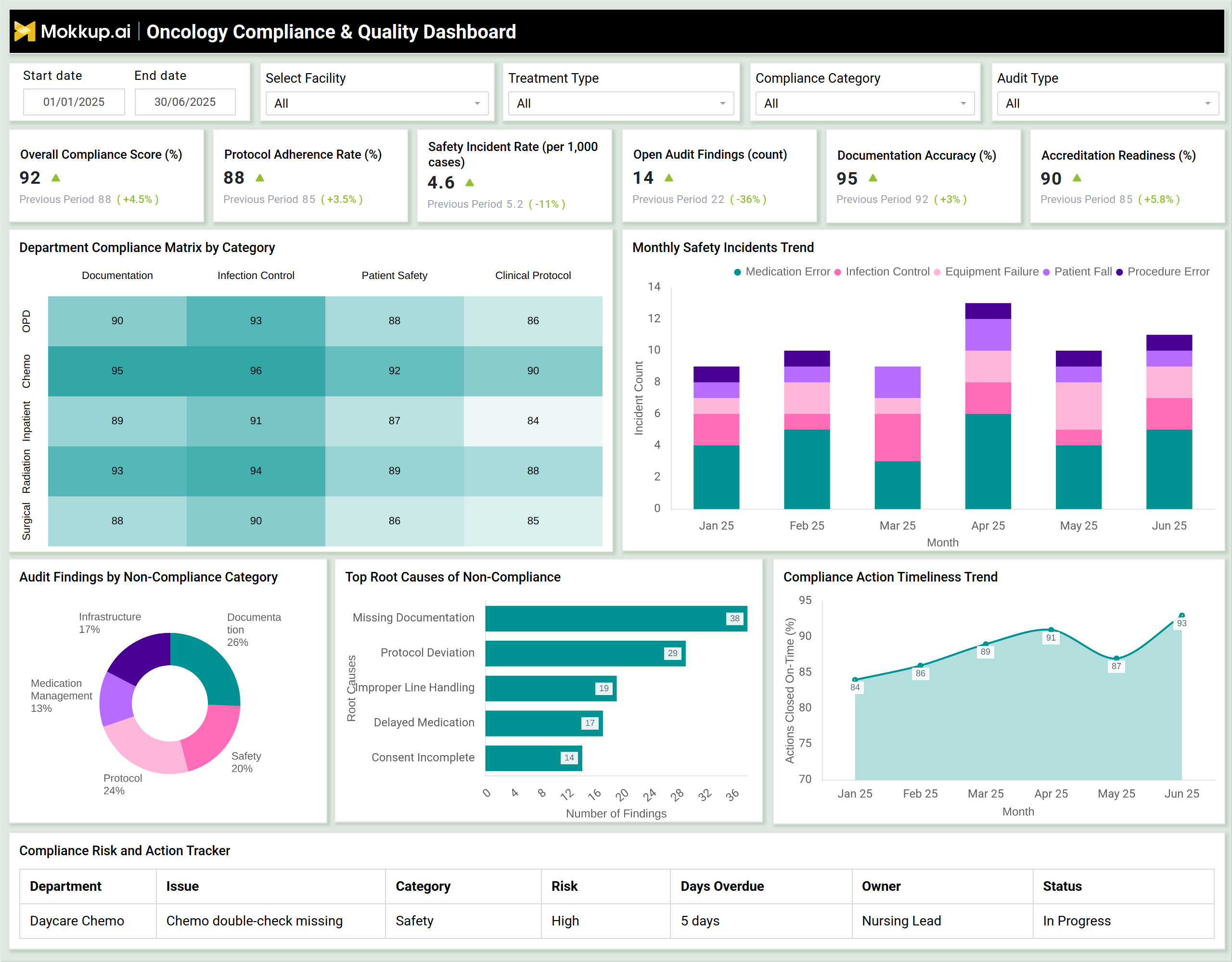
The example dashboard provides a comprehensive snapshot of compliance and quality performance for oncology facilities. It displays critical KPIs, including Overall Compliance Score, Protocol Adherence Rate, Safety Incident Rate, Open Audit Findings, Documentation Accuracy, and Accreditation Readiness. These indicators help evaluate how closely clinical teams follow treatment protocols, documentation standards, and safety requirements. Visual components, such as the Department Compliance Matrix, Monthly Safety Incident Trend, and Audit Findings by Non-Compliance Category, illustrate how performance varies across chemotherapy, inpatient oncology, radiation therapy, and surgical oncology units.
This aligns with the purpose of an oncology quality assurance and patient safety analytics platform, enabling leaders to identify high-risk departments and recurring compliance gaps. The dashboard also includes detailed insights such as Top Root Causes of Non-Compliance, Compliance Action Timeliness Trend, and a Compliance Risk & Action Tracker. These views help quality teams understand why issues occur and how quickly corrective actions are implemented. This makes the dashboard an effective tool for cancer treatment safety compliance and incident reporting, supporting continuous monitoring of medication errors, infection control incidents, equipment failures, patient falls, and procedural errors.
Together, these analytics features serve as an oncology audit readiness and regulatory compliance dashboard, enabling cancer centers to prepare for external audits and maintain clinical governance standards. Overall, the dashboard serves as a robust oncology clinical quality performance measurement system, providing reliable insights into compliance trends, safety risks, and the progress of corrective actions.
How to Analyze Data in Oncology Compliance & Quality Dashboard
Here is how you can analyze data from this cancer treatment safety compliance and incident reporting dashboard:
- Review department-wise compliance scores to identify high- and low-performing oncology units.
- Analyze safety incident trend charts to detect rising risks in medication errors, infection control, equipment failures, and patient safety.
- Monitor protocol adherence rates to understand whether clinical teams follow standardized care pathways.
- Evaluate open audit findings to identify unresolved issues that impact operational or regulatory compliance.
- Track documentation accuracy to reduce claim denials, safety events, and audit failures.
- Examine root cause analysis charts to identify common causes of non-compliance, such as missing documentation or protocol deviation.
- Monitor CAPA and action timeliness to ensure that corrective actions are completed on schedule.
- Use the compliance risk tracker to prioritize high-risk items and allocate resources effectively.
Benefits of Oncology Compliance & Quality Dashboard
- Provides real-time visibility into clinical compliance, safety events, and audit performance.
- Enhances patient safety by identifying error patterns and deviations from oncology treatment protocols.
- Supports regulatory compliance and accreditation readiness through structured audit tracking and management.
- Improves clinical governance by centralizing quality metrics across all oncology service lines.
- Reduces safety risks by enabling early detection of documentation issues, medication errors, and improper procedures.
- Strengthens quality improvement initiatives by providing evidence-based insights.
- Enhances cross-departmental coordination by displaying compliance performance across chemotherapy, radiation, and inpatient oncology units.
KPIs to Track in Oncology Compliance & Quality Dashboard
- Overall Compliance Score (%): Measures adherence to clinical, operational, and documentation standards.
- Protocol Adherence Rate (%): Tracks compliance with oncology treatment pathways and clinical protocols.
- Open Audit Findings (Count): Shows unresolved compliance issues across oncology departments.
- Documentation Accuracy (%): Indicates the quality of clinical documentation and record completeness.
- Accreditation Readiness (%): Measures preparedness for regulatory and accreditation audits.
- Root Cause Frequency: Identifies common non-compliance causes such as protocol deviation or missing documentation.
- Corrective Action Timeliness (%): Indicates the efficiency with which actions are completed to address compliance issues.
- Risk Categorization: Highlights high-, medium-, and low-risk issues requiring follow-up.
- Safety Incident Type Breakdown: Tracks medication errors, equipment failures, falls, and infection control breaches.
Frequently Asked Questions
1. Who uses an Oncology Compliance & Quality Dashboard?
Quality managers, oncology administrators, clinical governance teams, department heads, and safety officers.
2. Can this dashboard support accreditation audits?
Yes, it tracks audit findings, documentation accuracy, and readiness indicators to support accreditation processes.
3. Does it help reduce safety incidents?
Yes, by monitoring incident trends, root causes, and corrective action effectiveness.
4. Can the dashboard track compliance differently for chemo, radiation, or inpatient units?
Yes, it provides department-level performance for all oncology services.