
What is a Nutrition Care Outcomes Dashboard?
A Nutrition Care Outcomes Dashboard is a specialized analytics tool used by orthopedic hospitals and healthcare institutions to monitor, analyze, and optimize nutrition-related patient outcomes across various departments. This dashboard integrates patient data on clinical nutrition performance, dietary interventions, and healthcare nutrition metrics into a single visual interface. By systematically tracking patient nutrition outcomes and interventions, hospitals can identify trends, evaluate care effectiveness, and support evidence-based clinical decisions for improved patient recovery and operational efficiency.
How to Create a Nutrition Care Outcomes Dashboard
You don’t need to build your report from scratch—just start with a ready-to-use dashboard template from Mokkup. Add in your data and export it however you like. Here’s how to do it:
1. Create or Log in to Your Mokkup Account
Start by signing up on Mokkup.ai using your email. If you already have an account, just log in, and you’ll be good to go.
2. Choose and Customize Your Dashboard Template
Find the Nutrition Care Outcomes Dashboard template in the Templates section. Use the drag-and-drop editor to adjust KPIs, edit filters, or add elements based on your data.
3. Export to Your BI Tool
Once your dashboard wireframe is ready, use the BI Tool Export feature to send it directly to Power BI or Tableau for further analysis and enhancements. You can also download the dashboard as a PDF, PNG, or JPEG, embed it on a platform, or invite your team to collaborate.
Note: This is a Pro template. You’ll need a Pro subscription on Mokkup to use and customize this dashboard wireframe. Upgrade anytime to unlock full access.
Nutrition Care Outcomes Dashboard Example
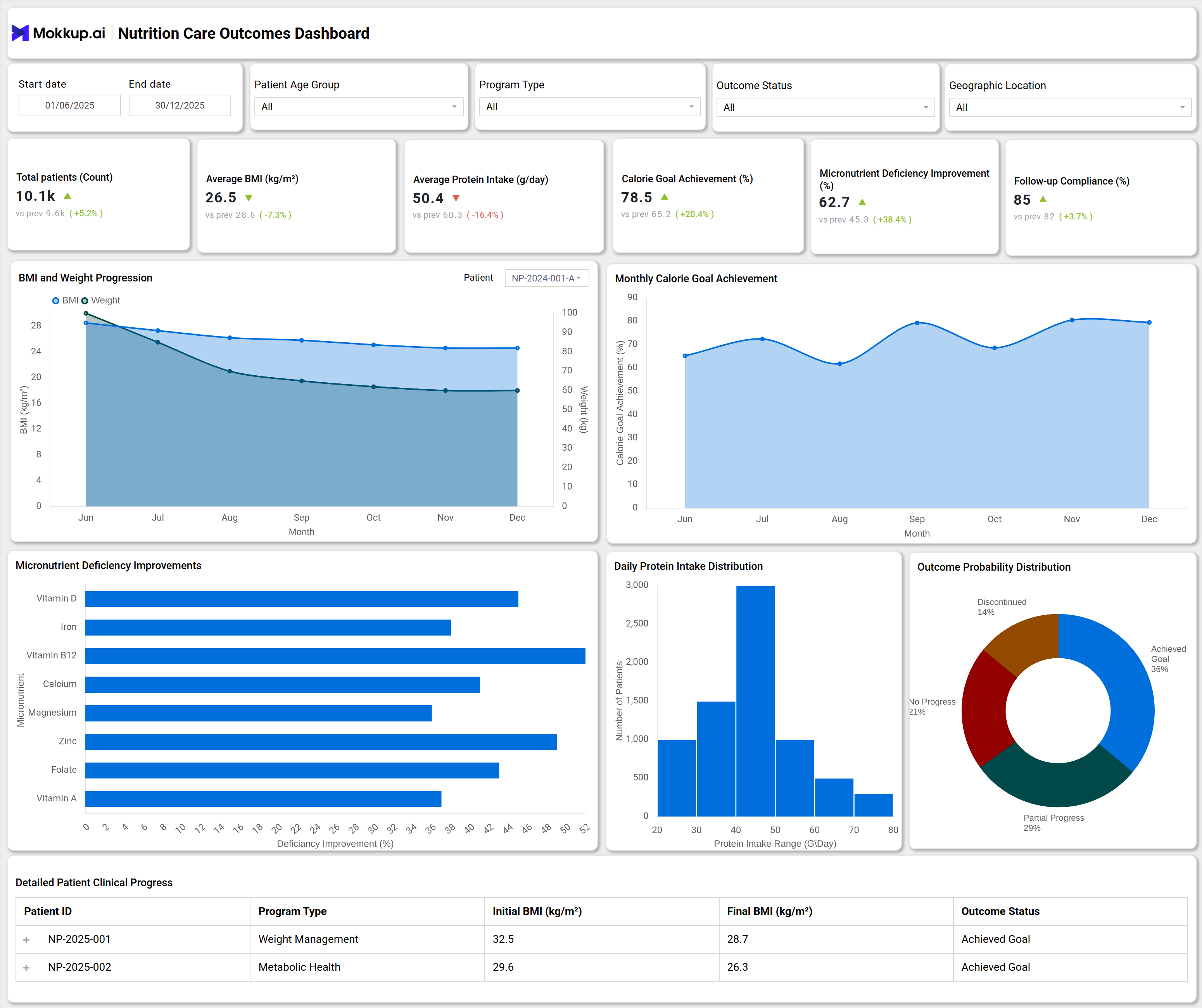
An orthopedic hospital using a Nutrition Care Outcomes Dashboard can visualize patient progress from initial admission through recovery. For example, the dashboard may display trends in average BMI, daily protein intake, micronutrient deficiency improvement, and calorie goal achievement across orthopedic cases. Users see how each patient group responds to specific nutrition plans, monitor follow-up compliance, and compare outcomes between different clinical programs. This allows caregivers and managers to quickly identify improvement opportunities, streamline nutrition intervention results, and ensure alignment with quality benchmarks. The dashboard centralizes all relevant healthcare nutrition metrics, driving coordinated care and supporting collaborative decision-making among dietitians, nutritionists, and orthopedic clinicians.
How to Analyze Data in Nutrition Care Outcomes Dashboards
Healthcare teams can make the most of patient nutrition care outcome dashboards by:
- Breaking Down Patient Outcomes – Filter results by date, age group, location, or program type to study progress at a granular level.
- Spotting Trend Patterns – Track shifts in BMI, protein intake, and calorie completion over time to see where patients are improving and where support is needed.
- Comparing Teams and Departments – Review performance across clinical units and care teams to uncover best practices and gaps in nutrition delivery.
- Evaluating Micronutrient Progress – Study improvement rates in micronutrient deficiencies to strengthen supplementation and intervention plans.
- Checking Follow-Up Adherence – Monitor how consistently patients attend post-discharge nutrition visits and follow ongoing care guidelines.
- Assessing Outcome Distribution – Use probability and progress charts to understand how many patients fully meet goals, show partial progress, or discontinue care.
- Sharing Insights – Export dashboard insights for multidisciplinary reviews, quality reporting, and documentation.
Benefits of Nutrition Care Outcomes Dashboards
A Nutrition Care outcome dashboard proves very helpful:
- Bring Everything Together – Consolidate all nutrition outcome data in one place for quick, unified access.
- Personalize Patient Care – Use evidence-backed insights to tailor nutrition plans, especially for orthopedic recovery and high-risk cases.
- Track Progress Continuously – Monitor recovery, dietary adherence, and nutrient status over time to guide timely interventions.
- Improve Team Coordination – Help clinicians, dietitians, and admin teams stay aligned with shared visibility into patient progress.
- Drive Better Outcomes – Turn trends and performance metrics into clear actions that elevate nutrition quality across departments.
- Support Standards and Accreditation – Maintain compliance by aligning care tracking with regulatory and hospital requirements.
- Save Time for Clinicians – Automate data collection and visualization so staff can focus more on patient care and less on manual reporting.
KPIs to Track in Nutrition Care Outcomes Dashboards
The KPIs to track:
- Total patients (Count): Tracks the number of orthopedic patients managed for nutritional outcomes.
- Average BMI (kg/m²): Measures patient weight status and changes over the care course.
- Average protein intake (g/day): Monitors dietary protein provided to support recovery.
- Calorie goal achievement (%): Shows patients meeting prescribed calorie targets.
- Micronutrient deficiency improvement (%): Evaluates resolution of key deficits such as iron, vitamin D, and B12.
- Follow-up compliance (%): Tracks adherence to post-care nutrition and checkups.
Frequently Asked Questions
1. Who uses a Nutrition Care Outcomes Dashboard in an orthopedic hospital?
Dietitians, nutritionists, orthopedic clinicians, quality managers, and hospital administrators use the dashboard to track and optimize nutrition interventions and outcomes.
2. Can nutrition dashboards be customized for other specialties?
Yes, dashboards can be tailored for different hospital departments, such as pediatrics, oncology, or surgical specialties, by setting relevant KPIs and patient groups.
3. Why are outcome tracking and follow-up compliance important?
Tracking outcomes and compliance ensures that nutrition plans are effective, supports patient recovery, and helps meet operational and accreditation goals