
- Improved Maintenance Planning: Enhances efficiency across preventive and corrective maintenance activities.
- Reduced Unplanned Downtime: Identifies failure risks early, preventing unexpected outages.
- Enhanced Equipment Reliability Monitoring: Provides deep visibility into reactor, turbine, and cooling system performance.
- Optimized Workforce Allocation: Aligns staffing based on backlog levels, task criticality, and asset priority.
- Data-Driven Reliability Decisions: Supports informed decisions for turbine, generator, and auxiliary systems.
- Lower Maintenance Costs: Enables targeted repairs and predictive scheduling to reduce unnecessary spend.
- Audit & Compliance Support: Maintains full traceability of maintenance actions for safety and regulatory audits.
- Stronger Cross-Functional Coordination: Improves alignment between maintenance, reliability engineering, and operations teams.
What is a Nuclear Power Plant Maintenance & Reliability Dashboard?
A Nuclear Power Plant Maintenance & Reliability Dashboard is a centralized analytics system used to track equipment performance, preventive maintenance schedules, corrective tasks, and asset readiness across reactor, turbine, cooling, and auxiliary systems. It supports nuclear power plant maintenance analytics by consolidating work orders, equipment availability, failure trends, repair duration, and backlog levels. These dashboards are crucial for monitoring reactor equipment reliability because they identify performance deviations early, minimize unplanned downtime, and enhance long-term maintenance planning. With integrated views of MTBF, MTTR, maintenance compliance, and critical equipment availability, operators gain the nuclear plant asset reliability insights needed for safe and continuous power generation.
How to Create a Nuclear Power Plant Maintenance & Reliability Dashboard
You don’t need to build your report from scratch—just start with a ready-to-use Nuclear Power Plant Maintenance & Reliability dashboard template from Mokkup. Add in your data and export it however you like. Here’s how to do it:
1. Create or Log in to Your Mokkup Account
Start by signing up on Mokkup.ai using your email. If you already have an account, just log in, and you’ll be good to go.
2. Choose and Customize Your Dashboard Template
Find the Nuclear Power Plant Maintenance & Reliability Dashboard template in the Templates section. Use the drag-and-drop editor to adjust KPIs, edit filters, or add elements based on your data.
3. Export to Your BI Tool
Once your dashboard wireframe is ready, use the BI Tool Export feature to send it directly to Power BI or Tableau for further analysis and enhancements. You can also download the dashboard as a PDF, PNG, or JPEG, embed it on a platform, or invite your team to collaborate.
Note: This is a Pro template. You’ll need a Pro subscription on Mokkup to use and customize this dashboard wireframe. Upgrade anytime to unlock full access.
Nuclear Power Plant Maintenance & Reliability Dashboard Example
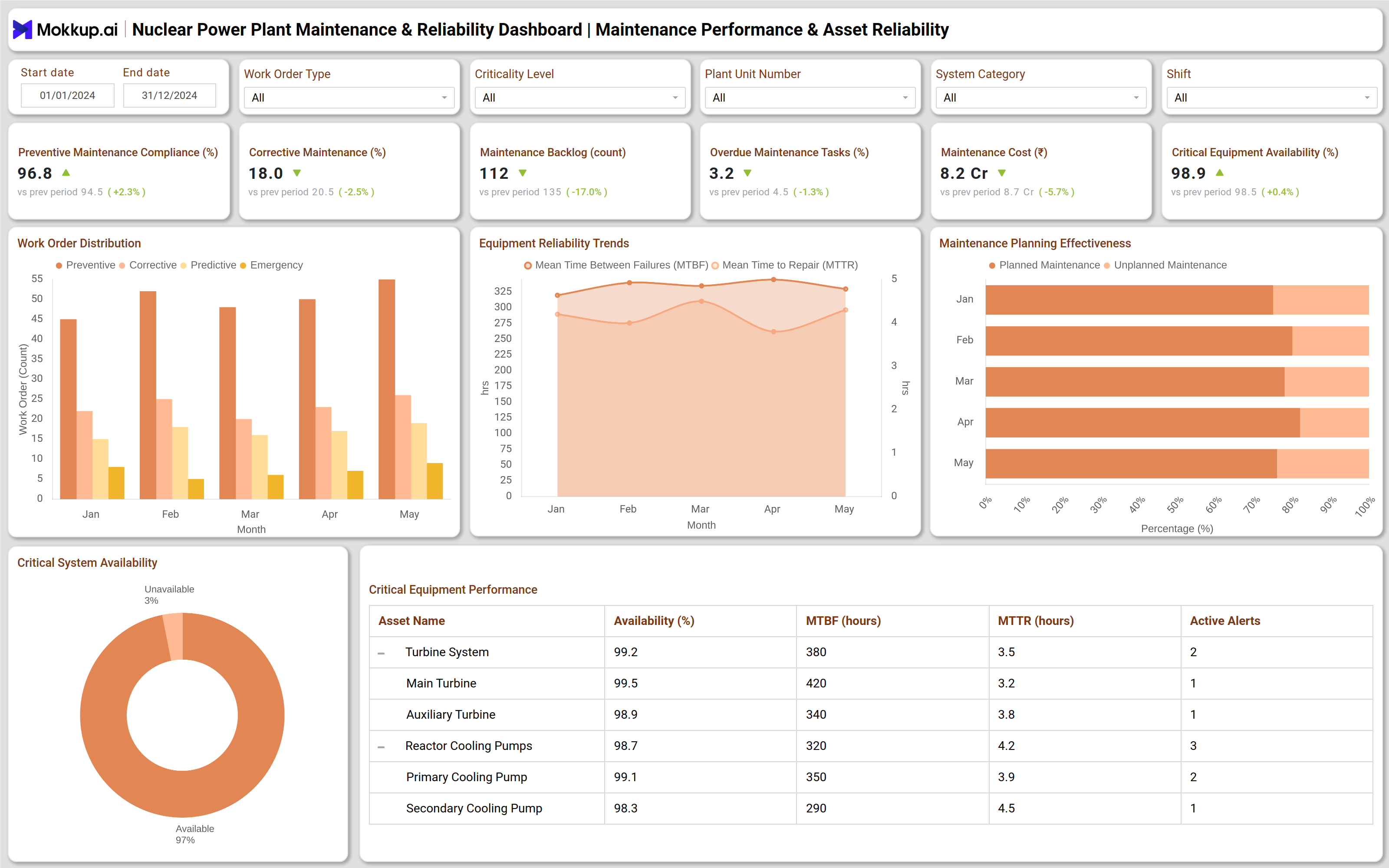
You can create a Nuclear Power Plant Maintenance & Reliability Dashboard that brings together modules for maintenance tracking, asset reliability assessment, and predictive monitoring. In the Maintenance Performance & Asset Reliability view (as shown in the reference images), users can track preventive maintenance compliance, corrective maintenance levels, maintenance backlog, overdue tasks, and total maintenance cost. As part of a comprehensive nuclear plant preventive maintenance dashboard, monthly work order distribution charts compare preventive, corrective, predictive, and emergency work, helping teams identify workload balance and planning gaps. The dashboard also visualizes equipment reliability trends, including Mean Time Between Failures (MTBF) and Mean Time to Repair (MTTR). Tables display system-level availability for turbines, cooling pumps, and reactor auxiliary equipment, allowing for detailed tracking of turbine and generator reliability.
The Predictive Maintenance & Condition Monitoring section expands this capability by identifying high-risk assets, predicted failure probabilities, and sensor uptime. Vibration trend charts and anomaly breakdowns help operators detect early failure signatures. A maintenance recommendation matrix highlights predicted issues, risk levels, required actions, and assigned technicians supporting proper predictive maintenance for nuclear plants. Together, these modules provide in-depth insights into nuclear plant asset reliability and support long-term maintenance optimization.
How to Analyze Data in a Nuclear Power Plant Maintenance & Reliability Dashboard
Here is how you can analyze data from this dashboard:
- Preventive Maintenance Compliance: Review compliance rates to ensure scheduled maintenance tasks are completed on time and according to plan.
- Corrective Maintenance Trends: Evaluate recurring corrective work orders to identify systems with persistent reliability issues.
- Maintenance Backlog & Overdues: Monitor backlog size and overdue tasks to assess workforce capacity and operational risk.
- Equipment Reliability Metrics (MTBF & MTTR): Track trends to determine whether asset reliability is improving or failure risk is increasing.
- Critical Equipment Availability: Analyze the availability of turbines, pumps, and cooling systems to ensure operational readiness.
- Predictive Maintenance Indicators: Utilize vibration spikes, anomaly types, and sensor uptime to identify early warning signs of potential failure.
- Maintenance Priority Distribution: Check priority levels to ensure high-risk and safety-critical assets receive timely attention.
- Predictive Action Recommendations: Review suggested interventions from predictive matrices to schedule repairs before failures occur.
Benefits of a Nuclear Power Plant Maintenance & Reliability Dashboard
The following are the benefits of using this dashboard:
KPIs to Track in a Nuclear Power Plant Maintenance & Reliability Dashboard
The following key KPIs can be tracked by using this dashboard:
- Preventive Maintenance Compliance (%): Measures the effectiveness of scheduled tasks being completed.
- Corrective Maintenance (%): Indicates the portion of work driven by component failures.
- Maintenance Backlog (count): Shows the volume of pending tasks that require attention.
- Overdue Maintenance Tasks (%): Reflects the timeliness of maintenance execution.
- Maintenance Cost (₹ or $): Tracks spending across maintenance operations.
- Critical Equipment Availability (%): Monitors the uptime of essential reactor and turbine systems.
- MTBF – Mean Time Between Failures (hours): Evaluates equipment reliability.
- MTTR – Mean Time to Repair (hours): Measures the efficiency of repairs.
- Failure Risk Score (%): Identifies assets most likely to fail.
- Sensor Uptime (%): Ensures accurate monitoring for predictive analytics.
- Predictive Accuracy (%): Validates the reliability of predictive maintenance models.
- Maintenance Priority Distribution: Categorizes tasks into critical, high, medium, and low priority.
Frequently Asked Questions
Q1. Who uses a Nuclear Power Plant Maintenance & Reliability Dashboard?
Maintenance managers, reliability engineers, operations supervisors, and asset management teams use the dashboard for decision support.
Q2. How does it support predictive maintenance?
The dashboard analyzes sensor data, vibration patterns, and anomaly trends to predict failures early and recommend corrective actions.
Q3. Can the dashboard reduce operational risk?
Yes. By improving equipment reliability and reducing unplanned downtime, it lowers the overall operational risk of reactors and turbines.
Q4. Which systems benefit most from monitoring?
Turbines, cooling pumps, reactor auxiliary systems, electrical systems, and mechanical components show the highest reliability gain.
Q5. Is the dashboard useful for regulatory compliance?
Yes. It provides full traceability of maintenance actions, asset condition, and performance metrics required for safety audits.