
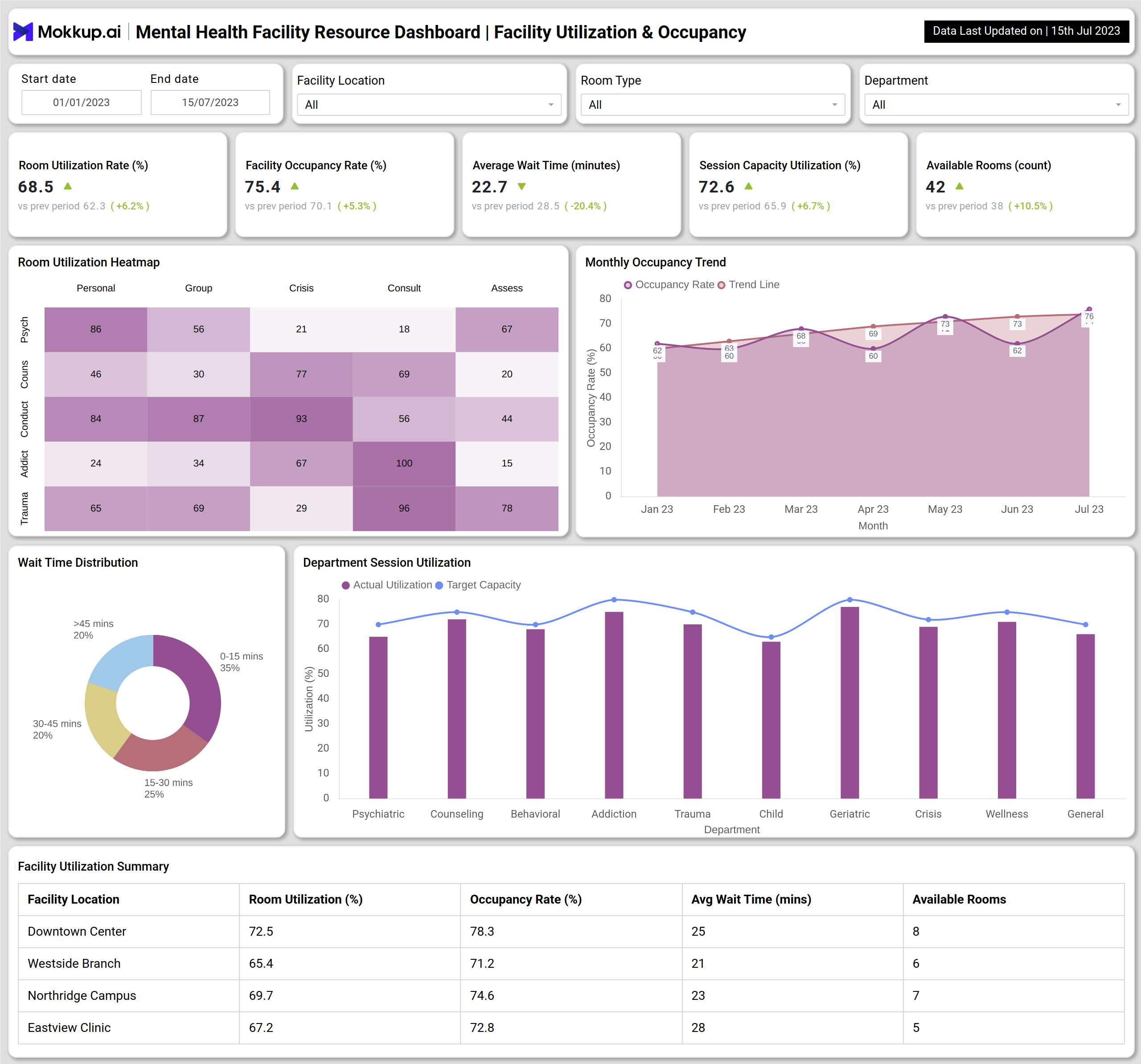
A Mental Health Facility Resource Dashboard is a healthcare performance tool that consolidates key metrics related to facility occupancy, scheduling efficiency, therapist-to-patient ratios, and session outcomes. It provides administrators with real-time insights into how resources are being utilized and whether services are meeting patient demand.
The mental health facility resource dashboard template combines operational and clinical KPIs into one view, allowing decision-makers to optimize utilization, improve patient scheduling, and reduce inefficiencies. As a real-time facility utilization monitoring dashboard, it helps clinics enhance capacity planning and improve patient access to care.
How to Create a Mental Health Facility Resource Dashboard
You don’t need to build your report from scratch—just start with a ready-to-use Mental Health Facility Resource Dashboard template from Mokkup. Add in your data and export it however you like. Here’s how to do it:
1. Create or Log in to Your Mokkup Account
Start by signing up on Mokkup.ai using your email. If you already have an account, just log in, and you’ll be good to go.
2. Choose and Customize Your Dashboard Template
Find the Mental Health Facility Resource Dashboard template in the Templates section. Use the drag-and-drop editor to adjust KPIs, edit filters, or add elements based on your data.
3. Export to Your BI Tool
Once your dashboard wireframe is ready, use the BI Tool Export feature to send it directly to Power BI or Tableau for further analysis and enhancements. You can also download the dashboard as a PDF, PNG, or JPEG, embed it on a platform, or invite your team to collaborate.
Note: This is a Pro template. You’ll need a Pro subscription on Mokkup to use and customize this dashboard wireframe. Upgrade anytime to unlock full access.
Mental Health Facility Resource Dashboard Example
The Mental Health Facility Resource Dashboard template integrates both facility utilization and scheduling insights into one comprehensive view. It highlights top KPIs such as room utilization, occupancy rate, average wait times, session capacity utilization, therapist-to-patient ratios, appointment scheduling efficiency, and resource availability. Visualizations like heatmaps track how rooms and departments such as psychiatry, counseling, trauma, and family therapy are utilized, while occupancy trends reveal how facility demand changes over time. A wait time distribution chart provides insights into patient delays, and departmental performance comparisons show which services are meeting target capacity.
At the same time, the dashboard wireframe also monitors patient scheduling efficiency, no-show rates, rescheduling, and on-time session starts. Appointment funnels capture the full process from scheduling through attendance, while regional therapist-patient session dynamics highlight workload distribution across locations. Bar charts and line trends show scheduled versus completed sessions and weekly no-show patterns, helping managers address service gaps. By combining utilization and scheduling in one view, this scheduling and resource efficiency dashboard empowers healthcare leaders to optimize resources, reduce no-shows, and improve both operational performance and patient experience.
How to Analyze Data in Mental Health Facility Resource Dashboards
Healthcare managers can use the mental health facility resource dashboard template by:
- Monitoring Facility Utilization: Use the real-time facility utilization monitoring dashboard to detect underused or overbooked facilities.
- Tracking Scheduling Efficiency: Review appointment flow to identify bottlenecks and reduce patient wait times.
- Reducing No-Show Rates: Use the dashboard as an incident tracking and performance dashboard to address high-risk appointment days.
- Analyzing Session Dynamics: Assess therapist-to-patient ratios and regional distribution to improve workload allocation.
- Evaluating Wait Times: Compare average wait times with capacity utilization to balance patient demand and resources.
Benefits of Mental Health Facility Resource Dashboards
Implementing a Mental Health Facility Resource Dashboard delivers several benefits:
- Optimized Utilization: The mental health facility resource dashboard template ensures rooms and therapists are fully used.
- Improved Scheduling: The scheduling and resource efficiency dashboard reduces missed appointments and enhances punctuality.
- Reduced Patient Wait Times: Real-time visibility helps shorten delays and improve care delivery.
- Enhanced Resource Allocation: Data-driven insights balance demand and therapist availability.
- Stronger Patient Experience: By aligning capacity and scheduling, clinics improve satisfaction and treatment outcomes.
KPIs to Track in Mental Health Facility Resource Dashboards
Monitoring these key metrics helps administrators optimize facility usage, improve scheduling, and enhance patient care:
- Room Utilization Rate (%): Tracks how effectively clinic rooms are being used across services.
- Scheduling Efficiency (%): Evaluates the percentage of sessions scheduled and completed without delays.
- Appointment No-Show Rate (%): Measures patient attendance reliability, identifying areas for intervention.
- Therapist-to-Patient Ratio: Ensures balanced workloads across departments to maintain service quality.
- Average Wait Time (minutes): Reflects patient experience and helps identify resource shortages.
Frequently Asked Questions
Q1. Why is a Mental Health Facility Resource Dashboard important?
It provides clinics with real-time insights into utilization, scheduling, and patient flow, helping improve efficiency and care quality.
Q2. Which facilities benefit most from this dashboard?
Behavioral health centers, psychiatric clinics, and multi-branch counseling facilities benefit from a facility utilization and scheduling dashboard.
Q3. How does this dashboard support decision-making?
It helps administrators identify bottlenecks, optimize room and staff allocation, and make data-driven improvements to enhance patient experience and operational efficiency.