
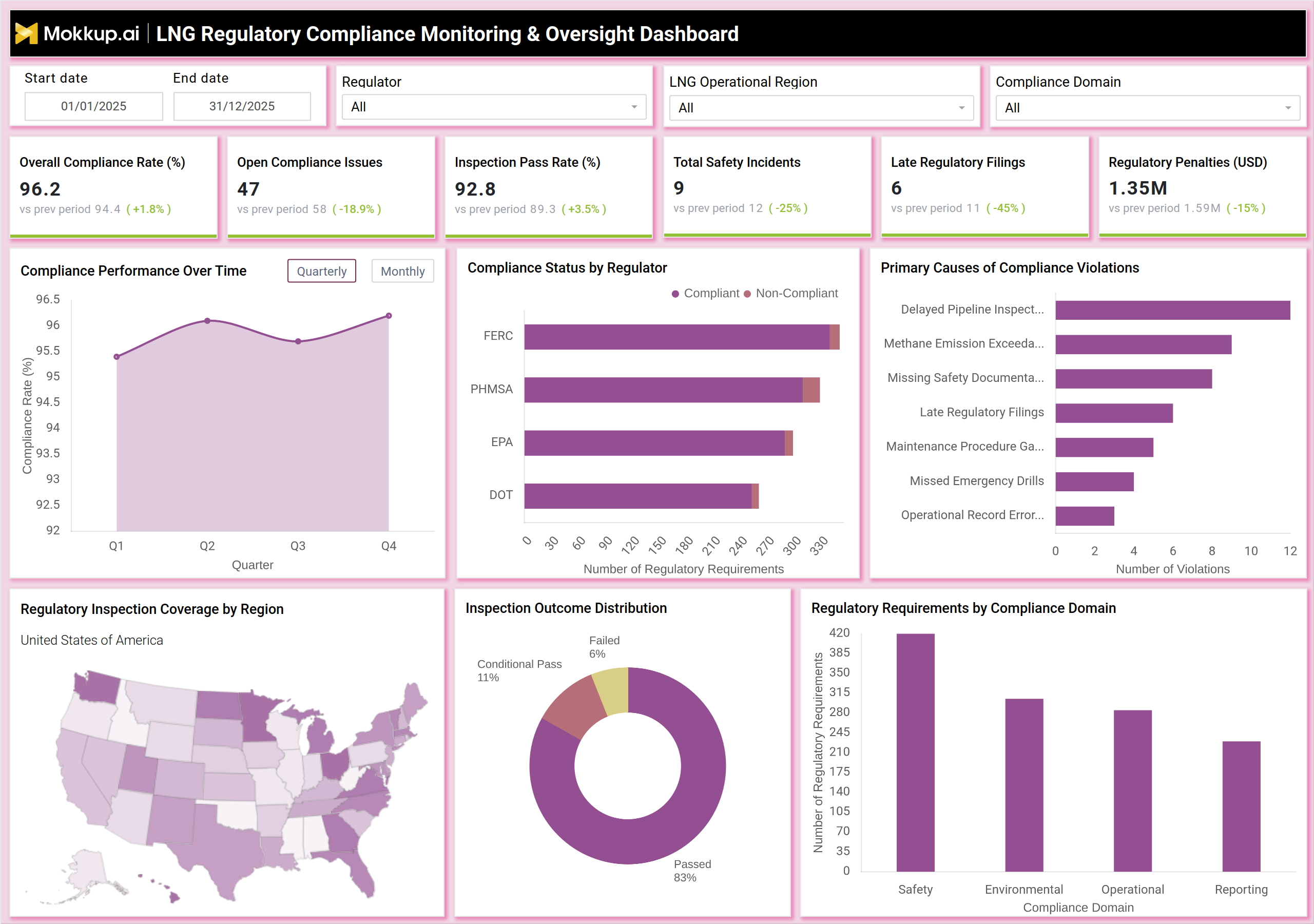
What is an LNG Regulatory Compliance Monitoring & Oversight Dashboard?
An LNG regulatory compliance monitoring dashboard is a centralized analytics tool used by natural gas utilities and LNG operators to track regulatory performance, inspections, safety incidents, and reporting obligations across LNG facilities. LNG terminals operate under strict oversight from agencies such as FERC, PHMSA, EPA, and DOT, making continuous compliance monitoring essential. An LNG regulatory compliance oversight dashboard integrates inspection results, incident data, and regulatory filings into a single system for liquefied natural gas compliance monitoring. This enables compliance teams to monitor regulatory status, identify violations early, and maintain oversight of safety and environmental obligations across LNG operations.
How to Create an LNG Regulatory Compliance Monitoring & Oversight Dashboard
You don’t need to build your report from scratch; just start with a ready-to-use dashboard template from Mokkup. Add in your data and export it however you like. Here’s how to do it:
1. Create or Log in to Your Mokkup Account
Start by signing up on Mokkup.ai using your email. If you already have an account, just log in, and you’ll be good to go.
2. Choose and Customize Your Dashboard Template
Find the LNG Regulatory Compliance Monitoring & Oversight Dashboard template in the Templates section. Use the drag-and-drop editor to adjust KPIs, edit filters, or add elements based on your data.
3. Export to Your BI Tool
Once your dashboard wireframe is ready, use the BI Tool Export feature to send it directly to Power BI or Tableau for further analysis and enhancements. You can also download the dashboard as a PDF, PNG, or JPEG, embed it on a platform, or invite your team to collaborate.
Note: This is a Pro template. You’ll need a Pro subscription on Mokkup to use and customize this dashboard wireframe. Upgrade anytime to unlock full access.
LNG Regulatory Compliance Monitoring & Oversight Dashboard Example
A natural gas utility operating multiple LNG terminals must manage regulatory requirements across safety, environmental, operational, and reporting domains. An LNG terminal regulatory compliance analytics dashboard provides a centralized view of compliance performance, including compliance rates, inspection outcomes, open issues, and regulatory filings. Using an LNG operations regulatory reporting dashboard, compliance teams can identify trends in violations, track inspection coverage, and support LNG safety and environmental compliance monitoring across facilities. This helps utilities detect compliance risks early and maintain consistent regulatory oversight across LNG operations.
How to Analyze Data in LNG Regulatory Compliance Monitoring & Oversight Dashboard
Here is how you can analyze data from this distribution utility asset health performance dashboard:
- Review Overall Compliance Rate: Evaluate whether LNG facilities are operating within established regulatory thresholds.
- Analyze Open Compliance Issues: Assess the number of unresolved violations across the LNG network to prioritize corrective actions.
- Track Inspection Pass Rates: Measure facility performance during regulatory audits to understand compliance readiness.
- Examine Safety Incident Trends: Identify operational or environmental risk patterns by analyzing safety-related incidents.
- Monitor Late Regulatory Filings: Ensure reporting obligations are completed on time by tracking delayed submissions.
- Investigate Regulatory Penalties: Evaluate penalties imposed to understand the financial impact of compliance failures.
- Review Compliance Performance Trends: Analyze compliance data over time to detect improvements or areas of decline.
- Compare Compliance Across Regulators: Identify agencies with higher violation rates by comparing compliance status across regulators.
- Study the Causes of Compliance Violations: Identify the primary reasons for violations to prioritize operational improvements.
- Evaluate Regional Inspection Coverage: Assess inspection distribution across regions to ensure balanced regulatory oversight.
Benefits of LNG Regulatory Compliance Monitoring & Oversight Dashboard
The following are the benefits of using this dashboard:
- Provide Centralized Compliance Visibility: Offer a unified view of regulatory performance across all LNG facilities.
- Reduce Compliance Risk: Identify violations early to prevent escalation and ensure timely corrective actions.
- Improve Team Coordination: Strengthen collaboration between regulatory, operational, and safety teams.
- Support Proactive Regulatory Reporting: Enable efficient documentation management and timely regulatory reporting.
- Track Safety and Environmental Obligations: Help LNG operators monitor compliance with safety and environmental requirements.
- Enable Faster Issue Investigation: Facilitate quicker analysis of compliance failures and incident root causes.
- Reduce Regulatory Penalties: Minimize fines and penalties through continuous compliance monitoring.
- Improve Audit Readiness: Ensure facilities remain prepared for regulatory inspections and audits.
- Enhance Governance Transparency: Provide clearer compliance insights for internal governance and oversight teams.
KPIs to Track in LNG Regulatory Compliance Monitoring & Oversight Dashboard
The following key KPIs can be tracked by using this dashboard:
- Overall compliance rate (%) – Measures the percentage of regulatory requirements currently satisfied across LNG facilities.
- Open compliance issues – Number of active violations or unresolved regulatory findings.
- Inspection pass rate (%) – Percentage of LNG inspections that meet regulatory standards.
- Total safety incidents – Count of operational safety incidents affecting regulatory compliance.
- Late regulatory filings – Number of delayed submissions for regulatory reports or documentation.
- Regulatory penalties (USD) – Total financial penalties issued due to non-compliance.
- Compliance performance trend – Change in compliance rate across months or quarters.
- Compliance status by regulator – Distribution of compliant versus non-compliant requirements by regulatory authority.
- Violation root causes – Operational or procedural drivers behind compliance failures.
- Inspection outcome distribution – Breakdown of inspection results such as passed, conditional pass, or failed.
- Regulatory inspection coverage by region – Percentage of facilities inspected across operational regions.
- Regulatory requirements by compliance domain – Total number of obligations within safety, environmental, operational, and reporting categories.
Frequently Asked Questions
1. What is the purpose of an LNG regulatory compliance monitoring dashboard?
It provides centralized visibility into regulatory obligations, inspections, incidents, and reporting performance for LNG operations.
2. Who uses an LNG regulatory compliance oversight dashboard?
Compliance officers, regulatory teams, safety managers, environmental specialists, and LNG operations leaders use it to monitor compliance performance.
3. Why is regulatory compliance critical in LNG operations?
LNG infrastructure operates under strict safety and environmental regulations. Failure to comply can lead to operational shutdowns, financial penalties, and safety risks.