
What is an Irrigation & Water Distribution Pump Energy Efficiency Dashboard?
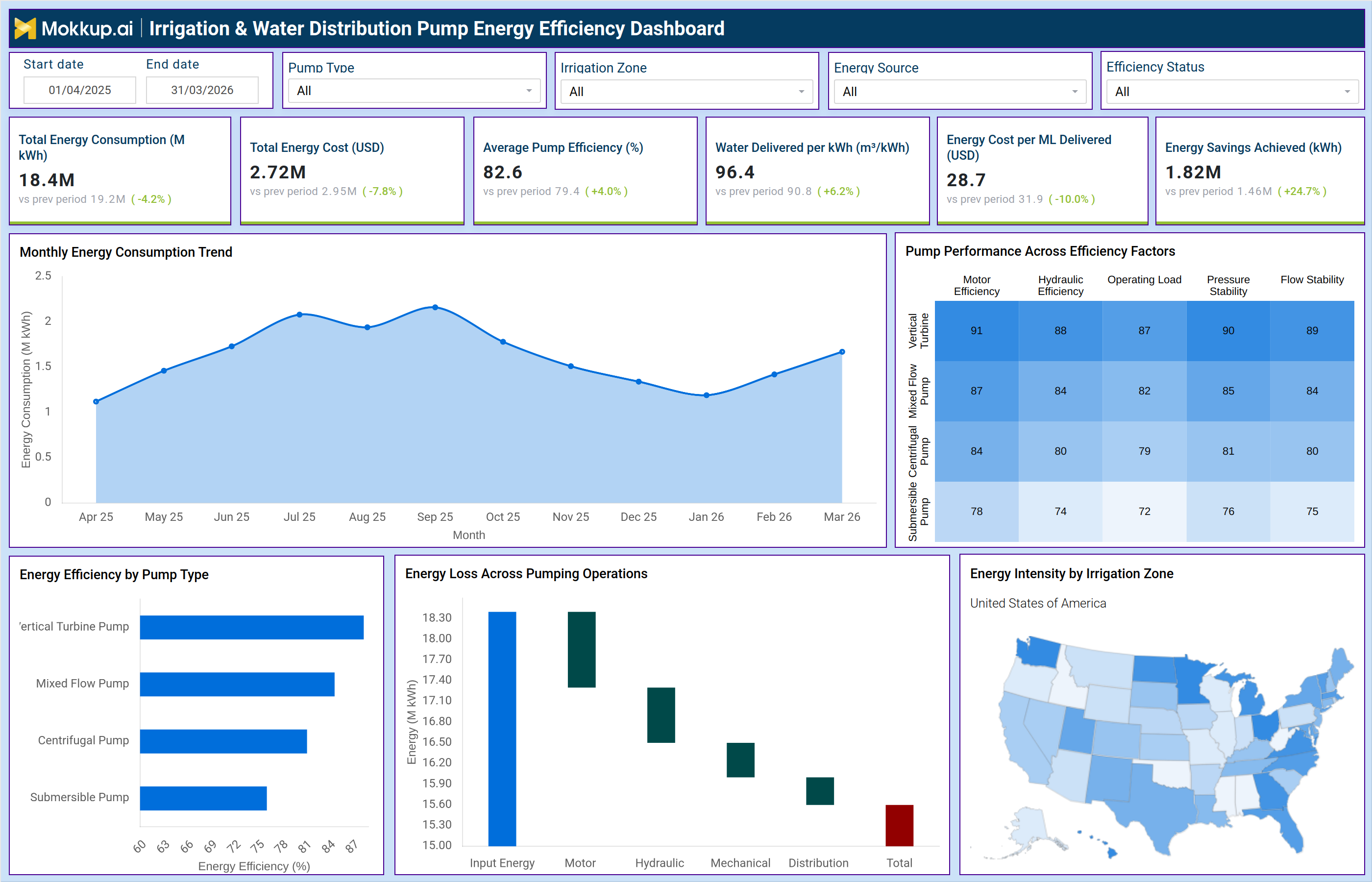
The Irrigation & Water Distribution Pump Energy Efficiency Dashboard is an analytics tool built for water utilities, agricultural operations, and infrastructure managers overseeing pump networks. It consolidates metrics for pump energy consumption tracking, operational costs, water delivery rates, and efficiency across pump categories. Teams can use it for pump efficiency analysis by pump type — comparing vertical turbine, mixed flow, centrifugal, and submersible pumps across motor efficiency, hydraulic efficiency, operating load, pressure stability, and flow stability. By mapping water delivery energy intensity by zone and pinpointing where energy is lost across the pumping chain, it supports water distribution pump performance monitoring and irrigation system energy cost optimization at both the operational and strategic levels.
How to Create an Irrigation & Water Distribution Pump Energy Efficiency Dashboard
You don't need to build your report from scratch; just start with a ready-to-use dashboard template from Mokkup. Add in your data and export it however you like. Here's how to do it:
1. Create or Log in to Your Mokkup Account
Start by signing up on Mokkup.ai using your email. If you already have an account, just log in, and you'll be good to go.
2. Choose and Customize Your Dashboard Template
Find the Irrigation & Water Distribution Pump Energy Efficiency Dashboard template in the Templates section. Use the drag-and-drop editor to adjust KPIs, edit filters, or add elements based on your data.
3. Export to Your BI Tool
Once your dashboard wireframe is ready, use the BI Tool Export feature to send it directly to Power BI or Tableau for further analysis and enhancements. You can also download the dashboard as a PDF, PNG, or JPEG, embed it on a platform, or invite your team to collaborate.
Note: This is a Pro template. You'll need a Pro subscription on Mokkup to use and customize this dashboard wireframe. Upgrade anytime to unlock full access.
Irrigation & Water Distribution Pump Energy Efficiency Dashboard Example
An irrigation operations manager opens this dashboard at the start of a reporting cycle to determine whether energy spend is tracking favorably against water delivery rates, and which pump types or zones are contributing most to overall inefficiency. The monthly consumption trend reveals how energy use has shifted across the full operating year, while the pump performance matrix supports pump efficiency analysis by pump type across five dimensions. This lets maintenance teams prioritize attention on the categories and efficiency factors with the weakest scores, rather than managing the entire fleet uniformly.
The waterfall breakdown of energy losses across the pumping chain shows planners precisely where energy is absorbed before water reaches its destination. For teams managing multiple regions, the geographic view of water delivery energy intensity by zone highlights which areas are consuming energy disproportionately. The result is a clear, stage-level understanding of where this irrigation pump energy efficiency dashboard surfaces gaps and where targeted improvement will deliver the greatest return.
How to Analyze Data in an Irrigation & Water Distribution Pump Energy Efficiency Dashboard
Here is how you can analyze data from this dashboard:
- Filter by Pump Type to isolate performance data for vertical turbine, mixed flow, centrifugal, or submersible pumps.
- Use the Irrigation Zone filter to compare water delivery energy intensity by zone across geographic regions.
- Apply the Energy Source filter to assess consumption differences across power supply types.
- Set the Efficiency Status filter to surface pumps currently flagged as underperforming.
- Track the Monthly Energy Consumption Trend for seasonal spikes or sustained upward shifts in consumption.
- Use the Pump Performance Across Efficiency Factors matrix to identify the weakest dimensions by pump type.
- Review the Energy Loss Across Pumping Operations waterfall to locate the stage with the highest energy bleed.
- Adjust the date range to evaluate trends and support irrigation system energy cost optimization across reporting periods.
Benefits of an Irrigation & Water Distribution Pump Energy Efficiency Dashboard
The following are the benefits of using this dashboard:
- Centralizes water distribution pump performance monitoring across multiple pump types and irrigation zones into a single structured view.
- Enables pump efficiency analysis by pump type across five performance dimensions without manual compilation.
- Identifies the specific pumping stage where energy losses are highest, enabling precise and targeted remediation.
- Tracks Energy Cost per ML Delivered and Energy Savings Achieved to validate the measurable impact of efficiency programs.
- Provides geographic energy intensity visibility to prioritize infrastructure investment by irrigation zone.
KPIs to Track in an Irrigation & Water Distribution Pump Energy Efficiency Dashboard
The following key KPIs can be tracked by using this dashboard:
- Total Energy Consumption (M kWh): The core pump energy consumption tracking metric — measures total electrical energy used by all pumps in the reporting period.
- Total Energy Cost (USD): Tracks cumulative energy spend for budget control and period-over-period cost comparison.
- Average Pump Efficiency (%): Measures how effectively pumps convert input energy into useful water delivery output.
- Water Delivered per kWh (m3/kWh): Quantifies the volume of water delivered per unit of energy consumed.
- Energy Cost per ML Delivered (USD): Benchmarks the cost efficiency of delivering one megalitre of water.
- Energy Savings Achieved (kWh): Tracks energy saved versus the prior period as a direct result of efficiency initiatives.
- Motor Efficiency: Assesses how well a pump motor converts electrical input energy into mechanical energy.
- Hydraulic Efficiency: Measures how effectively mechanical energy is converted into useful water flow.
- Operating Load: Tracks the percentage of rated pump capacity currently in active use.
- Pressure Stability: Measures the consistency of pressure output across pump operation cycles.
- Flow Stability: Tracks the uniformity of water flow rates delivered through the distribution network.
Frequently Asked Questions
1. What pump types does this dashboard track?
The dashboard analyzes four pump types: vertical turbine, mixed flow, centrifugal, and submersible pumps. Each is scored across motor efficiency, hydraulic efficiency, operating load, pressure stability, and flow stability in the performance matrix.
2. How does the Energy Loss Across Pumping Operations chart help teams prioritize?
The waterfall chart breaks down energy losses at the motor, hydraulic, mechanical, and distribution stages separately. This allows operations teams to target the specific stage driving the most loss rather than applying broad system-wide changes.
3. Can this dashboard compare energy performance across different irrigation zones?
Yes. The Energy Intensity by Irrigation Zone map shows geographic variation in energy demand, and the Irrigation Zone filter isolates data for a specific region — supporting irrigation system energy cost optimization decisions at the zone level.