
What is a Geriatrics & Elderly Cognitive & Mental Health Care Dashboard?
A Geriatrics & Elderly Cognitive & Mental Health Care Dashboard is a centralized tool designed for healthcare leadership to monitor overall performance, including directors, clinical heads, geriatricians, and care coordinators. It provides visibility into cognitive function improvement, readmission rates, anxiety and depression reduction, therapy compliance, behavioral stability, and medication adherence. Unlike static reports, this dashboard acts as a comprehensive geriatrics performance dashboard, helping institutions track clinical outcomes, therapy effectiveness, and patient progress in one place.
How to Create a Geriatrics & Elderly Cognitive & Mental Health Care Dashboard
You don’t need to build your report from scratch—just start with a ready-to-use dashboard template from Mokkup. Add in your data and export it however you like. Here’s how to do it:
1. Create or Log in to Your Mokkup Account
Start by signing up on Mokkup.ai using your email. If you already have an account, just log in, and you’ll be good to go.
2. Choose and Customize Your Dashboard Template
Find the Geriatrics & Elderly Cognitive & Mental Health Care Dashboard Template in the Templates section. Use the drag-and-drop editor to adjust KPIs, edit filters, or add elements based on your data.
3. Export to Your BI Tool
Once your dashboard wireframe is ready, use the BI Tool Export feature to send it directly to Power BI or Tableau for further analysis and enhancements. You can also download the dashboard as a PDF, PNG, or JPEG, embed it on a platform, or invite your team to collaborate.
Note: This is a Pro template. You’ll need a Pro subscription on Mokkup to use and customize this dashboard wireframe. Upgrade anytime to unlock full access.
Geriatrics & Elderly Cognitive & Mental Health Care Dashboard Example
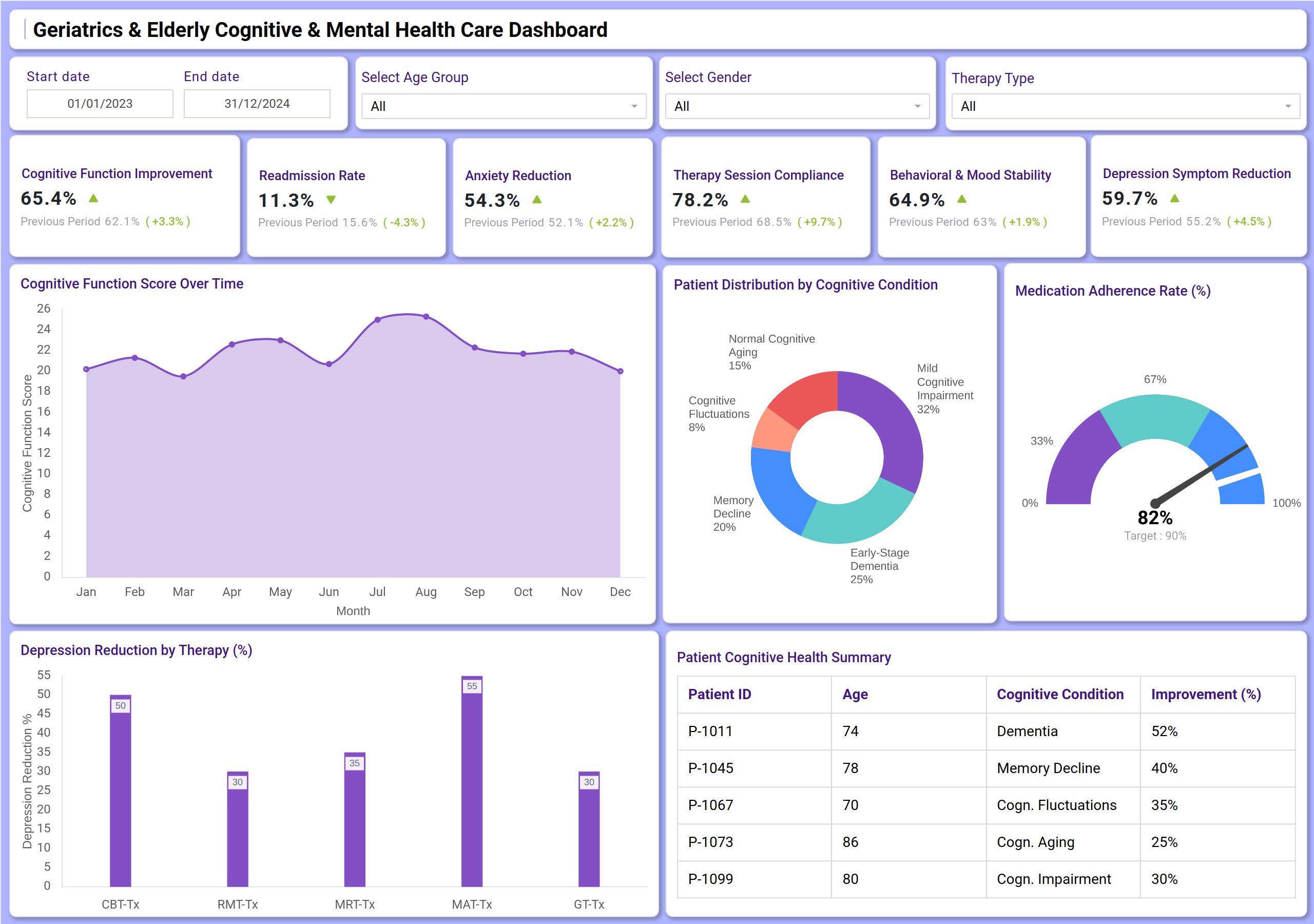
You can create a Geriatrics & Elderly Cognitive & Mental Health Care Dashboard that combines KPI tiles and visualizations. At the top, KPI cards track key metrics, including cognitive function improvement, readmission rate, anxiety reduction, therapy session compliance, behavioral & mood stability, and depression symptom reduction. Below that, charts show trends in cognitive function scores over time, patient distribution by cognitive condition, and medication adherence rates. Bar charts display the reduction in depression by therapy type, while tables summarize the individual patient's cognitive health progress. Together, this dashboard serves as a comprehensive tool for tracking geriatric cognitive and mental health metrics, ensuring leadership gains visibility into both clinical and care quality metrics.
How to Analyze Data in Geriatrics & Elderly Cognitive & Mental Health Care Dashboards
Here’s how healthcare teams can make the most of the data available on the Geriatrics & Elderly Cognitive & Mental Health Care Dashboard:
- Track cognitive progression: Use line charts to monitor cognitive function scores over time.
- Assess care continuity: Analyze readmission rates against therapy compliance and medication adherence.
- Evaluate therapy effectiveness: Compare depression and anxiety reduction across CBT-Tx, RMT-Tx, MRT-Tx, MAT-Tx, and GT-Tx.
- Understand patient demographics: Review the distribution of cognitive conditions (e.g., dementia, memory decline) by age and gender.
- Monitor adherence and stability: Track medication adherence and trends in behavioral & mood stability.
- Identify high-risk patients: Use the patient summary table to flag individuals needing intervention.
Benefits of Geriatrics & Elderly Cognitive & Mental Health Care Dashboards
- Improved clinical oversight: KPIs across cognitive, mental, and behavioral domains.
- Better care planning: Links therapy compliance with symptom reduction for targeted interventions.
- Reduced readmissions: Tracks readmission rates alongside adherence and stability metrics.
- Evidence-based therapy selection: Compares depression and anxiety reduction by therapy type.
- Enhanced patient outcomes: Monitors individual progress and population-level trends.
- Compliance & reporting: Works as a geriatrics cognitive & mental health reporting and compliance dashboard for audits and governance.
Together, these elements provide leadership with clinical and operational visibility, making it easier to align care delivery with patient outcomes. That’s why many geriatric care leaders call it the best performance dashboard for elderly cognitive and mental health when scaling quality and continuity of elderly care.
KPIs to Track in Geriatrics & Elderly Cognitive & Mental Health Care Dashboards
- Cognitive Function Improvement (%): Measures the percentage increase in cognitive assessment scores compared to baseline, indicating the effectiveness of interventions in enhancing memory, reasoning, and daily functioning.
- Readmission Rate (%): Tracks the percentage of patients readmitted within a defined period, reflecting care continuity, discharge planning quality, and post-treatment stability.
- Anxiety Reduction (%): Measures the average reduction in anxiety symptoms after therapy, as assessed by standardized scales, indicating the impact of mental health interventions.
- Therapy Session Compliance (%): Monitors the percentage of scheduled therapy sessions attended, critical for assessing patient engagement and treatment plan adherence.
- Behavioral & Mood Stability (%): Evaluates the consistency of mood and behavior over time using clinical ratings, essential for managing agitation, depression, or emotional volatility in elderly patients.
- Depression Symptom Reduction (%): Measures the decline in depression severity scores after therapeutic interventions, demonstrating efficacy in improving emotional well-being.
- Medication Adherence Rate (%): Tracks the proportion of prescribed doses taken correctly, vital for treatment success and preventing cognitive or mental health decline.
Frequently Asked Questions
1. Who should use a Geriatrics & Elderly Cognitive & Mental Health Care Dashboard?
Clinical directors, geriatricians, psychiatrists, care coordinators, and quality assurance teams are responsible for developing and monitoring elderly cognitive and mental health strategies.
2. Can this dashboard help reduce readmissions?
Yes. Leadership can correlate readmission rates with therapy compliance, medication adherence, and symptom reduction to strengthen discharge and follow-up protocols.
3. How does it support therapy optimization?
It compares depression and anxiety reduction across therapy types (CBT-Tx, RMT-Tx, etc.), enabling data-driven selection of effective interventions.
4. Is this dashboard useful for compliance?
Yes, because a geriatrics cognitive & mental health workflow and outcome analytics dashboard supports governance, reporting, and regulatory audits.