
What is a Biomass and Bioenergy Power Plant Workforce Productivity & Skill Compliance Dashboard?
A Biomass and Bioenergy Power Plant Workforce Productivity & Skill Compliance Dashboard is a centralized analytics tool used by electric power utilities to monitor biomass power plant workforce productivity, workforce utilization, and bioenergy power plant skill compliance analytics across generation facilities. It consolidates key workforce performance indicators such as MWh generated per employee, manpower cost per MWh, overtime trends, certification status, and critical role coverage into a single operational view. This biomass power plant workforce performance monitoring dashboard supports plant managers, HR teams, and compliance officers by directly linking labor productivity to power generation output, operational costs, and regulatory readiness. By combining workforce productivity data with training and certification maturity, utilities ensure that qualified personnel are consistently available to operate biomass boilers, fuel handling systems, turbines, and safety-critical processes without disruption.
How to Create a Biomass and Bioenergy Power Plant Workforce Productivity & Skill Compliance Dashboard
You don’t need to build your report from scratch, just start with a ready to use dashboard template from Mokkup. Add in your data and export it however you like. Here’s how to do it:
1. Create or Log in to Your Mokkup Account
Start by signing up on Mokkup.ai using your email. If you already have an account, just log in, and you’ll be good to go.
2. Choose and Customize Your Dashboard Template
Find the Biomass and Bioenergy Power Plant Workforce Productivity & Skill Compliance Dashboard
template in the Templates section. Use the drag and drop editor to adjust KPIs, edit filters, or add elements based on your data.
3. Export to Your BI Tool
Once your dashboard wireframe is ready, use the BI Tool Export feature to send it directly to Power BI or Tableau for further analysis and enhancements. You can also download the dashboard as a PDF, PNG, or JPEG, embed it on a platform, or invite your team to collaborate.
Note: This is a Pro template. You’ll need a Pro subscription on Mokkup to use and customize this dashboard wireframe. Upgrade anytime to unlock full access.
Biomass and Bioenergy Power Plant Workforce Productivity & Skill Compliance Dashboard Example
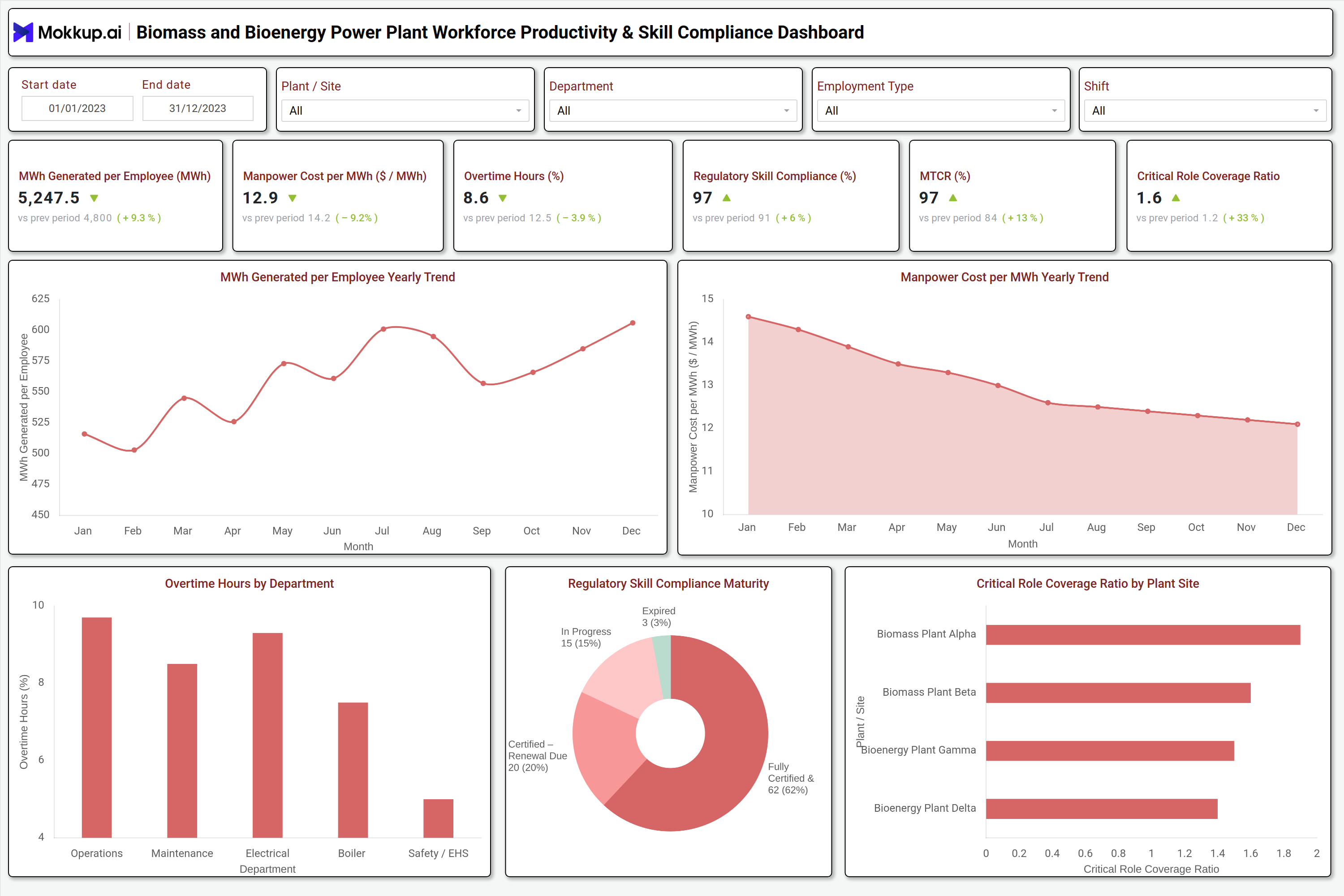
A typical biomass power plant workforce productivity dashboard example includes filters for time period, plant site, department, employment type, and shift, enabling detailed bioenergy power plant workforce performance monitoring. Core KPI tiles highlight metrics such as MWh generated per employee, manpower cost per MWh, overtime hours percentage, regulatory skill compliance rate, mandatory training completion rate, and critical role coverage ratio. Trend charts visualize year-over-year changes in workforce productivity and labor costs, helping utilities identify efficiency improvements or cost escalation risks. Department-level overtime analysis reveals workforce pressure points across operations, maintenance, electrical, and boiler teams. Skill compliance maturity visuals display the distribution of fully certified employees, renewals due, training in progress, and expired certifications. Site-wise critical role coverage analysis ensures that every biomass or bioenergy plant maintains adequate staffing for safety, reliability, and regulatory compliance.
How to Analyze Data in a Biomass and Bioenergy Power Plant Workforce Productivity & Skill Compliance Dashboard
Here is how you can analyze data from this dashboard:
- Compare MWh generated per employee across months to assess workforce productivity trends
- Track the manpower cost per MWh to evaluate labor cost efficiency against the generation output
- Monitor overtime hours percentage by department to identify staffing gaps or workload imbalance
- Review regulatory skill compliance percentage to ensure adherence to statutory training requirements
- Analyze bioenergy workforce training and certification dashboard maturity to prioritize renewals and avoid skill lapses.
- Evaluate the critical role coverage ratio by plant site to reduce operational and safety risks
- Filter by shift or employment type to detect productivity differences between permanent and contract staff
- Use historical trends to align workforce planning with seasonal biomass fuel availability and load demand
Benefits of a Biomass and Bioenergy Power Plant Workforce Productivity & Skill Compliance Dashboard
The following are the benefits of using this dashboard:
- Improves biomass power plant workforce productivity across generation assets
- Reduces manpower cost per MWh through data-driven staffing decisions
- Enhances visibility into bioenergy power plant workforce compliance tracking.
- Prevents skill shortages by tracking certification and training status
- Minimizes operational risk through critical role coverage monitoring
- Supports proactive workforce planning and scheduling
- Aligns labor performance with power generation efficiency goals
- Enables standardized workforce reporting across multiple plant sites
KPIs to Track in a Biomass and Bioenergy Power Plant Workforce Productivity & Skill Compliance Dashboard
The following key KPIs can be tracked by using this dashboard:
- MWh Generated per Employee: Measures workforce productivity by calculating the total electricity generated per employee over a defined period.
- Manpower Cost per MWh: Indicates labor cost efficiency by dividing total workforce expenses by the total energy generated.
- Overtime Hours Percentage: Shows the proportion of total working hours that are overtime, highlighting workforce load and staffing balance.
- Regulatory Skill Compliance Percentage: Represents the percentage of employees who meet all regulatory and role-specific skill certification requirements.
- Mandatory Training Completion Rate: Measures the percentage of employees who have completed all required safety, technical, and compliance training within the reporting period.
- Critical Role Coverage Ratio: Assesses workforce readiness by comparing the number of qualified personnel available for critical roles to the number required for safe plant operation.
Frequently Asked Questions
1. What is workforce productivity in a biomass power plant?
Workforce productivity measures how effectively employees contribute to power generation, typically expressed as MWh generated per employee or per labor hour.
2. How does the dashboard help reduce manpower costs?
By correlating labor cost metrics with generation output, utilities can optimize staffing levels, reduce excessive overtime, and improve shift allocation.
3. Why is skill compliance critical in bioenergy power plants?
Bioenergy plants operate complex systems such as boilers, turbines, and fuel handling units that require certified personnel to meet safety and regulatory standards.