
What is a Wind Power Plant Workforce Productivity & Training Dashboard?
A Wind Power Plant Workforce Productivity & Training Dashboard is a centralized digital platform that tracks technician utilization, labor availability, training status, and safety performance across onshore and offshore wind power operations. It consolidates data from maintenance systems, HR platforms, training records, and operational KPIs to provide wind power utilities with a view of workforce readiness and efficiency. The dashboard supports productivity management by highlighting technician workload, skill distribution, shift coverage, and work order performance. It also serves as a workforce training analytics system, enabling plant managers to identify certification gaps, track safety compliance, and optimize labor allocation to minimize downtime. This allows better planning and ensures that technicians deployed onsite have the required skills, certifications, and capacity to maintain reliable wind turbine performance.
How to Create a Wind Power Plant Workforce Productivity & Training Dashboard
You don’t need to build your report from scratch, just start with a ready to use dashboard template from Mokkup. Add in your data and export it however you like. Here’s how to do it:
1. Create or Log in to Your Mokkup Account
Start by signing up on Mokkup.ai using your email. If you already have an account, just log in, and you’ll be good to go.
2. Choose and Customize Your Dashboard Template
Find the Wind Power Plant Workforce Productivity & Training Dashboard template in the Templates section. Use the drag and drop editor to adjust KPIs, edit filters, or add elements based on your data.
3. Export to Your BI Tool
Once your dashboard wireframe is ready, use the BI Tool Export feature to send it directly to Power BI or Tableau for further analysis and enhancements. You can also download the dashboard as a PDF, PNG, or JPEG, embed it on a platform, or invite your team to collaborate.
Note: This is a Pro template. You’ll need a Pro subscription on Mokkup to use and customize this dashboard wireframe. Upgrade anytime to unlock full access.
Wind Power Plant Workforce Productivity & Training Dashboard Example
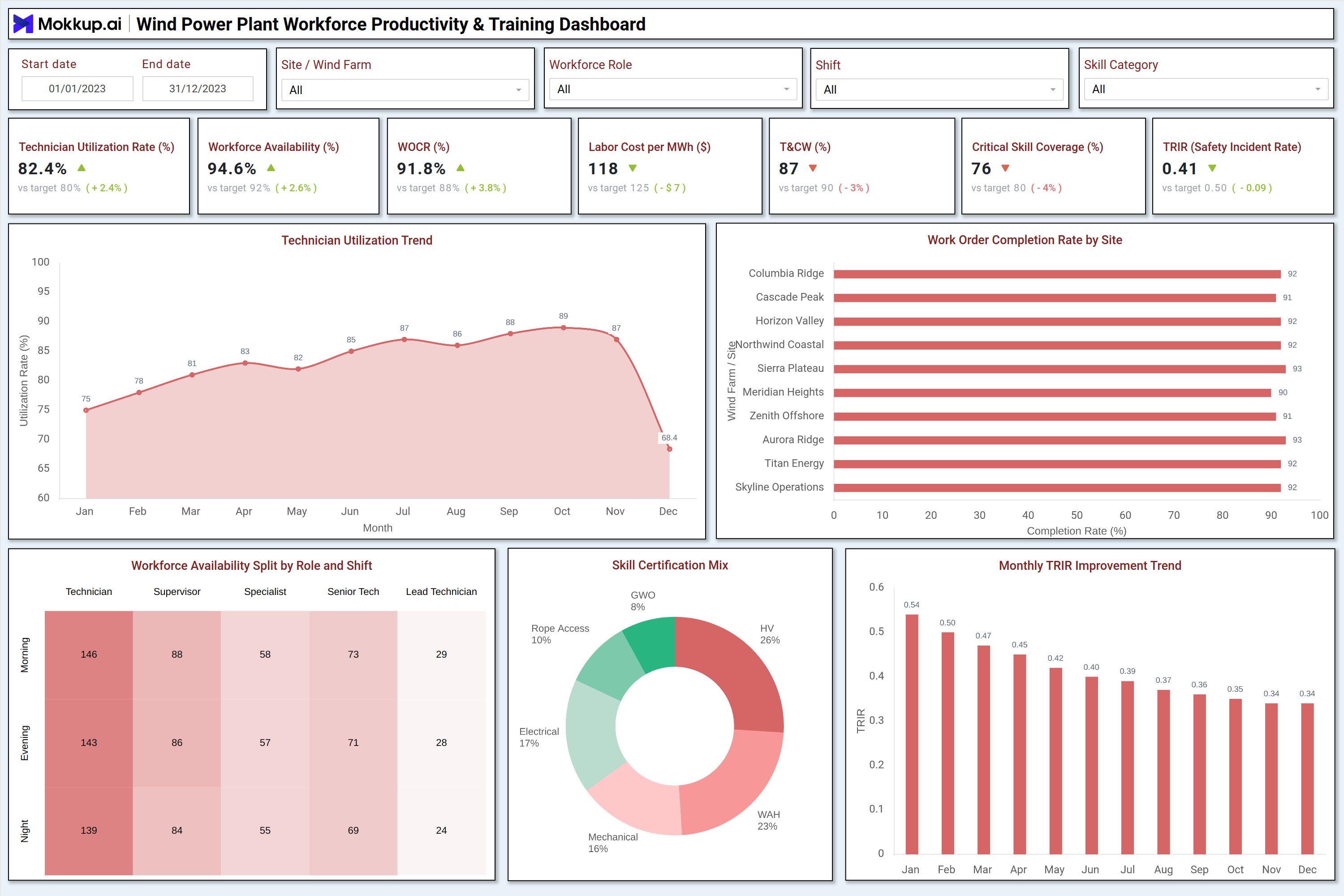
The dashboard example shown above presents a comprehensive snapshot of workforce performance for a wind farm portfolio. It includes technician utilization trends, role-wise availability, shift distribution, certification mix, and TRIR safety improvement. KPIs such as Workforce Availability Rate, Work Order Completion Rate (WOCR), Critical Skill Coverage, and Labor Cost per MWh help plant managers assess operational readiness across all sites. The dashboard breaks down workforce availability by technicians, supervisors, specialists, senior technicians, and lead technicians. It also includes performance tracking across morning, evening, and night shifts. Visualizations, such as certification mix charts, highlight technician competency levels across critical domains, including electrical, rope access, GWO, WAH, mechanical, and HV skills. Monthly TRIR trends help evaluate safety improvements over time. Work order completion rates across sites provide insights into operational discipline and field execution efficiency. This example represents a practical workforce productivity monitoring system for wind energy operations that supports decision-making with clear, data-driven insights.
How to Analyze Data in a Wind Power Plant Workforce Productivity & Training Dashboard
Here is how you can analyze data from this wind power plant workforce productivity dashboard:
- Technician Utilization Rate: Review how effectively technician labor hours are being used across wind sites to identify idle time or over-allocation.
- Workforce Availability: Analyze technician availability to uncover staffing gaps during peak maintenance periods or seasonal demand spikes.
- Work Order Completion Rate (WOCR): Track the completion rate of planned and corrective work orders to assess maintenance execution efficiency.
- Labor Cost per MWh: Compare actual labor cost per MWh against targets to identify cost overruns or workforce inefficiencies.
- Training & Certification Mix: Evaluate whether technicians hold the required certifications for electrical, mechanical, HV, WAH, and rope access work.
- Critical Skill Coverage: Monitor the availability of certified personnel for complex turbine operations at each site to avoid skill-related bottlenecks.
- TRIR Safety Trends: Assess Total Recordable Incident Rate (TRIR) trends to identify safety risks and ensure continuous improvement in safety performance.
- Role-wise & Shift-wise Availability: Use role-wise and shift-wise views to optimize scheduling and prevent under-staffing during high workload periods.
- Site-level Performance Comparison: Compare workforce performance across wind farms to identify top-performing sites and those requiring intervention.
- Monthly Workforce Trends: Examine monthly trends to evaluate the impact of new training programs, policy changes, or workforce restructuring initiatives.
Benefits of a Wind Power Plant Workforce Productivity & Training Dashboard
The following are the benefits of using the wind turbine technician performance tracking system:
- Improved Workforce Visibility: Provides clear visibility into utilization, availability, and skill gaps across multiple wind farm locations.
- Data-driven Labor Planning: Supports informed workforce planning by identifying technician shortages or excess capacity.
- Enhanced Safety Compliance: Strengthens safety governance through continuous tracking of certifications, training status, and compliance metrics.
- Optimized Labor Cost per MWh: Helps reduce labor costs by improving scheduling efficiency and minimizing idle time.
- Stronger Maintenance Execution: Ensures the right technicians with the right competencies are assigned to critical maintenance tasks.
- Continuous Safety Monitoring: Enables ongoing tracking of TRIR and safety performance at both site and fleet levels.
- Reduced Operational Downtime: Aligns technician availability with preventive maintenance schedules to minimize turbine downtime.
- Actionable Training Insights: Delivers training analytics that highlight upskilling needs and support long-term workforce capability building.
KPIs to Track in a Wind Power Plant Workforce Productivity & Training Dashboard
You can track the following key KPIs for workforce training analytics for wind power plants:
- Technician Utilization Rate (%) – Measures the percentage of productive hours used versus total available hours.
- Workforce Availability (%) – Tracks labor availability across roles, shifts, and wind sites.
- WOCR (Work Order Completion Rate %) – Evaluates the timely execution of maintenance tasks.
- Labor Cost per MWh – Helps assess labor cost efficiency relative to energy output.
- Training, Competency & Workforce (T&CW%) – Measures training progress and competency alignment.
- Critical Skill Coverage (%) – Indicates whether essential skill sets are adequately covered across sites.
- TRIR (Total Recordable Incident Rate) – Tracks safety incidents and identifies risk patterns.
Frequently Asked Questions
1. Why is workforce productivity important in wind power plants?
Wind farms depend heavily on skilled technicians for maintenance and operations. Efficient workforce utilization directly reduces downtime and improves turbine reliability.
2. How does this dashboard improve technician performance?
It tracks utilization, skill readiness, training gaps, and safety performance, helping managers align technicians with tasks that match their competencies.
3. Can this dashboard support both onshore and offshore wind sites?
Yes. Workforce KPIs, training requirements, and safety metrics apply to both onshore and offshore wind operations.