What are KPIs?
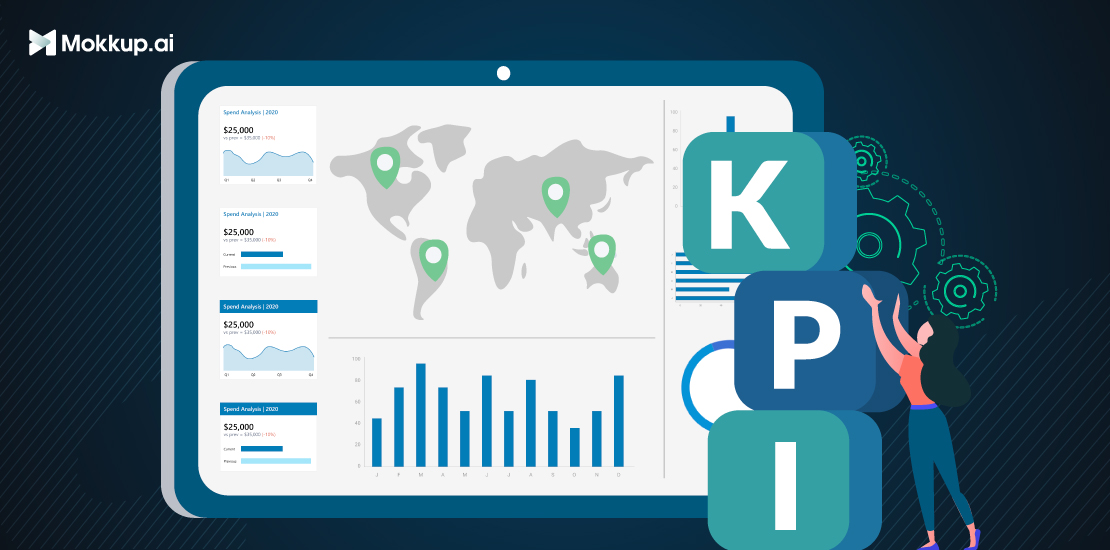
KPIs provide a clear understanding of an organization's performance and help identify areas for improvement. They are typically tied to specific targets and timeframes and can be used to monitor performance at various organizational levels. KPIs are essential for measuring and analyzing performance data and making informed decisions to improve organizational performance.
Table of Contents
- Key Performance Indicators Examples
- Key Performance Indicators Vs. Metrics
- How to Use KPIs Effectively in Business Operations
- Types Of Key Performance Indicators
- KPI Tracking: Using Dashboards
- Make The Most Of Your KPIs
Key performance indicators (KPIs) are a much-discussed but underutilized business tool. Few companies implement them with the rigor necessary to achieve good results. Choosing the right KPIs and implementing a KPI tracking process requires dedication and commitment from everyone. They provide a clear and concise way to monitor performance, identify areas for improvement, and ensure your organization is on track to meet its goals. In this blog, we'll explore everything you need to know about KPIs, including what they are, how they work, and how to choose the right KPIs for your business.
Key Performance Indicators Examples
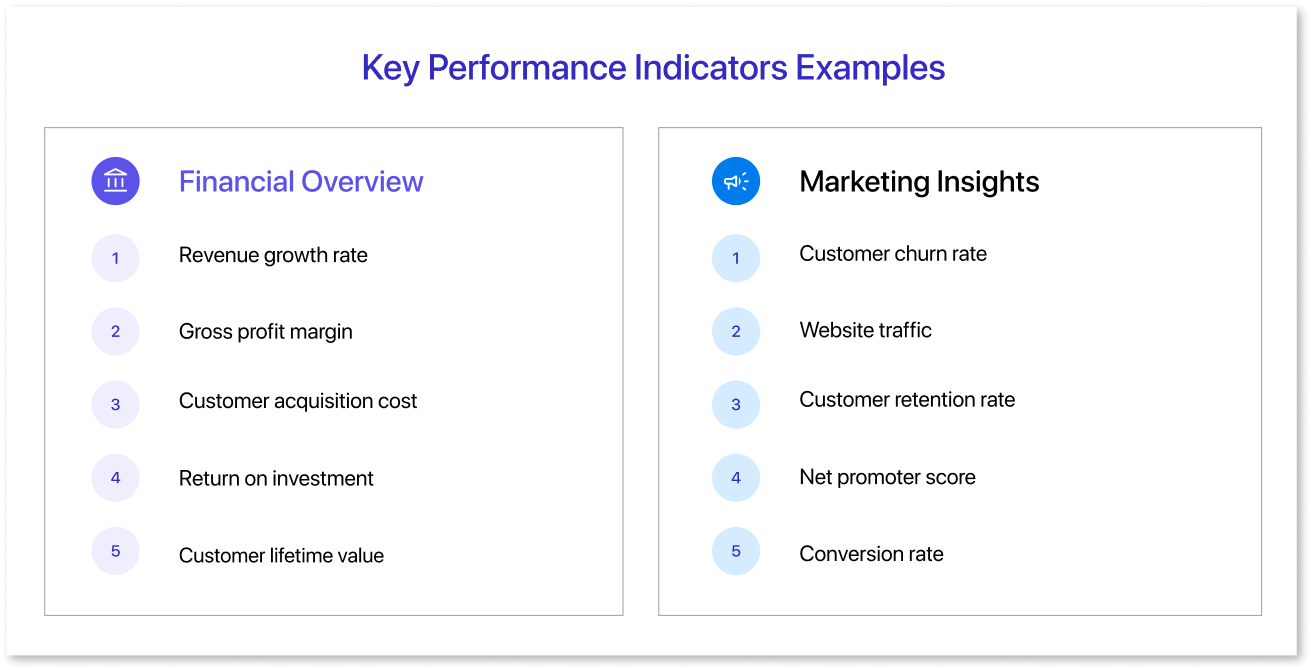
The specific KPIs that are most relevant for your business will depend on your industry, goals, and priorities. Here are some examples of Key Performance Indicators (KPIs) that businesses commonly use to measure performance:
- Revenue growth rate: Measures the percentage increase or decrease in revenue over a period of time.
- Customer acquisition cost (CAC): Measures the cost of acquiring new customers.
- Customer lifetime value (CLV): Measures the total value of a customer over their entire lifetime of doing business with your company.
- Net promoter score (NPS): Measures customer satisfaction and loyalty by asking customers how likely they are to recommend your company to others.
- Employee turnover rate: Measures the percentage of employees who leave the company in a given period of time.
- Gross profit margin: Measures the percentage of revenue that remains after deducting the cost of goods sold.
- Website traffic: Measures the number of visitors to your website.
- Conversion rate: Measures the percentage of website visitors who take a desired action, such as making a purchase or filling out a form.
- Return on investment (ROI): Measures the return on an investment in a particular project or initiative.
- Customer retention rate: Measures the percentage of customers who continue to do business with your company over a period of time.
Key Performance Indicators Vs. Metrics
KPIs (Key Performance Indicators) and Metrics are both used to measure performance and track progress toward business goals. However, there are some key differences between the two:
|
Definition |
KPIs are specific, measurable indicators that are used to track progress toward specific business goals or objectives. Metrics are more general measurements that can be used to track a wide range of activities and performance indicators. |
|
Relevance |
KPIs are directly relevant to the success of a business and are often tied to strategic objectives. Metrics, on the other hand, maybe less directly tied to business success but are still useful for tracking performance. |
|
Focus |
KPIs are focused on the most important areas of a business and are typically tied to a specific department or function. Metrics may be more general in nature and can be used to track performance across multiple departments or functions. |
|
Actionability |
KPIs are designed to be actionable, meaning that they provide specific guidance on how to improve performance. Metrics may be more descriptive in nature, providing information about what is happening without necessarily providing guidance on how to improve it. |
|
Timeframe |
KPIs are typically measured over long terms, such as quarterly or annual periods. Metrics may be measured over shorter timeframes, such as daily or weekly intervals. |
In summary, KPIs are a subset of metrics that are specifically tied to business goals and objectives. KPIs are directly relevant to business success and provide actionable guidance on how to improve performance, while metrics are more general in nature and can be used to track performance across multiple areas of a business.
How to Use KPIs Effectively in Business Operations
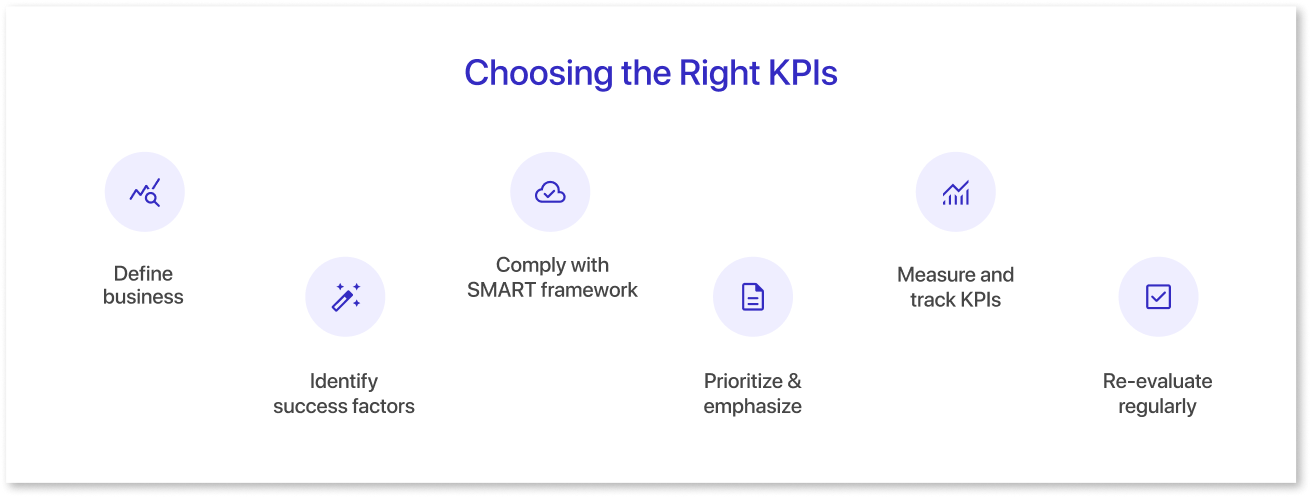
Choosing the right KPIs is essential for ensuring that the organization tracks the metrics that matter most to achieving its objectives. To select the right KPIs, it is important to consider the organization's overall goals and objectives, as well as the specific objectives of each department or function. KPIs should be relevant, specific, measurable, achievable, and time-bound. They should also be aligned with the organization's overall strategy and should provide a clear understanding of progress toward achieving specific objectives.
Follow these steps to create KPIs that clearly indicate whether performance is improving.
1. First, define your business goals.
Developing KPIs is an important part of the strategic planning process, which includes defining your organization's goals and objectives. But you can't create meaningful performance metrics if you don't understand what you're trying to achieve. First, set a specific set of goals that represent the goals your organization wants to achieve.
2. Identify critical success factors
This step addresses the main problem for most organizations: defining key performance indicators. Identify the critical success factors that will contribute to achieving your business goals. These could be factors such as revenue growth, customer retention, or employee productivity.
Choose Leading Indicators. Once you've determined which activity yields better results, select that activity as your KPI. For example, if you know that your sales team makes more outbound calls to increase revenue, choose outbound call count as your KPI. If you meet or exceed your outbound call goals, you'll find that your sales will increase as well. You can have multiple KPIs if both are strong leading indicators.
3. Make sure each KPI complies with the SMART framework.
Identifying the activities influencing your goals brings you closer to determining your KPIs, but effective KPIs must be SMART.
- Specific: The KPI should be clearly defined and specific, so that everyone involved knows exactly what is being measured and why.
- Measurable: It should be measurable in a way that allows for tracking and comparison over time, so that progress can be monitored and evaluated.
- Achievable: This can be challenging but realistic, so that it motivates and encourages improvement without being too overwhelming or unattainable.
- Relevant: The KPI must be relevant to the overall objectives and goals of the business or organization, so that it contributes to meaningful progress towards those objectives.
- Time-bound: This should have a specific time frame or deadline for achievement, so that progress can be tracked and evaluated within a specific period of time.
4. Prioritize KPIs:
We have good KPIs in mind. That is wonderful. Before you start using it, you need to clarify the necessary information listed below. Prioritize your KPIs based on their importance to achieving your business goals.
Focus on the most important KPIs that will have the greatest impact on your business success. This helps present and explain each KPI to stakeholders. It also helps with tracking. We recommend using a template like the one below to ensure you have everything covered.
- Explanation: Briefly describe the measure and what it should indicate.
- Method: Are calculations required to report measurements? If so, write it down clearly.
- Reporting frequency: Decide how often you want to report your KPIs (monthly, quarterly, etc.).
- Owner: Who or which department reports on actions and performance? Accountability is essential in tracking.
- Goal: Consider the level of performance you want to achieve. It must be a numerical (quantitative) goal.
5. Measure and track key performance indicators (KPIs)
Setting important metrics does not end the KPI process. Then, we need to measure their performance. To do that, you need to track them effectively and know when to replace them.
KPIs and their performance need to be continuously reviewed and tracked on a monthly, quarterly, or other predefined reporting frequency. With regular monitoring, you can easily identify periods when something underperformed or overperformed and the events within that period that might have caused the change.
6. Re-evaluate regularly:
When a participant presents her KPI data analytics in a strategy meeting, she spends more time understanding the data and why it was collected than making decisions based on the data.
Regularly re-evaluate your KPIs to ensure that they remain relevant and aligned with your business goals. As your business evolves, you may need to adjust your KPIs to reflect changing priorities.
Think you've developed a smart move? wonderful! Now it's time to determine how well your company (and your KPIs) are doing.
Types Of Key Performance Indicators
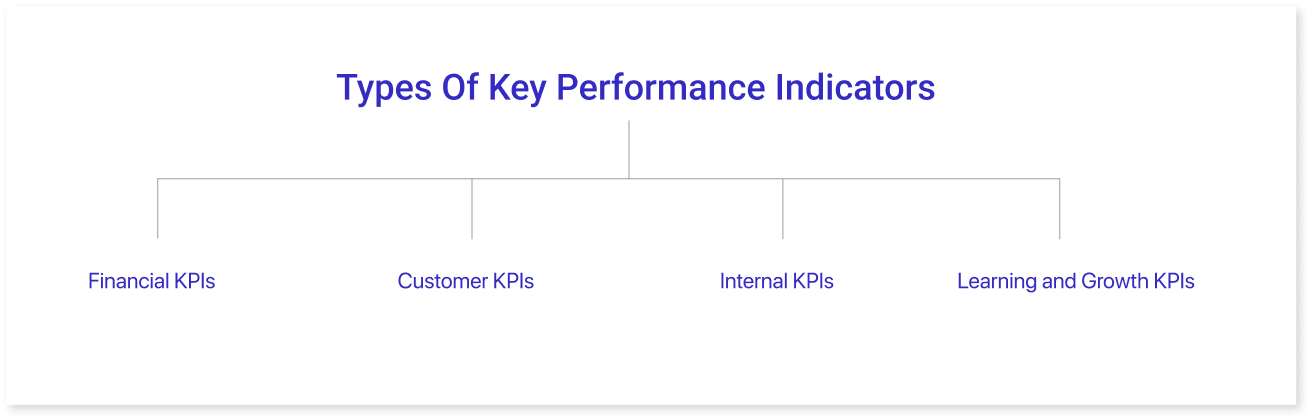
Organizations can use several types of KPIs, depending on their specific objectives and goals. Some common types of KPIs include
1. Financial KPIs:
Financial Key Performance Indicators (KPIs) are metrics used to assess the financial performance of a business or organization. These KPIs are critical for analyzing and evaluating the financial health and stability of a company. They focus on the financial performance of the organization, such as revenue, profit margin, and cash flow.
2. Customer KPIs:
Customer Key Performance Indicators (KPIs) are metrics used to measure the success and effectiveness of a company's customer service and support efforts. These KPIs help businesses assess their ability to meet customer needs and expectations, retain customers, and generate new business through positive customer experiences. They focus on customer satisfaction, loyalty, and retention, as well as the organization's ability to meet customer needs.
3. Internal KPIs:
Internal KPIs, are metrics that organizations use to evaluate their internal performance and measure progress toward specific goals. These KPIs are typically used to monitor and improve the efficiency and effectiveness of internal processes and operations. Some examples are as follows- Employee engagement rate, Capacity utilization, Cost per unit, and many more.
4. Learning and Growth KPIs:
Learning and Growth KPIs, or strategic key performance indicators, are metrics that organizations use to measure the effectiveness of their employee training and development programs. These KPIs are typically used to track progress toward enhancing the skills, knowledge, and capabilities of employees, which can help organizations improve their overall performance and achieve strategic objectives. Some examples of learning and growth are Innovation rate, Research and development investment, Technology adoption rate, Leadership effectiveness, etc.
KPI Tracking: Using Dashboards
The KPI Dashboards present all your KPIs in one place for easy decision-making. By creating a KPI dashboard, you can quickly see which metrics are below target and which are trending up. It gives you a complete picture of all your metrics so you can jump right into the quantitative information you need to decide what to do next.
You can create any type of KPI dashboard that suits your needs. Below are three examples of his dashboard design that are particularly helpful.
1. Red Measures Dashboard
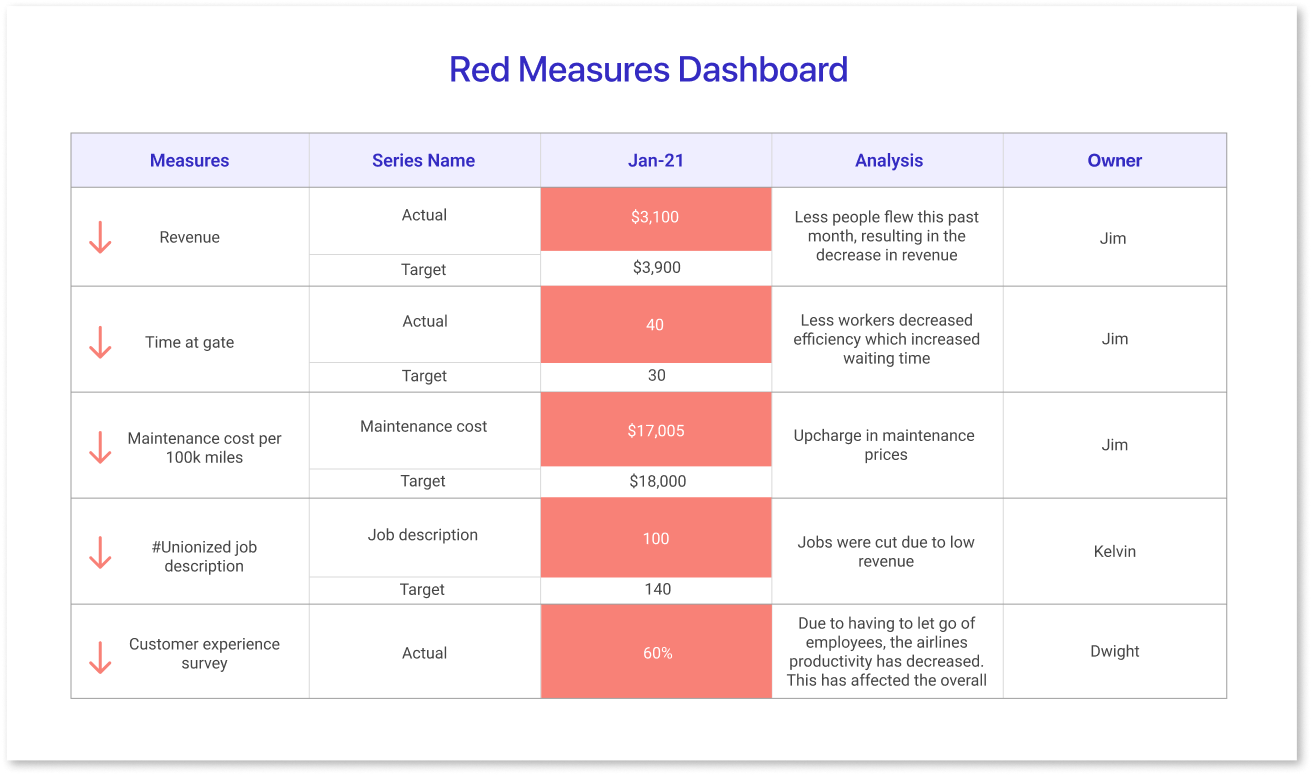
The red metrics dashboard focuses on underperforming metrics, making it easy to identify and fix lagging KPIs.
2. KPI Dashboard Template
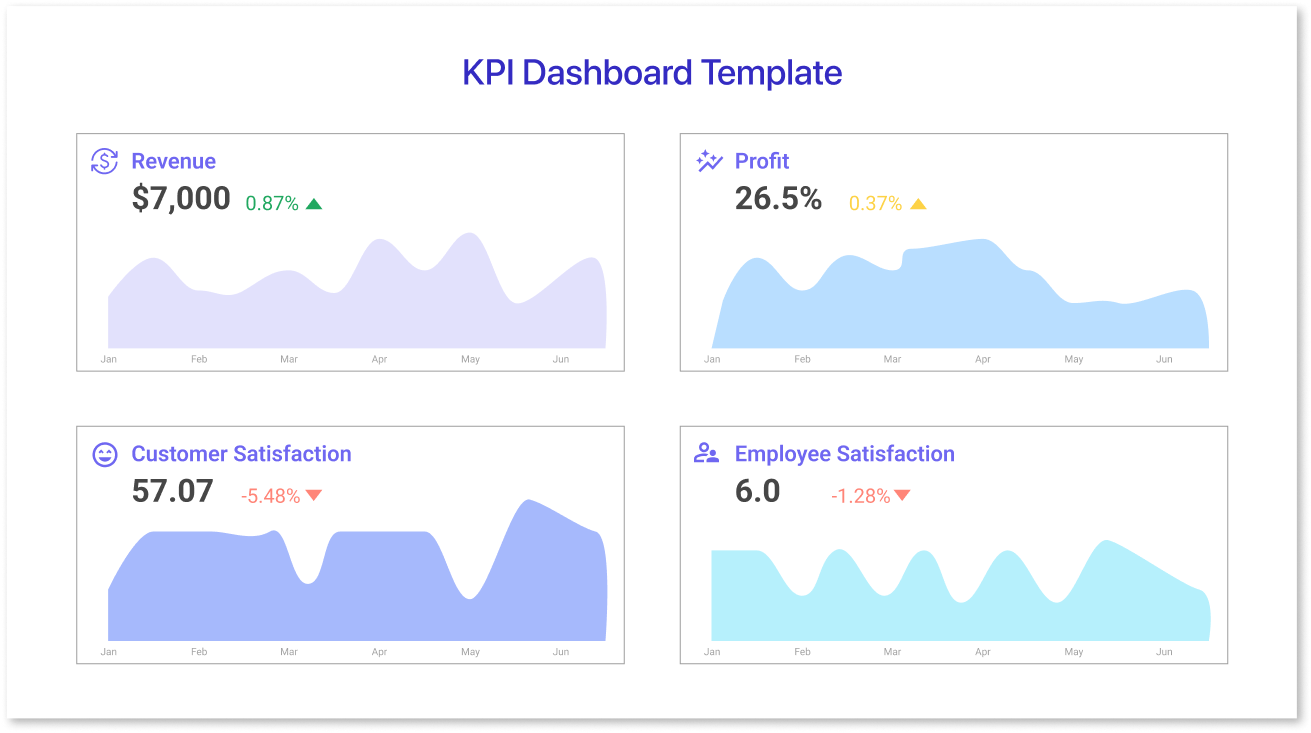
KPI dashboard templates visualize the performance of your organization's metrics over real time. These dashboards typically include indicators showing each metric's red, yellow, or green status. Adding qualitative fields to your KPI dashboards is a great way to add more context to these metrics.
3. Trend Dashboard Template
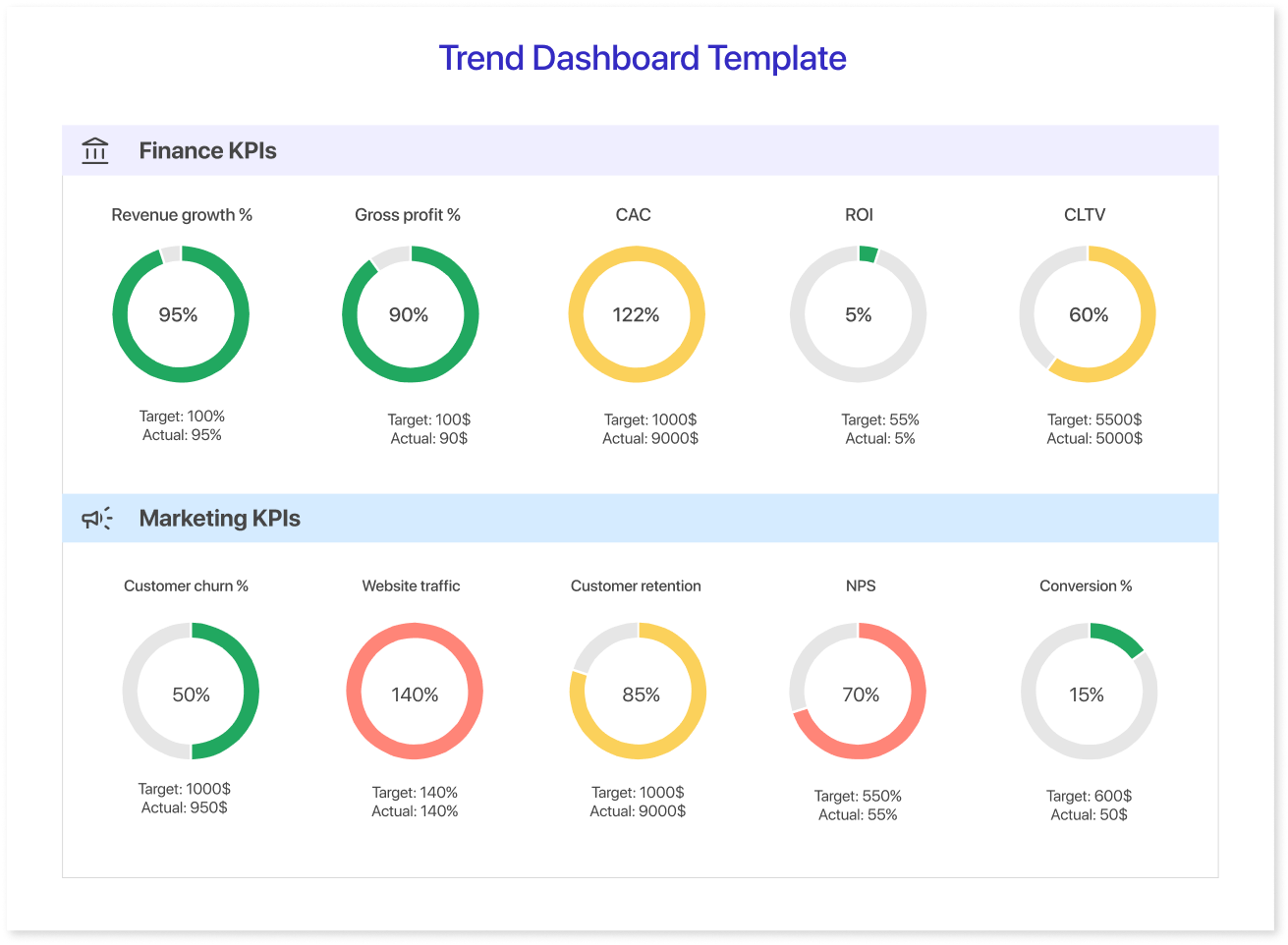
The trending dashboard template visually displays the trend of metrics over time so you can easily identify problem periods and drill down to address potential causes.
Make The Most Of Your KPIs
There is no doubt that KPIs have a positive impact on your business, but using them effectively takes time and effort. We've also stressed the importance of choosing the "right" KPIs, but remember that it's an experimental process, no matter how long you've been doing it. Our experience and practice will give you insight into your performance and help you make strategic decisions that steer your business processes in the right direction.
Conclusion
KPIs are essential for tracking and measuring an organization's performance in achieving its objectives. Mokkup.ai is a dashboard wireframing tool that facilitates the selection of relevant KPIs, enabling seamless integration into your final dashboard design for consistent tracking; organizations can identify areas for improvement, ensure they are on track to meet their objectives, and ultimately improve their overall performance. Understanding KPIs is essential for success, whether you are an individual employee or part of a large organization.
Prompt it. Wireframe it with Mokkup.ai.