Artificial intelligence (AI) has emerged as an influential force in the dynamic landscape of project management. Today, AI project management tools offer a smarter and more efficient approach to project execution, including planning, implementation, and delivery. By using AI for project management, teams can move beyond manual tracking and rely on real-time, data-driven insights.
Rather than simply automating monotonous operations, AI tools for project management provide advanced analytics, predictive forecasting, and real-time visibility, helping project managers make faster and better decisions.
In fact, about 70% of project professionals report that their organizations are already using AI in project workflows, up from just 36 % two years ago, showing rapid adoption across industries.
As companies seek efficiency and agility in a fast-changing market, adopting advanced technologies becomes essential for sustaining a competitive advantage.
Table of Contents
- How AI Tools Can Improve Project Management in 2026
- What is AI-Driven Project Management Software?
- How AI Powers Project Management Solutions?
- What are the Essential Features of AI Project Management Tools?
- How to Select the Ideal AI Project Management Tool?
- Top 10 AI Project Management Tools
How AI Tools Can Improve Project Management in 2026
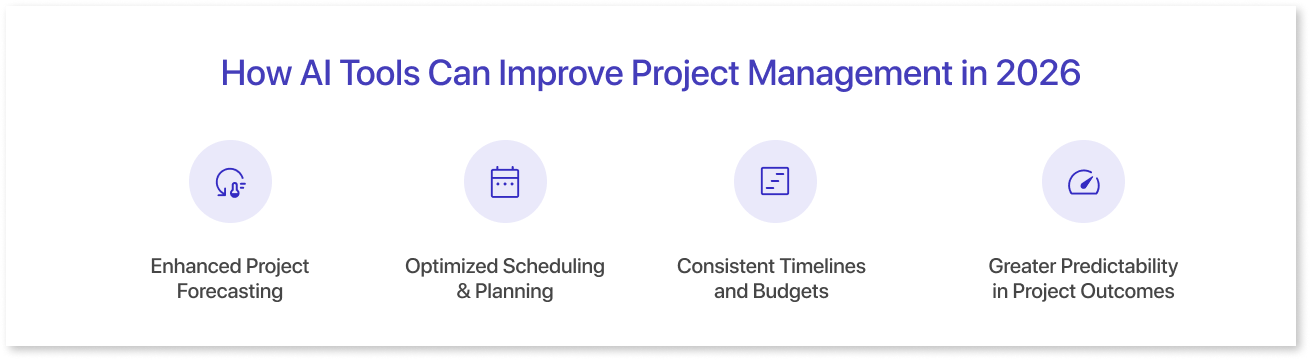
AI is constantly improving, and AI project management tools are evolving along with modern business needs. These AI tools for project management bring clear benefits across planning, forecasting, and delivery. Let’s explore how they improve project management outcomes:
1. Enhanced Project Forecasting
Accurate project estimates are essential to successful project management; however, many managers struggle with this aspect. Inaccurate estimates, whether too optimistic or pessimistic, can destroy projects before they even start. Human estimates are frequently inaccurate due to cognitive biases and a limited ability to interpret complex facts.
AI tackles these issues by harnessing its ability to evaluate massive volumes of historical data and make exact predictions. Unlike humans, AI computers can handle complex datasets without bias or psychological impact. This results in more accurate forecasts of project deadlines, resource allocation, and budgeting.
Managers who use AI for project estimating can lower the likelihood of project failure while also improving overall planning and execution.
2. Optimized Scheduling & Planning
AI improves scheduling and planning by successfully connecting multiple data points, maximizing the value of your dataset. Unlike humans, who may struggle to process complicated data, AI can manage and analyze massive amounts of data to deliver smart recommendations and findings.
How can AI be used as a project manager? AI-driven insights allow project managers to make more informed decisions, resulting in better project outcomes. AI project management software centralizes critical information, allocating team members and tasks more efficiently. This complete method optimizes all elements of scheduling and planning, allowing project managers to make informed decisions based on accurate and thorough data analysis.
3. Consistent Timelines and Budgets
Cost and time alignment are vital for project success. AI solutions provide accurate and predictable time estimates, allowing project managers to precisely define team scope and needs while also creating realistic client proposals that are mutually advantageous.
These reliable time estimates also help create solid project roadmaps, allowing for more efficient resource scheduling. As a result, clients are clear about project completion dates and job objectives, while team members are knowledgeable about their respective tasks and responsibilities.
This clarity and predictability contribute to a smoother project execution and increased stakeholder satisfaction.
4. Greater Predictability in Project Outcomes
Improved project estimations result in more predictability. AI's ability to store large volumes of data, recollect prior outcomes, and quickly interpret this knowledge allows for superior decision-making.
AI constantly improves its predictions for future jobs and resources by studying data from previous projects, team performance, and various resources. The continually developing algorithms use current and past data to offer precise estimations, allowing project managers to anticipate likely outcomes and spot potential problems early on.
This enhanced predictability helps with proactive planning and risk management, resulting in better project execution and higher success rates.
What is AI-Driven Project Management Software?
AI project management software blends artificial intelligence with project management tools to improve decision-making. These technologies simplify project tasks by using AI and machine learning processing capabilities. This technology replicates human cognitive processes, allowing computers to make decisions and rationalize. AI helps to assure project completion on schedule by analyzing massive datasets using algorithms.
AI can swiftly forecast outcomes, learn user preferences, categorize data, and highlight important aspects. In simple terms, AI focuses on providing machines with appropriate data to efficiently achieve specified project goals.

How AI Powers Project Management Solutions?
AI project management systems use artificial intelligence for better planning, execution, and monitoring. These technologies use machine learning algorithms and data analytics to automate repetitive activities, analyze vast amounts of data, and deliver predictive insights.
These tools often function in multiple ways. They can automatically assign work depending on teammates' abilities and availability, hence improving resource allocation. Furthermore, they can predict project durations, expenses, and potential dangers by evaluating previous data.
Some AI technologies improve collaboration amongst project teams by analyzing text data and providing automatic insights and summaries. These technologies improve workflow efficiency by automating everyday operations, spotting project risks, and providing data-driven recommendations.
As a result, AI project management systems improve decision-making and project outcomes, keeping teams on track and projects completed effectively.
What are the Essential Features of AI Project Management Tools?
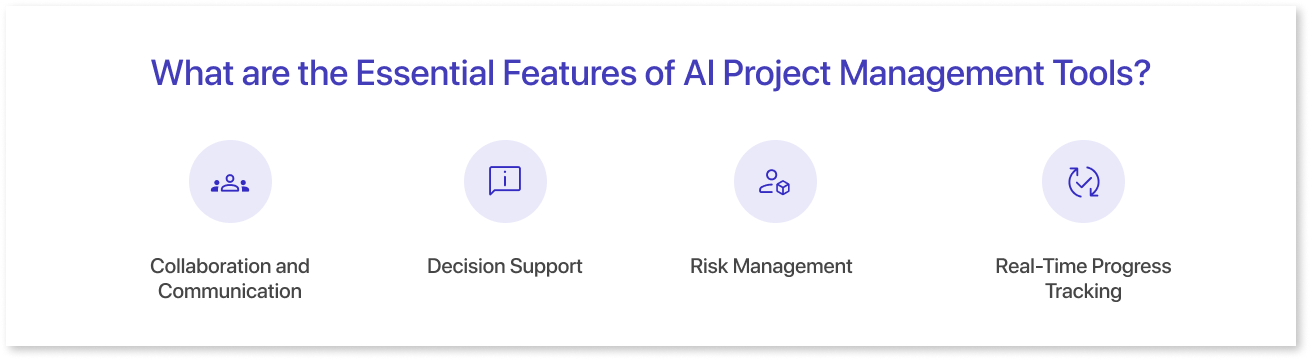
AI project management systems include a variety of characteristics that boost project efficiency and outcomes. Here are some of the key features:
- Collaboration and Communication: Improved collaboration features like AI-powered chatbots and connectivity with communication platforms allow team members to interact more seamlessly.
- Decision Support: AI-driven insights and recommendations help project managers make informed decisions faster, improving overall project planning and execution.
- Risk Management: These tools evaluate potential risks by analyzing various factors and provide early warnings and actionable insights to help prevent issues before they escalate.
- Real-Time Progress Tracking: AI project management solutions provide real-time updates on project status, allowing managers to monitor goals, budgets, and resource utilization continuously.
These features work together to accelerate workflows, improve decision-making, and lead to successful project completion.
How to Select the Ideal AI Project Management Tool?
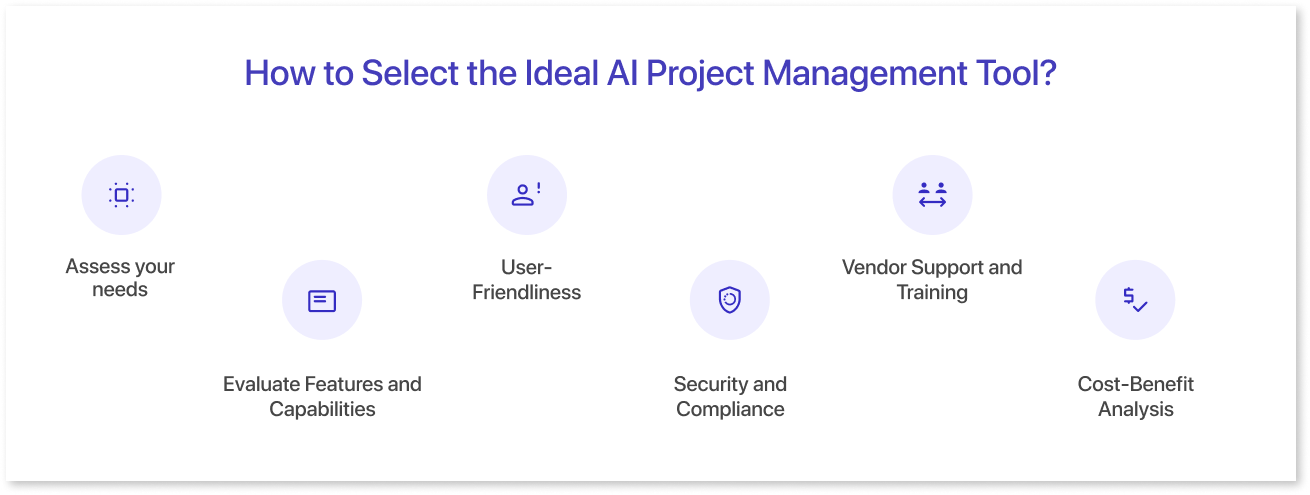
Choosing the appropriate AI project management tool can have a big impact on the project's success. Here are some important considerations to keep in mind before making a decision:
- Assess your needs: Determine exactly what is needed for your projects. Identify which features are required, such as task automation, predictive analytics, or resource optimization.
- Evaluate Features and Capabilities: Look for tools that provide a comprehensive collection of features targeted to your specific requirements. Make sure the program has automated task management, real-time progress tracking, risk management, and collaborative features.
- User-Friendliness: The tool should have an intuitive interface that is simple to use. A user-friendly design enhances user experience and allows your workforce to swiftly adjust to the new program without requiring extensive training.
- Security and Compliance: Ensure that the tool fulfills your organization's security standards and complies with all regulations. This is essential for protecting sensitive project information.
- Vendor Support and Training: Choose a tool that comes with solid customer support and training resources. Adequate support guarantees that any issues are resolved quickly and that your staff can fully utilize the software.
- Cost-Benefit Analysis: Evaluate the price model to verify it is within your budget. Compare the expense against the possible benefits and efficiencies that the technology will add to your project management processes.
By carefully examining all of these factors, you can find the AI project management tool which is best suited for your organization's requirements, thus enhancing your project management capabilities and results.
Top 10 AI Project Management Tools
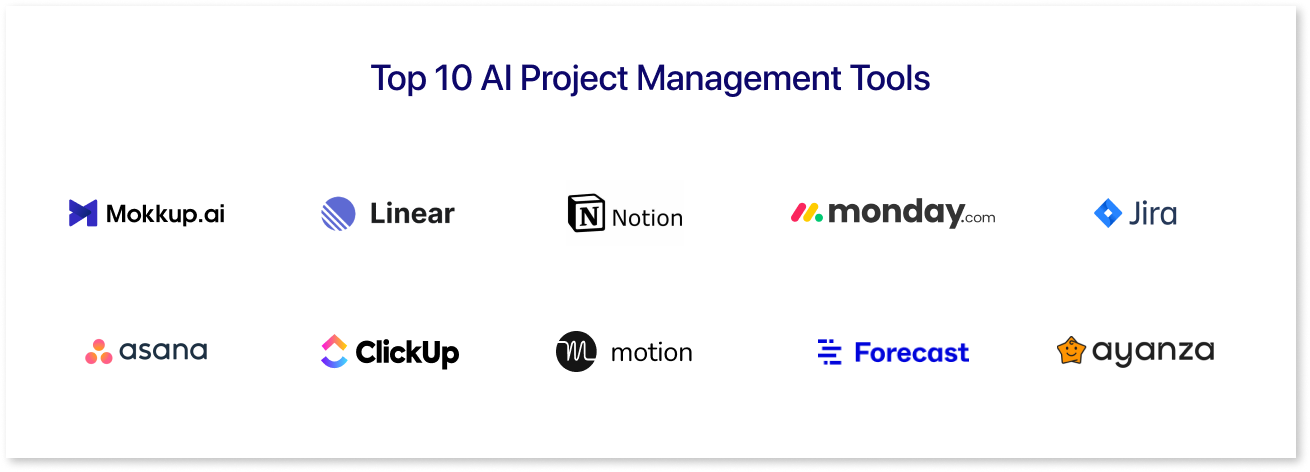
Artificial intelligence is reinventing project management by automating tasks, identifying risks and increasing efficiency. Here are the top ten best AI tools for project management solutions that are changing project management and productivity:
1. Mokkup.ai
Mokkup.ai is a cloud-based wireframing tool for project managers, data analysts, and developers. It allows users to create dashboard wireframes using drag-and-drop elements, pre-built templates, and various customization options. Plus, the new AI feature allows users to create stunning wireframes with a single line of text or prompt and export them directly to Tableau and Power BI.
This flexibility enables project managers to effectively communicate data visualization ideas to stakeholders and ensures everyone is on the same page about the final product.
2. Linear
Linear is a fast, modern project and issue tracking tool popular with product and engineering teams. In 2026, its AI helps teams auto-triage issues, summarize project updates, and predict delivery delays, making sprint planning smoother and more focused.
3. Notion
Notion combines documents, tasks, wikis, and databases in one flexible workspace. In 2026, Notion AI supports project planning by turning notes into tasks, summarizing updates, and helping teams maintain documentation automatically. It works well for teams that want lightweight project management with strong knowledge sharing.
4. Monday.com
Monday.com has expanded its AI capabilities to support workflow automation, resource planning, and risk alerts. In 2026, teams use it to generate project plans, forecast timelines, and get instant insights with minimal setup.
5. Jira
Jira is a well-known project management and issue tracking solution designed primarily for software development but applicable to various industries. It is a robust platform for software teams managing agile projects, bugs, and releases. It integrates deeply with Atlassian tools and leverages AI to automate issue triage, backlog prioritization, and sprint planning.
6. Asana
It is a popular project management tool with many features, such as task management, subtasks, dependencies, time tracking, and reporting. Asana's AI features, known as Asana Intelligence, can help you automate tasks, identify potential roadblocks, and recommend improvements to your workflow.
7. ClickUp
ClickUp is a feature-rich project management tool that offers task management, scheduling, time tracking, chat, and docs in a single platform. Its AI features streamline team productivity and improve collaboration by summarizing notes, automating tasks, and organizing workflows based on project needs.
8. Motion
Motion is a project management tool that uses AI to automate project planning. It can help you make project plans, allocate tasks, and monitor progress. Motion can help you save time and increase the efficiency of your project management process.
9. Forecast
Forecast uses machine learning to predict project outcomes, optimize resource allocation, and keep projects under budget. It helps with project planning, execution, and delivery, ideal for consultancies, agencies, and development teams.
10. Ayanza
Ayanza is an AI-powered work management tool designed for goal-driven teams. It connects company goals to daily tasks and uses AI to surface priorities, insights, and progress updates.
Conclusion
AI-powered project management tools have changed how teams approach planning, execution, and delivery. These tools improve productivity and decision-making by automating repetitive tasks, providing accurate forecasts, and offering real-time insights. For businesses of all sizes, incorporating AI technologies into project management can result in more efficient processes, consistent schedules, and better project outcomes.
As the market evolves, embracing these new tools is essential for preserving a competitive advantage. Whether a small startup or a major corporation, adding AI to your project management processes can help you streamline operations and achieve success.

Frequently Asked Questions
Various AI tools, such as Motion, Asana, ClickUp, and Jira, assist project managers in automating their routine tasks by utilizing unique AI-driven capabilities.
Yes, there are several free AI tools like Mokkup, ChatGPT, Notion AI, and ClickUp AI that come with the basic plan. For more advanced features, you need to take the upgraded plan.
In 2026, AI can strategically boost team productivity by automating tedious tasks and streamlining communication. By reducing the time spent on repetitive tasks, the team can free up time to focus on important tasks.
The best AI tool depends on the project's business needs, scope, and budget. Mokkup.ai is one of the best AI tools for dashboard-driven projects, letting project managers turn simple text prompts into ready-to-use dashboard wireframes.
Absolutely! AI can create project plans. They can generate timelines, task lists, milestones, and even assign responsibilities, all from a short prompt or project brief.
Prompt it. Wireframe it with Mokkup.ai.