
What is an Oil Power Plant Workforce Competency Dashboard?
An Oil Power Plant Workforce Competency Dashboard is a structured system that tracks employee skills, qualifications, training progress, and readiness for operational roles in oil-fired generation. This dashboard helps HR teams, operations leaders, and plant managers understand workforce capability across all critical functions. It acts as a unified view of workforce competency metrics for oil-fired power generation and supports continuous improvement in workforce capability.It brings together the essential metrics needed to evaluate proficiency, training coverage, and skill alignment for plant operations. It also supports a competency assessment framework for oil power plant teams and helps identify improvement areas in technical and regulatory qualifications. As a result, it enhances workforce planning and supports safer and more reliable operations of oil-fired power plants.
How to Create an Oil Power Plant Workforce Competency Dashboard
You don’t need to build your report from scratch—just start with a ready-to-use dashboard template from Mokkup. Add in your data and export it however you like. Here’s how to do it:
1. Create or Log in to Your Mokkup Account
Start by signing up on Mokkup.ai using your email. If you already have an account, just log in, and you’ll be good to go.
2. Choose and Customize Your Dashboard Template
Find the Oil Power Plant Workforce Competency Dashboard template in the Templates section. Use the drag-and-drop editor to adjust KPIs, edit filters, or add elements based on your data.
3. Export to Your BI Tool
Once your dashboard wireframe is ready, use the BI Tool Export feature to send it directly to Power BI or Tableau for further analysis and enhancements. You can also download the dashboard as a PDF, PNG, or JPEG, embed it on a platform, or invite your team to collaborate.
Note: This is a Pro template. You’ll need a Pro subscription on Mokkup to use and customize this dashboard wireframe. Upgrade anytime to unlock full access.
Oil Power Plant Workforce Competency Dashboard Example
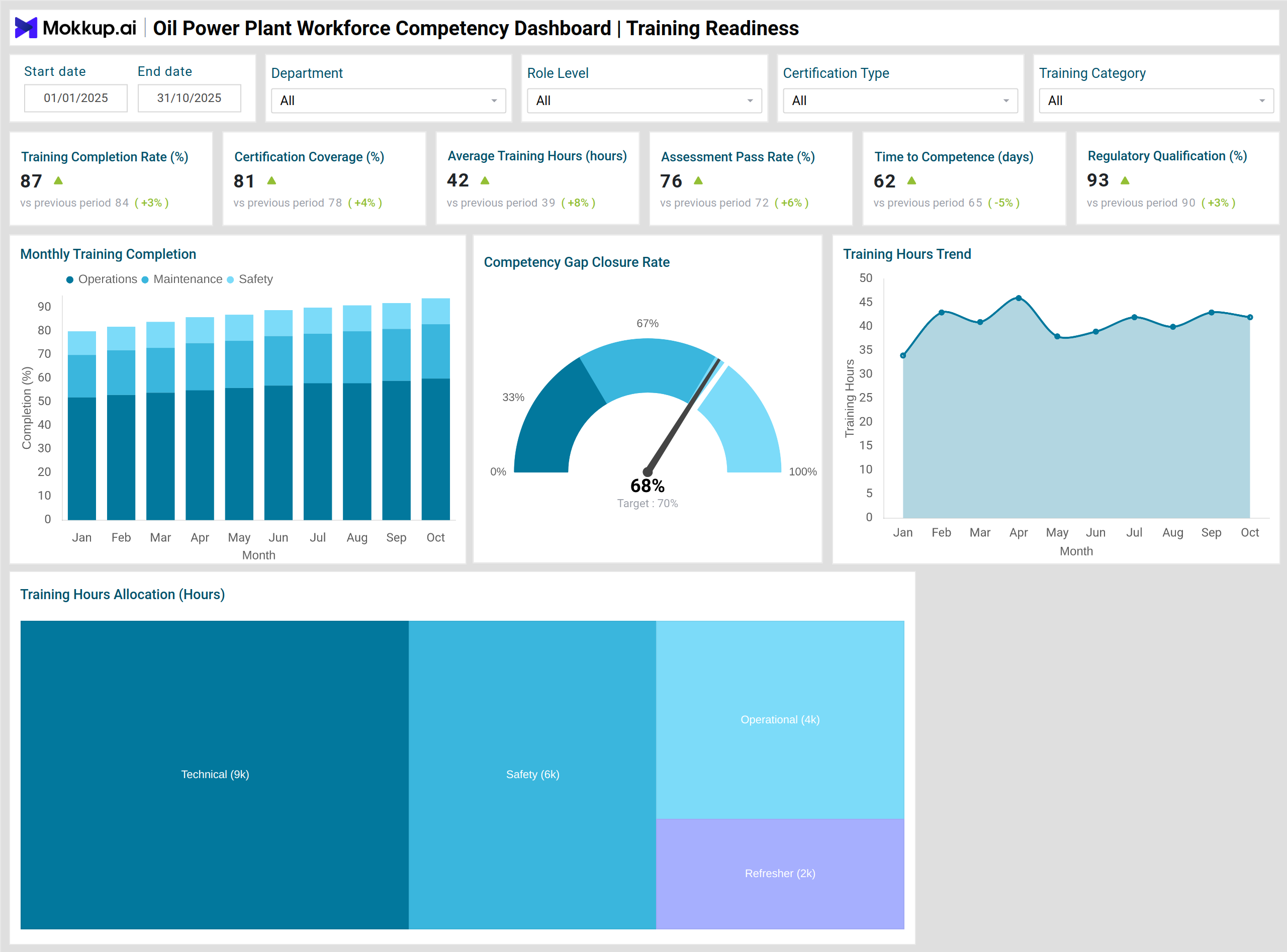
A typical Oil Power Plant Workforce Competency Dashboard provides clarity on the distribution of workforce strength and capability. For example, HR teams can monitor training completion status across departments using stacked column visuals. A line chart tracks the trend of average training hours per employee, helping identify gaps in skill development. Certification coverage is represented through pie charts, allowing leaders to review compliance across job families.
Operations leaders use bar charts that display competency coverage by role type to ensure that high-risk job roles meet qualification standards. A gauge chart highlights the rate of competency gap closure, supporting targeted workforce interventions. A skills evaluation dashboard for oil power utilities also provides mobility trends, experience distribution, and readiness levels for critical positions. This example demonstrates how oil-fired generation workforce performance monitoring becomes structured and measurable through a focused competency model.
How to Analyze Data in Oil Power Plant Workforce Competency Dashboards
The dashboard can allow you to perform competency gap analysis for oil power plant workforce in the following ways:
- Compare department-wise training completion to identify skill development gaps.
- Review certification coverage to confirm compliance with regulatory qualification requirements.
- Track experience distribution to ensure adequate knowledge retention within critical teams.
- Study internal mobility trends to evaluate workforce agility and the strength of the talent pipeline.
- Analyze the time to competence to understand training effectiveness and onboarding efficiency.
- Use a competency gap analysis for the oil power plant workforce to identify areas that require targeted interventions.
- Assess hiring cycle stages using waterfall charts to improve recruitment timelines for critical roles.
- Evaluate the allocation of training hours to check if priority skills receive adequate development time.
Benefits of Oil Power Plant Workforce Competency Dashboards
Here are the benefits of using Oil Power Plant Workforce Competency Dashboards:
- Provides a consistent method to assess workforce capability across job roles.
- Enhances compliance with technical standards and regulatory requirements.
- Supports succession planning for critical operational positions.
- Helps HR teams optimize training budgets and training focus areas.
- Strengthens workforce planning through enhanced visibility of skill demand and supply.
- Enhances operational reliability by ensuring employees are adequately trained and competent for their assigned tasks.
- Enables structured monitoring of workforce readiness across departments.
- Reduces competency-related risks in oil-fired power generation.
- Supports informed decision-making through consolidated workforce metrics.
KPIs to Track in Oil Power Plant Workforce Competency Dashboards
- Training Completion Rate Percent – Measures the proportion of required training completed.
- Certification Coverage Percent – Tracks the share of employees holding mandatory certifications.
- Average Training Hours per Employee – Indicates the level of training exposure across the workforce.
- Assessment Pass Rate Percentage – Reflects an employee's understanding of key technical skills.
- Average Time to Competence – Measures how long employees take to reach defined competency levels.
- Regulatory Qualification Compliance Percent – Ensures adherence to industry and safety standards.
- Average Experience Years for Critical Roles – Shows expertise depth in essential operational positions.
Frequently Asked Questions
1. Who uses an Oil Power Plant Workforce Competency Dashboard?
HR departments, operations heads, plant managers, training teams, and compliance officers use it to manage workforce capability.
2. Why is workforce competency critical in oil-fired power generation?
Competency ensures operational safety, improves plant reliability, and reduces skill-related risks in high-risk environments.
3. Can this dashboard support regulatory audits?
Yes, certification coverage, qualification tracking, and experience distribution help prepare for compliance checks.
4. What makes competency tracking essential for critical roles?
Critical roles require specific qualifications and experience. This dashboard helps ensure those roles remain filled with capable employees.