
What is a Mental Health Patient Engagement Dashboard?
A Mental Health Patient Engagement Dashboard is a healthcare marketing analytics tool that helps mental health clinics monitor patient acquisition, engagement, and retention. It provides insights into campaign performance, referral programs, patient conversion, and outreach effectiveness. Clinics can track patient satisfaction and loyalty while optimizing acquisition strategies. Integrating data in one view improves decision-making, enhances patient trust, and boosts clinic performance.
How to Create a Mental Health Patient Engagement Dashboard
You don’t need to build your report from scratch-just start with a ready-to-use Mental health patient engagement dashboard template from Mokkup. Add your data and export it as needed.
Here’s how to do it:
1. Create or Log in to Your Mokkup Account
Start by signing up on Mokkup.ai using your email. If you already have an account, simply log in, and you’ll be all set.
2. Choose and Customize Your Dashboard Template
Find the Mental Health Patient Engagement Dashboard template in the Templates section. Use the drag-and-drop editor to adjust KPIs, edit filters, or add elements based on your data.
3. Export to Your BI Tool
Once your dashboard wireframe is ready, use the BI Tool Export feature to send it directly to Power BI or Tableau for further analysis and enhancements. You can also download the dashboard as a PDF, PNG, or JPEG, embed it on a platform, or invite your team to collaborate.
Note: This is a Pro template. You’ll need a Pro subscription on Mokkup to use and customize this dashboard wireframe. Upgrade anytime to unlock full access.
Mental Health Patient Engagement Dashboard Example
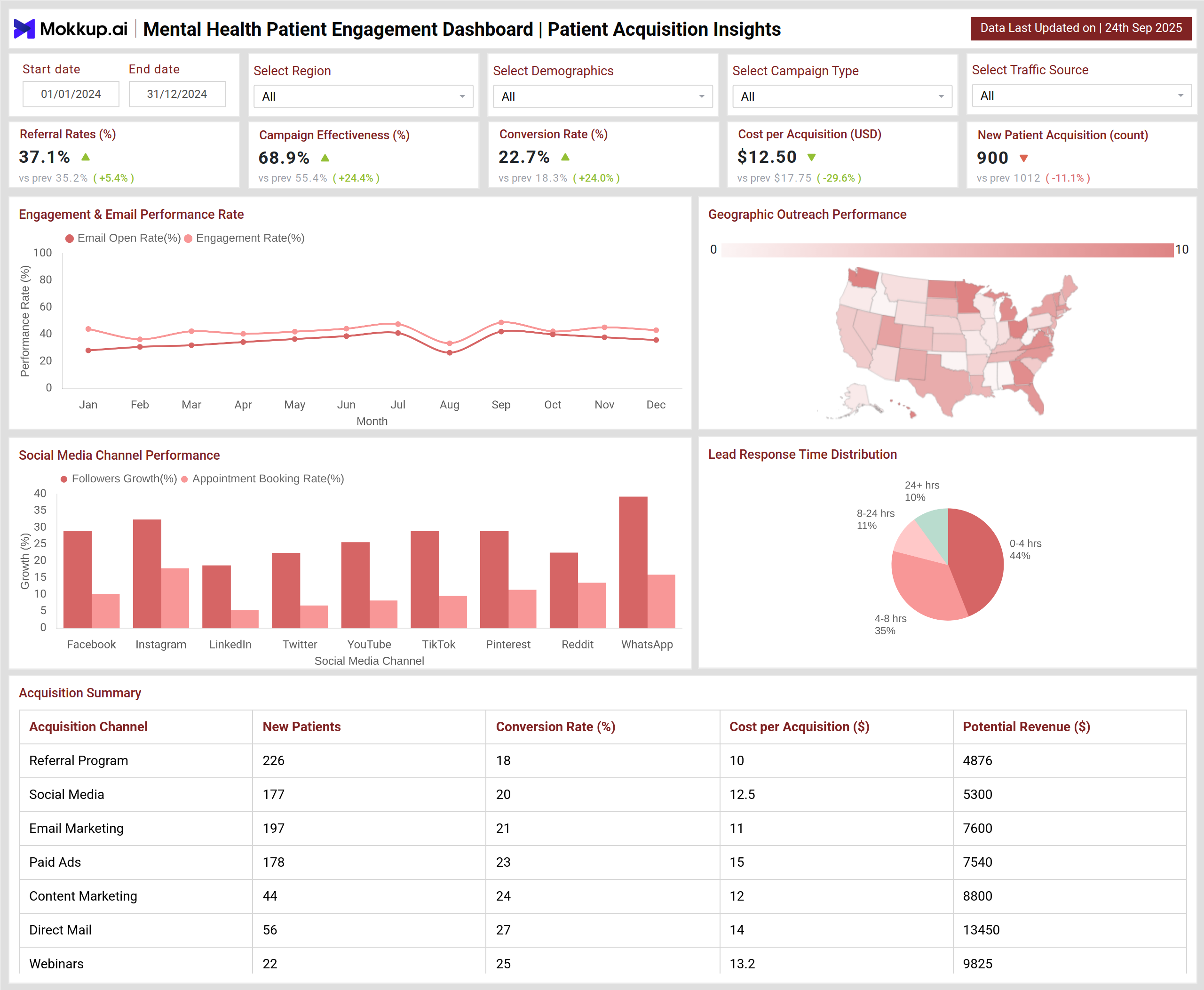
You can create a Mental Health Patient Engagement Dashboard with a mix of KPI tiles and visualizations. At the top, KPI cards track key metrics such as referral conversions, campaign performance, patient acquisition costs, total patients acquired, and retention rates. Alongside, charts show trends in patient engagement, social media interactions versus appointment bookings, response times, and geographic heat maps. This setup works as a Patient Acquisition & Retention Tracker, helping clinics monitor both patient inflow and long-term engagement. Additional visuals like feedback score breakdowns, NPS trends, lifetime value distribution, and campaign ROI give a clear view of retention and loyalty, ensuring clinics get a complete picture of acquisition and ongoing patient satisfaction.
How to Analyze Data in the Dashboard
The dashboard combines real-time insights, historical trends, and predictive analytics. Acting as a Patient Satisfaction and Loyalty Dashboard, it helps clinics monitor both acquisition and engagement outcomes. Steps to analyze data effectively:
- Start with KPIs - Compare metrics like Referral Rates, Patient Retention Rate, and Customer Satisfaction Score to evaluate overall performance.
- Assess Patient Engagement - Track Email Open Rates, Social Media Growth, and Outreach Participation to measure campaign reach.
- Spot High-Impact Areas - Use heat maps to identify regions with the highest patient engagement.
- Track Conversion & Costs - Monitor Cost per Acquisition (CPA) and Conversion Rates to optimize spending.
- Measure Loyalty & Churn - Analyze Repeat Visit Rates, Churn Rate, and Patient Lifetime Value to enhance retention.
- Identify Campaign ROI - Use tree maps and line charts to determine which campaigns are most effective.
Benefits of a Mental Health Patient Engagement Dashboard
- Real-Time Visibility: Quickly track patient acquisition and engagement trends using the Patient Acquisition & Retention Tracker.
- Campaign Effectiveness: Identify which outreach programs deliver the best results with the Outreach Program Dashboard.
- Financial Insights: Optimize CPA and campaign ROI for better budget use.
- Patient Retention: Reduce churn through loyalty tracking and targeted interventions.
- Data-Driven Decisions: Focus resources on high-priority patients and regions.
- Enhanced Trust: Patients experience improved communication and engagement.
KPIs to Track in Mental Health Patient Engagement Dashboard
- Referral Rates (%) - Percentage of new patients acquired via referrals, showing the effectiveness of word-of-mouth campaigns.
- Campaign Effectiveness (%) - Proportion of campaigns meeting target KPIs.
- Conversion Rate (%) - Ratio of leads converted to appointments or registrations.
- Cost per Acquisition (CPA) - Average cost to acquire a new patient, helping optimize marketing spend.
- Patient Retention Rate (%) - Percentage of patients retained over a period, reflecting loyalty.
- Customer Satisfaction Score (CSAT) - Overall patient satisfaction, guiding service improvements.
Frequently Asked Questions
1. How can a Mental health patient engagement dashboard help improve patient acquisition?
It tracks referral rates, conversion rates, and campaign performance to optimize marketing strategies and attract more patients.
2. Who should use a Mental Health Patient Engagement Dashboard?
This dashboard is ideal for clinic administrators, marketing teams, and patient care coordinators who want to monitor acquisition, engagement, and retention effectively.
3. How does this dashboard support patient retention?
By tracking repeat visits, churn rates, and satisfaction scores, clinics can identify at-risk patients and improve loyalty programs.