
What is a Mental Health Compliance & Safety Dashboard?
A Mental Health Compliance & Safety Dashboard is a healthcare monitoring tool designed to track compliance with clinical protocols, patient privacy standards, staff training, and safety incidents. By consolidating multiple compliance and safety KPIs into one platform, it enables clinics to monitor adherence, manage risks, and improve patient care quality.
The mental health compliance and safety dashboard template supports regulatory readiness by aligning staff performance with compliance goals. As a real-time compliance and safety monitoring dashboard, it provides visibility into patient privacy, audit findings, training completion, and incident reporting.
How To Create Mental Health Compliance & Safety Dashboard
You don’t need to build your report from scratch—just start with a ready-to-use Mental health compliance and safety dashboard template from Mokkup. Add in your data and export it however you like. Here’s how to do it:
1. Create or Log in to Your Mokkup Account
Start by signing up on Mokkup.ai using your email. If you already have an account, just log in, and you’ll be good to go.
2. Choose and Customize Your Dashboard Template
Find the Mental Health Compliance & Safety Dashboard template in the Templates section. Use the drag-and-drop editor to adjust KPIs, edit filters, or add elements based on your data.
3. Export to Your BI Tool
Once your dashboard wireframe is ready, use the BI Tool Export feature to send it directly to Power BI or Tableau for further analysis and enhancements. You can also download the dashboard as a PDF, PNG, or JPEG, embed it on a platform, or invite your team to collaborate.
Note: This is a Pro template. You’ll need a Pro subscription on Mokkup to use and customize this dashboard wireframe. Upgrade anytime to unlock full access.
Mental Health Compliance & Safety Dashboard Example
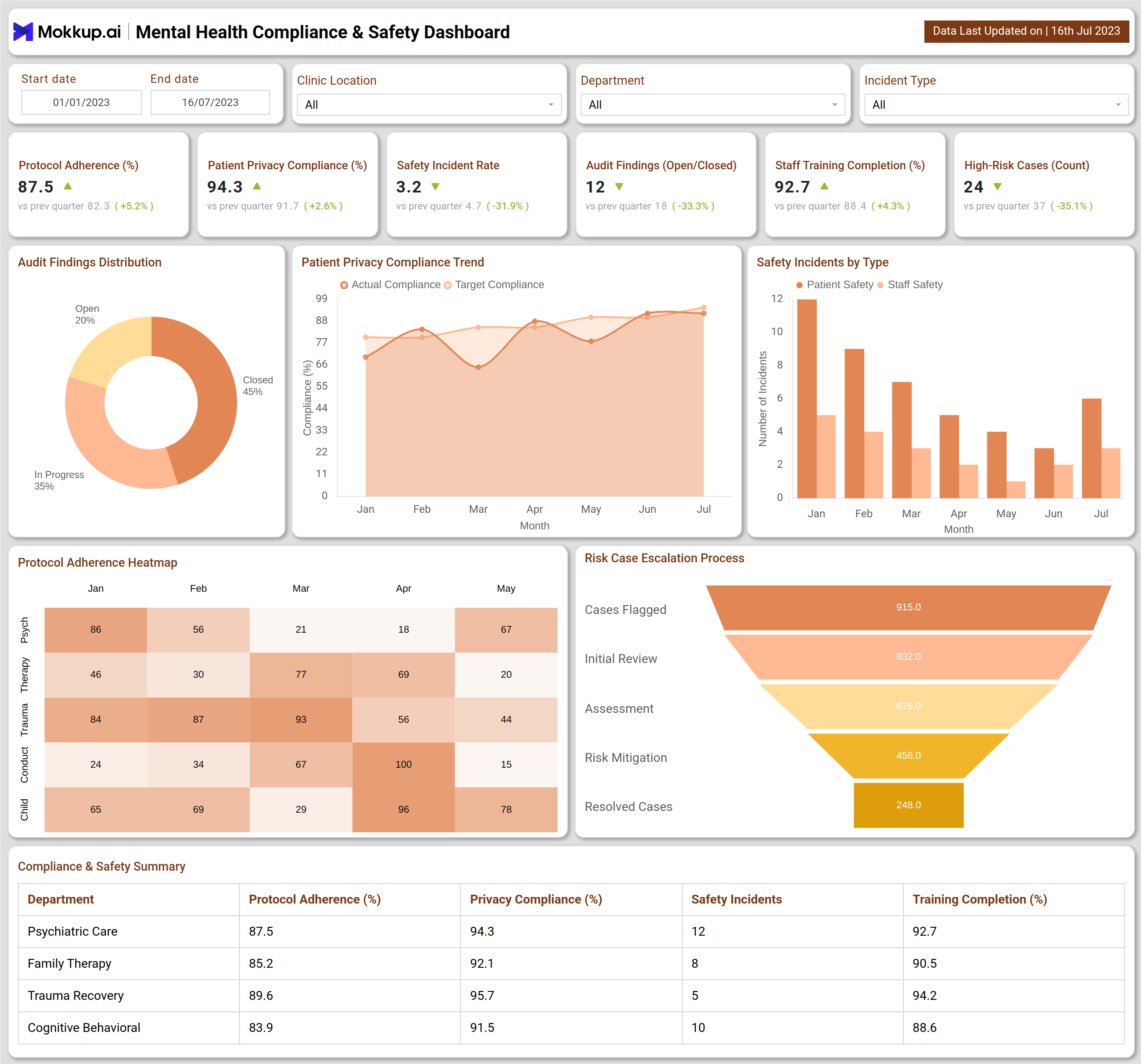
Create your personalized Mental Health Compliance dashboard, bringing all of your compliance analytics into one structured view. At the top, KPIs display protocol adherence, patient privacy compliance, safety incident rate, audit findings, staff training completion, and high-risk cases. These give administrators a quick overview of compliance and safety status.
Charts include an Audit Findings Distribution pie chart, which breaks down cases by open, closed, and in-progress status, and a Patient Privacy Compliance Trend line graph, which compares actual performance against targets. A Safety Incidents by Type bar chart categorizes incidents involving patient safety and staff safety concerns.
The Protocol Adherence Heatmap reveals compliance levels across psychiatry, therapy, trauma recovery, and child counseling departments, while the Risk Case Escalation Process funnel tracks cases from flagging to resolution. Lastly, the Compliance & Safety Summary table provides a department-level breakdown of adherence, privacy compliance, incidents, and training completion.
How to Analyze Data in Mental Health Compliance & Safety Dashboards
To make the most of a mental health compliance and safety dashboard template, administrators should:
- Track Protocol Adherence: Use the real-time compliance and safety monitoring dashboard to ensure departments meet clinical standards.
- Monitor Patient Privacy Compliance: Evaluate how well the organization safeguards patient data and confidentiality.
- Review Safety Incidents: Treat the dashboard as an incident tracking and compliance dashboard to identify frequent safety concerns.
- Assess Audit Findings: Use the dashboard to track open and resolved audits for regulatory reporting.
- Evaluate Training Completion: Ensure staff compliance training is completed on time across departments.
Benefits of Mental Health Compliance & Safety Dashboards
Using a Mental Health Compliance & Safety Dashboard provides multiple benefits:
- Enhanced Compliance: The mental health compliance and safety dashboard template ensures organizations meet regulatory standards.
- Risk Reduction: The real-time compliance and safety monitoring dashboard helps minimize patient and staff safety incidents.
- Data Transparency: Centralized metrics provide clear visibility into compliance performance.
- Stronger Patient Trust: Patient privacy tracking strengthens trust and confidence in care.
- Targeted Improvements: Department-level metrics guide corrective actions for better compliance.
KPIs to Track in Mental Health Compliance & Safety Dashboards
- Protocol Adherence (%) – Measures compliance with clinical guidelines across departments.
- Patient Privacy Compliance (%) – Evaluates how well patient confidentiality and data protection standards are maintained.
- Safety Incident Rate (%) – Tracks the frequency of patient and staff safety incidents.
- Audit Findings (Open/Closed) – Monitors the status of compliance audits and corrective actions.
- Staff Training Completion (%) – Ensures staff are up-to-date with safety and compliance requirements.
Frequently Asked Questions
1.Why is a Mental Health Compliance & Safety Dashboard important?
It provides clinics with visibility into compliance, training, and safety incidents, ensuring regulatory readiness and patient trust.
2. Which organizations benefit most from this dashboard?
Behavioral health centers, psychiatric hospitals, and counseling clinics benefit from a compliance and risk management dashboard.
3. What type of data does a Mental Health Compliance & Safety Dashboard track?
It typically includes information on protocol adherence, patient privacy, safety incidents, audit findings, and staff training completion to help monitor overall compliance and risk.