
What is a Mental Health Clinic Performance Dashboard?
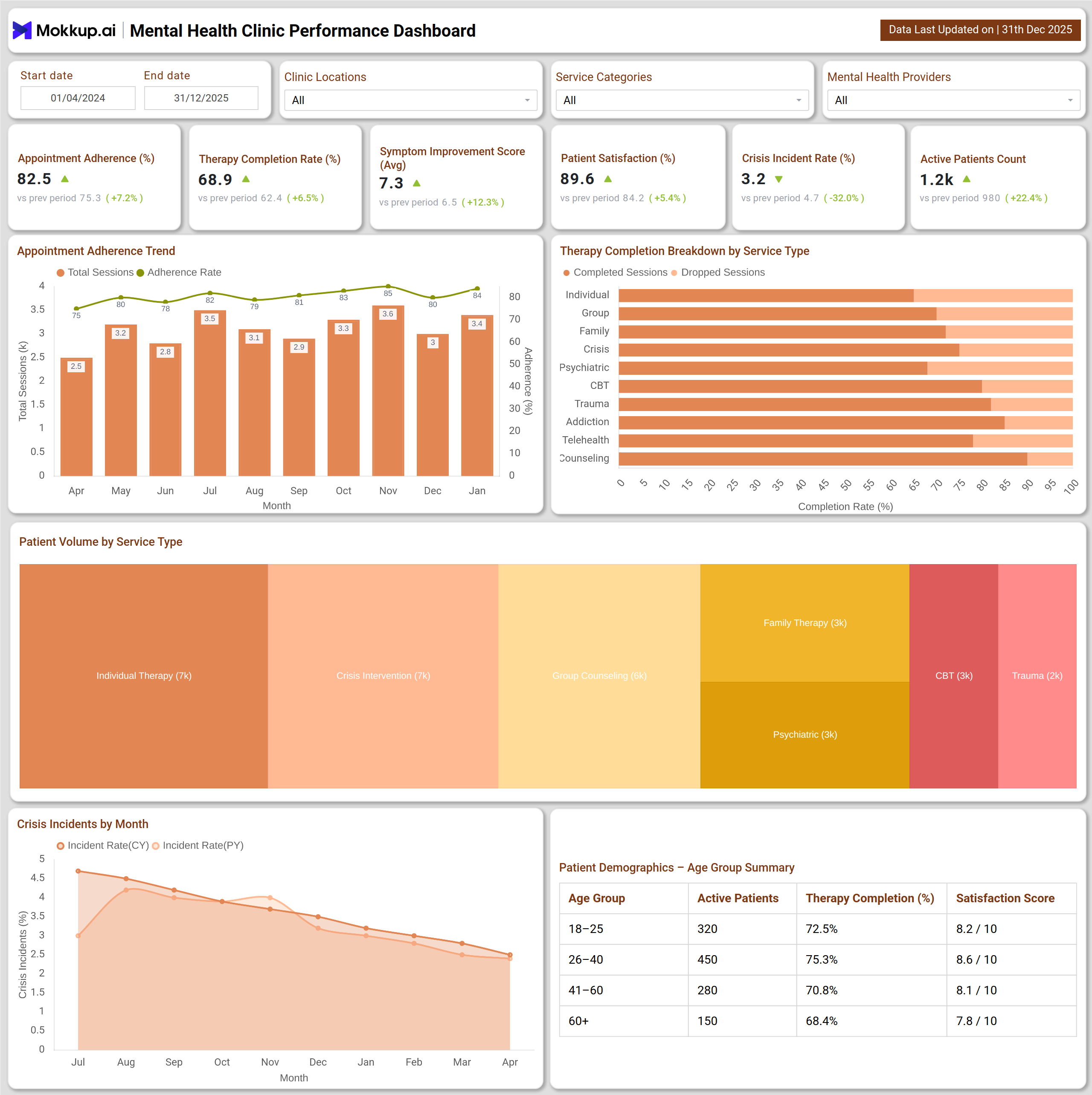
A Mental Health Clinic Performance Dashboard template is a healthcare analytics tool that provides real-time visibility into patient care, therapy outcomes, and service efficiency. It consolidates key KPIs such as appointment adherence, therapy completion rate, symptom improvement scores, patient satisfaction, crisis incident rate, and active patient count. By centralizing data, the mental health clinic performance dashboard template allows healthcare providers to evaluate treatment effectiveness, monitor clinic operations, and identify areas for improvement. As a real-time mental health performance monitoring dashboard, it enables better decision-making to improve patient outcomes and operational efficiency.
How to Create a Mental Health Clinic Performance Dashboard
You don’t need to build your report from scratch—just start with a ready-to-use dashboard Mental Health Clinic Performance dashboard template from Mokkup. Add in your data and export it however you like. Here’s how to do it:
1. Create or Log in to Your Mokkup Account
Start by signing up on Mokkup.ai using your email. If you already have an account, just log in, and you’ll be good to go.
2. Choose and Customize Your Dashboard Template
Find the Mental Health Clinic Performance Dashboard template in the Templates section. Use the drag-and-drop editor to adjust KPIs, edit filters, or add elements based on your data.
3. Export to Your BI Tool
Once your dashboard wireframe is ready, use the BI Tool Export feature to send it directly to Power BI or Tableau for further analysis and enhancements. You can also download the dashboard as a PDF, PNG, or JPEG, embed it on a platform, or invite your team to collaborate.
Note: This is a Pro template. To use and customize this dashboard wireframe, you’ll need a Pro subscription on Mokkup. Upgrade anytime to unlock full access.
Mental Health Clinic Performance Dashboard Example
The Appointment Adherence Trend chart shows how consistently patients attend scheduled sessions. A Therapy Completion Breakdown by Service Type tracks completion and dropout rates across individual therapy, group sessions, family therapy, psychiatric care, telehealth, and other service categories. The Patient Volume by Service Type treemap visualizes which therapies have the highest utilization, offering insights into demand patterns.
Other visuals include the Crisis Incidents by Month trend, which monitors fluctuations in crisis events over time, and the Patient Demographics table, which links active patients to therapy completion and satisfaction scores by age group and therapy type. This mental health performance dashboard wireframe provides clinic leaders with actionable insights into patient outcomes, service demand, and crisis management, supporting data-driven healthcare delivery.
How to Analyze Data in Mental Health Clinic Performance Dashboards
Organizations can use a mental health clinic performance dashboard template by following these steps:
- Track Appointment Adherence: Ensure patients attend scheduled sessions regularly.
- Monitor Therapy Completion Rates: Treat the dashboard as an incident tracking and performance dashboard to identify service types with high dropout rates.
- Evaluate Symptom Improvement: Analyze patient progress across different therapy types using symptom improvement scores.
- Review Patient Satisfaction: Use patient-reported feedback to measure service quality and outcomes.
- Analyze Crisis Incidents: Leverage the real-time mental health performance monitoring dashboard to detect patterns in crisis events and intervene early.
- Segment by Demographics: Compare outcomes across age groups and therapy categories for targeted care improvements.
Benefits of Mental Health Clinic Performance Dashboards
Implementing a Mental Health Clinic Performance Dashboard provides several key benefits:
- Improved Patient Outcomes: Clinics can track symptom improvement and therapy completion across service types.
- Operational Efficiency: The mental health clinic performance dashboard template helps reduce no-shows and improve adherence rates.
- Proactive Crisis Management: An incident tracking and performance dashboard enables early intervention in high-risk cases.
- Enhanced Service Quality: The mental health performance dashboard tracks patient satisfaction to improve care delivery.
- Data-Driven Planning: A real-time mental health performance monitoring dashboard supports better resource allocation and clinic management.
KPIs to Track in Mental Health Clinic Performance Dashboards
Tracking the right KPIs is essential for measuring clinic performance and improving patient care. A mental health clinic dashboard highlights these metrics for better outcomes and efficient operations.
- Appointment Adherence (%): Measures how consistently patients attend scheduled sessions, reducing care gaps.
- Therapy Completion Rate (%): Tracks completion across therapy categories, identifying risks of dropouts or disengagement.
- Symptom Improvement Score (avg): Evaluates patient progress over time, reflecting treatment effectiveness.
- Patient Satisfaction (%): Monitors patient feedback, ensuring quality of care and service experience.
- Crisis Incident Rate (%): Tracks the frequency of crises among patients, supporting early intervention and risk management.
Frequently Asked Questions
Q1. Why is a Mental Health Clinic Performance Dashboard important?
It provides clinics with real-time visibility into patient outcomes, service quality, and operational performance, supporting better care delivery.
Q2. Which types of clinics benefit most from this dashboard?
A mental health performance dashboard would benefit behavioral health centers, psychiatric hospitals, counseling practices, and telehealth providers most.
Q3. Can this dashboard integrate with EHR systems?
Yes. The mental health clinic performance dashboard template can integrate with EHR and practice management systems to ensure seamless data tracking.