
What is a Medical Education Academic Performance Dashboard?
A Medical Education Academic Performance Dashboard is a data visualization tool used by medical schools and research institutions to monitor and analyze student outcomes. It provides a clear view of academic progress, performance trends, and institutional effectiveness. This academic performance dashboard for medical students consolidates key information, including pass rates, graduation rates, remediation patterns, and research participation, into a single platform.
By using a medical education performance analytics dashboard, administrators and faculty can assess how students are performing across courses, cohorts, and departments. It supports evidence-based decision-making by presenting real-time academic insights. For educators, this tool helps identify struggling students early, track competency development, and ensure alignment with accreditation standards. For leadership teams, it provides a transparent view of institutional academic performance and educational quality.
This data-driven dashboard for medical student outcomes helps academic leaders continuously monitor student success and institutional effectiveness
How to Create a Medical Education Academic Performance Dashboard
You don’t need to build your report from scratch—just start with a ready-to-use dashboard template from Mokkup. Add in your data and export it however you like. Here’s how to do it:
1. Create or Log in to Your Mokkup Account
Start by signing up on Mokkup.ai using your email. If you already have an account, just log in, and you’ll be good to go.
2. Choose and Customize Your Dashboard Template
Find the Medical Education Academic Performance Dashboard template in the Templates section. Use the drag-and-drop editor to adjust KPIs, edit filters, or add elements based on your data.
3. Export to Your BI Tool
Once your dashboard wireframe is ready, use the BI Tool Export feature to send it directly to Power BI or Tableau for further analysis and enhancements. You can also download the dashboard as a PDF, PNG, or JPEG, embed it on a platform, or invite your team to collaborate.
Note: This is a Pro template. You’ll need a Pro subscription on Mokkup to use and customize this dashboard wireframe. Upgrade anytime to unlock full access.
Medical Education Academic Performance Dashboard Example
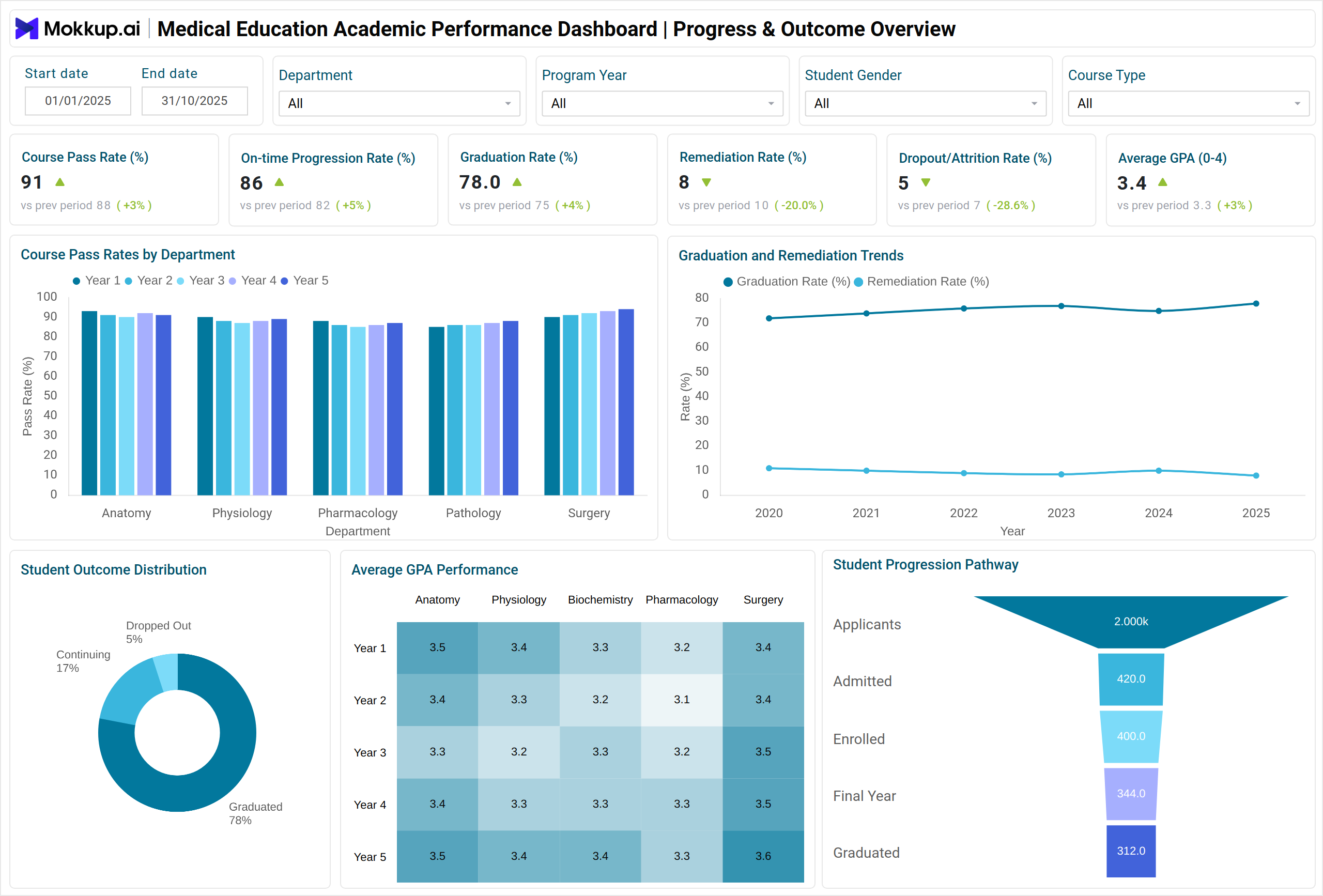
A well-designed academic progress tracking system for medical schools includes both academic and research-focused metrics. For instance, the dashboard displays a Stacked Column Chart showing pass rates across courses and departments. Faculty can quickly identify which departments maintain consistently high academic success. Another visual, the Line Chart for Graduation and Remediation Trends, reveals how cohorts perform over multiple academic years, showing where improvement or intervention is needed.
The Funnel Chart highlights the student progression pipeline — from admission to graduation — helping educators pinpoint stages where attrition occurs. A Waterfall Chart breaks down how factors like course completion, attendance, and research participation contribute to graduation outcomes. Other visuals, such as a Heatmap for student performance by course and term, a Donut Chart for research participation, and a Gauge Chart for course evaluation scores, provide valuable multidimensional insights. Collectively, these visuals make the student assessment and evaluation dashboard an essential academic management tool for healthcare institutions.
How to Analyze Data in Medical Education Academic Performance Dashboards
Healthcare providers can leverage the Medical Education Academic Performance dashboard template by:
- Monitor course success: Track module-wise pass rates and department-level performance to identify areas needing academic support.
- Review progression patterns: Use graduation, remediation, and dropout trends to assess academic program efficiency.
- Assess research engagement: Analyze student research participation and publication trends to evaluate scholarly activity levels.
- Correlate outcomes: Link attendance, remediation, and participation data with graduation success for targeted interventions.
- Evaluate teaching quality: Use course evaluation scores and feedback analytics to improve instructional quality.
- Track professionalism metrics: Review behavioral incident trends to enhance professional conduct standards.
Benefits of Medical Education Academic Performance Dashboards
These are the benefits of using the Medical Education Academic Performance Dashboards:
- Centralized academic insights: Consolidates student performance, research, and professionalism data in one system.
- Data-driven decision-making: Supports evidence-based academic planning and continuous quality improvement.
- Early intervention support: Identifies at-risk students through real-time academic trend monitoring.
- Improved program outcomes: Helps institutions boost graduation rates and minimize remediation cycles.
- Enhanced transparency: Provides clear visibility of departmental and cohort-level performance metrics.
- Accreditation readiness: Aligns performance tracking with accreditation requirements and institutional benchmarks.
- Performance monitoring: As a performance monitoring tool for medical education institutions, the dashboard ensures continuous improvement across academic programs through data-driven tracking and reporting.
KPIs to Track in Medical Education Academic Performance Dashboards
The key KPIs in Medical Education Academic Performance Dashboard include:
- Course/Module Pass Rate (%): Measures student success in individual courses or modules.
- On-Time Progression Rate (%): Tracks students advancing through the curriculum without delays.
- Graduation Rate (%): Shows the percentage of students completing the program successfully.
- Remediation Rate (%): Identifies students needing repeated coursework or support.
- Time-to-Graduation (Years): Measures average duration for degree completion.
- Dropout/Attrition Rate (%): Indicates student retention and program continuity.
- Student Research Participation Rate (%): Reflects engagement in scholarly or clinical research.
Frequently Asked Questions
Q1. Who uses a Medical Education Academic Performance Dashboard?
Academic deans, program directors, faculty, and institutional research teams use it to evaluate student and program performance.
Q2. How does this dashboard help in identifying struggling students?
By analyzing performance trends and remediation rates, the dashboard highlights students at risk of underperforming, enabling timely academic support.
Q3. How often should academic dashboards be updated?
Ideally, data should refresh automatically or at least once per academic term to maintain accuracy.