
What is an LNG Tariff & Contract Compliance Dashboard?
An LNG tariff and contract compliance dashboard is a data analytics tool used by natural gas utilities and LNG operators to monitor tariff adherence, contract obligations, and billing accuracy across LNG facilities. LNG terminals operate under regulated tariff structures and long-term commercial contracts that define pricing, access rights, storage capacity, and regasification services. An LNG tariff compliance monitoring dashboard consolidates tariff rules, contract data, and billing transactions into a centralized system for LNG tariff compliance monitoring. This helps utilities ensure that LNG services are billed in accordance with approved tariffs and contractual agreements. The platform also functions as an LNG contract compliance analytics dashboard, providing visibility into tariff deviations, contract disputes, and revenue performance. By converting commercial data into measurable KPIs, organizations can strengthen tariff governance, reduce billing errors, and maintain regulatory transparency across LNG operations.
How to Create LNG Tariff & Contract Compliance Dashboard
You don’t need to build your report from scratch; just start with a ready-to-use dashboard template from Mokkup. Add in your data and export it however you like. Here’s how to do it:
1. Create or Log in to Your Mokkup Account
Start by signing up on Mokkup.ai using your email. If you already have an account, just log in, and you’ll be good to go.
2. Choose and Customize Your Dashboard Template
Find the LNG Tariff & Contract Compliance Dashboard template in the Templates section. Use the drag-and-drop editor to adjust KPIs, edit filters, or add elements based on your data.
3. Export to Your BI Tool
Once your dashboard wireframe is ready, use the BI Tool Export feature to send it directly to Power BI or Tableau for further analysis and enhancements. You can also download the dashboard as a PDF, PNG, or JPEG, embed it on a platform, or invite your team to collaborate.
Note: This is a Pro template. You’ll need a Pro subscription on Mokkup to use and customize this dashboard wireframe. Upgrade anytime to unlock full access.
LNG Tariff & Contract Compliance Dashboard Example
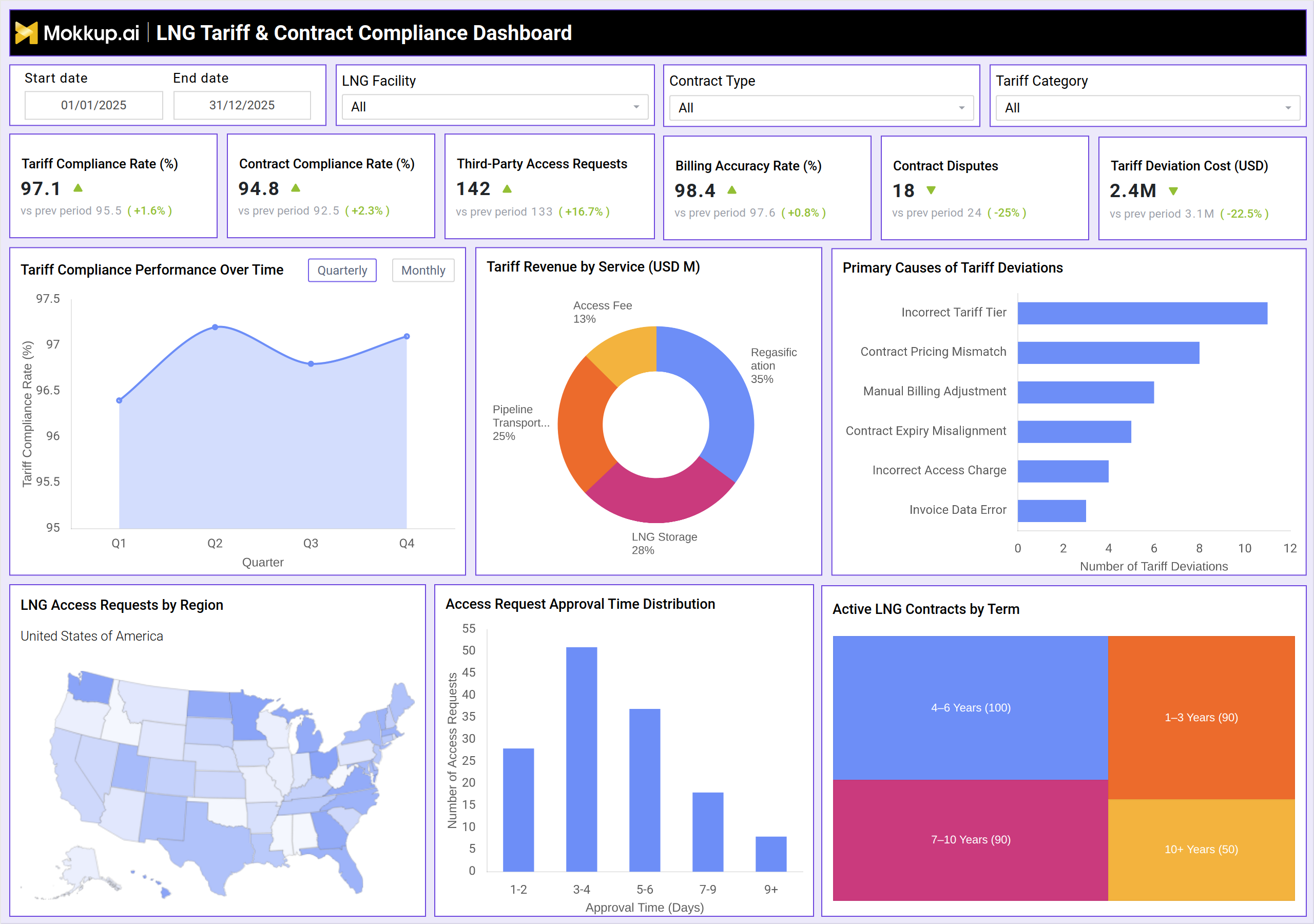
A natural gas utility operating multiple LNG terminals must manage tariff regulations and commercial contracts across services, including regasification, LNG storage, and pipeline transportation. Monitoring these agreements manually often leads to billing inconsistencies and compliance risks. An LNG terminal tariff and contract management dashboard provides a centralized view of tariff and contract compliance rates, billing accuracy, and third-party access requests. Commercial teams can quickly identify whether tariff rules are applied correctly and whether contract obligations are being fulfilled. The dashboard also identifies common causes of tariff deviations, such as incorrect tariff tiers, contract pricing mismatches, invoice data errors, or manual billing adjustments. Using an LNG tariff regulatory compliance tracking dashboard, operators can detect revenue leakage and address compliance gaps early. Revenue insights across LNG services help utilities understand tariff-regulated revenue performance. These insights support better contract governance and ensure LNG operations remain aligned with regulatory tariff requirements.
How to Analyze Data in LNG Tariff & Contract Compliance Dashboard
Here is how you can analyze data from this distribution utility asset health performance dashboard:
- Review Tariff Compliance Rate: Evaluate whether tariff rules are applied correctly across LNG services.
- Analyze Contract Compliance Rate: Determine whether contractual obligations are consistently being met.
- Examine Billing Accuracy Rate: Identify invoicing errors or incorrect tariff calculations affecting billing accuracy.
- Track Third-Party Access Requests: Monitor demand for LNG terminal capacity through third-party access requests.
- Investigate Contract Disputes: Analyze disputes to identify areas of commercial conflict or tariff misinterpretation.
- Review Tariff Deviation Costs: Assess the financial impact of tariff misalignment across LNG services.
- Analyze Tariff Compliance Trends: Study compliance trends over time to detect operational or billing issues.
- Study Tariff Revenue Distribution: Evaluate how tariff revenue is distributed across services such as regasification, LNG storage, and pipeline transportation.
- Examine Causes of Tariff Deviations: Identify operational or billing process gaps that lead to tariff deviations.
- Evaluate LNG Access Approval Time: Assess the efficiency of contract approvals by tracking the time required for LNG access requests.
Benefits of LNG Tariff & Contract Compliance Dashboard
The following are the benefits of using this dashboard:
- Provide Centralized Tariff and Contract Visibility: Offer a unified view of LNG tariff structures and contract performance across facilities.
- Improve Tariff Compliance Monitoring: Track tariff adherence across LNG operations to ensure regulatory compliance.
- Reduce Revenue Leakage: Identify billing errors and tariff deviations that may cause financial losses.
- Enhance Contract Management Transparency: Improve visibility into LNG contract management and commercial governance processes.
- Support Regulatory Reporting: Facilitate accurate reporting related to LNG tariff structures and regulatory requirements.
- Detect Contract Disputes Early: Help utilities identify and resolve contract disputes more quickly.
- Improve Billing Accuracy: Ensure invoicing accuracy across LNG commercial operations.
- Enable Data-Driven Contract Negotiations: Use performance data to support informed LNG contract negotiation decisions.
- Strengthen Tariff Compliance: Ensure adherence to regulated tariff frameworks across LNG services.
- Align Commercial Operations with Regulations: Maintain consistency between commercial practices and regulatory tariff requirements.
KPIs to Track in LNG Tariff & Contract Compliance Dashboard
The following key KPIs can be tracked by using this dashboard:
- Tariff compliance rate (%) – Measures the percentage of LNG transactions correctly billed according to tariff structures.
- Contract compliance rate (%) – Indicates how effectively LNG services meet contractual terms and conditions.
- Third-party access requests – Number of external requests for LNG terminal capacity access.
- Billing accuracy rate (%) – Percentage of invoices generated without tariff or contract pricing errors.
- Contract disputes – Total number of active disputes related to LNG tariffs or contract interpretation.
- Tariff deviation cost (USD) – Financial impact caused by incorrect tariff application or billing adjustments.
- Tariff compliance trend – Changes in tariff adherence across reporting periods.
- Tariff revenue by service – Revenue generated from services such as regasification, LNG storage, and pipeline transportation.
- Tariff deviation root causes – Operational or billing issues responsible for tariff misalignment.
- Access request approval time – Average time required to approve LNG access requests.
- Active contracts by term – Distribution of LNG contracts based on duration categories.
- Regional LNG access demand – Geographic distribution of LNG terminal access requests.
Frequently Asked Questions
1. What is an LNG tariff and contract compliance dashboard?
It is a monitoring platform that tracks tariff adherence, contract obligations, billing accuracy, and commercial performance across LNG facilities.
2. Who uses an LNG tariff compliance monitoring dashboard?
Commercial operations teams, contract managers, regulatory compliance officers, and finance teams in LNG utilities use it.
3. Why is tariff compliance important for LNG terminals?
Tariffs regulate how LNG services such as storage, regasification, and transportation are priced. Incorrect tariff application can lead to regulatory penalties and revenue losses.