
What is a Clinical Operations & Maternity Dashboard?
A Clinical Operations & Maternity Dashboard is a specialized data visualization tool used in mother and child care centers to track, analyze, and optimize key metrics related to pregnancy, labor, delivery, and newborn care. It collects vital data from clinical operations such as deliveries, patient outcomes, and workflow efficiency.
How to Create a Clinical Operations & Maternity Dashboard
You don’t need to build your report from scratch—just start with a ready-to-use dashboard template from Mokkup. Add in your data and export it however you like. Here’s how to do it:
1. Create or Log in to Your Mokkup Account
Start by signing up on Mokkup.ai using your email. If you already have an account, just log in, and you’ll be good to go.
2. Choose and Customize Your Dashboard Template
Find the Clinical Operations & Maternity Dashboard template in the Templates section. Use the drag-and-drop editor to adjust KPIs, edit filters, or add elements based on your data.
3. Export to Your BI Tool
Once your dashboard wireframe is ready, use the BI Tool Export feature to send it directly to Power BI or Tableau for further analysis and enhancements. You can also download the dashboard as a PDF, PNG, or JPEG, embed it on a platform, or invite your team to collaborate.
Note: This is a Pro template. You’ll need a Pro subscription on Mokkup to use and customize this dashboard wireframe. Upgrade anytime to unlock full access.
Clinical Operations & Maternity Dashboard Example
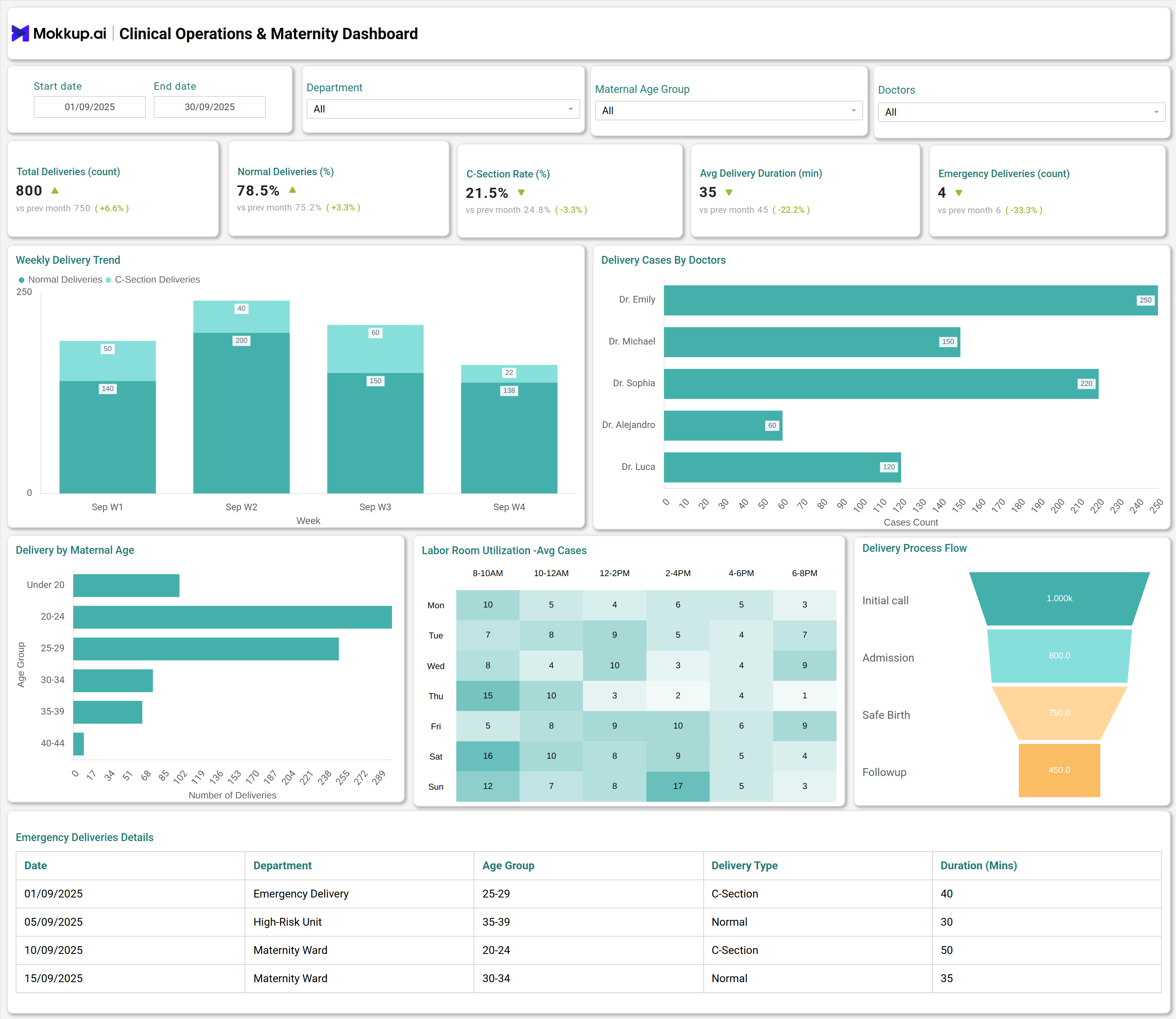
A robust Clinical Operations & Maternity Dashboard displays aggregated live data on total deliveries, normal vs. cesarean deliveries, emergency cases, and average delivery duration. It provides breakdowns by maternal age group, department, and healthcare provider, along with visualizations of delivery trends, labor room utilization, and emergency delivery details. The dashboard template supports pregnancy and birth data dashboard requirements and newborn care dashboard reporting. Users leverage this template to swiftly analyze outcomes, manage operational resources, and enhance patient safety protocols.
How to Analyze Data in Clinical Operations & Maternity Dashboards
- Review total delivery volumes and assess trends over time.
- Monitor normal vs. cesarean section rates for quality benchmarking.
- Evaluate emergency delivery rates and response efficiency.
- Analyze average delivery duration to identify workflow bottlenecks.
- Track performance by provider and department for targeted improvements.
- Segment data by maternal age group to identify risk patterns.
- Use funnel and heatmap visualizations for process and time-based insights.
Benefits of Clinical Operations & Maternity Dashboards
- Centralizes maternity metrics for optimal resource planning.
- Improves care quality by surfacing clinical performance trends.
- Enables rapid response to emergency delivery cases.
- Supports compliance and risk management initiatives in childbirth care.
- Enhances patient safety through real-time data monitoring.
- Facilitates benchmarking against industry standards.
- Streamlines documentation for audits and regulatory needs.
KPIs to Track in Clinical Operations & Maternity Dashboards
- Total Deliveries: Tracks the number of births over time.
- Normal Deliveries: Measures the rate of standard childbirths.
- C-Section Rate: Monitors the frequency of cesarean procedures.
- Avg Delivery Duration: Calculates the average time for labor and birth.
- Emergency Deliveries: Flags urgent delivery incidents for review.
- Delivery by Maternal Age: Breaks down outcomes by patient age groups.
Frequently Asked Questions
1. Who should use a Clinical Operations & Maternity Dashboard?
Maternity centers, delivery wards, and clinical management teams benefit most, especially where centralized monitoring improves operational oversight.
2. How does a maternity dashboard help reduce risk?
The dashboard enables early detection of abnormal patterns, helping prevent adverse events and improving quality assurance.
3. Which birth outcome metrics are most important for clinical quality?
Normal delivery rates, C-section frequencies, and emergency incidents are key for clinical benchmarking and compliance.