
Accurately evaluating market size is essential for businesses as it determines investor interest, strategic planning, and long-term profitability. When businesses have a clear idea of the potential of their market, investors are more willing to support them.
Furthermore, having a clear understanding of market size helps organizations avoid errors, develop well-informed plans, and match their efforts to the dynamics of the real market.
Consider a tech startup entering the cybersecurity sector. By carefully examining the number of businesses vulnerable to cyber threats and the market share held by existing solutions, the startup can adjust its approach.
This understanding guides decisions on product development, pricing, and marketing strategies, positioning the business for success in a rapidly evolving and competitive cybersecurity landscape.
To put it simply, market size is more than just a theoretical quantity—it is a useful guide for companies navigating the complex dynamics of the industry.
Table of Contents
- What is Market Sizing and Why Does it Matter?
- Approaches to Estimate The Market Size
- What Does TAM, SAM, & SOM Stand For?
- 5 Steps for Calculating the Market Size
What is Market Sizing and Why Does it Matter?
Market sizing involves analyzing the prospective customer base and potential revenue or sales for a product or service in a particular market. While this practice is essential for all businesses, it holds particular significance for startups and entrepreneurs in their early stages, offering a valuable overview of their potential market share.
1. Startup Significance:
Important for startups lacking primary data, delivering an early assessment of potential market share. It helps individuals to traverse the complexities of the industry and make informed choices.
2. Data Collection Process:
It involves collecting data from primary and secondary sources. While secondary sources include information gathered from other sources, primary sources offer unique, first-hand knowledge.
3. Sources of Market Research:
It makes use of a range of sources, including government data, competitors' public records, and independent primary research.
4. Insights from Market Sizing:
It provides valuable information on the overall market size and worth, characteristics of the desired customer base, primary rivals, investment choices, ongoing market patterns, and the range of products or services available.
5. Inexact Nature:
The market sizing process involves making assumptions about the sector, industry, and product or service. It's not a precise research; when additional market data is obtained, assumptions must be continuously reviewed and refined.
6. Navigational Pillar for Business Strategy:
Although being uncertain, it provides a fundamental stage for enterprises. And also helps with strategic decision-making and offers a structure for upcoming data-driven modifications.
Importance of Market Sizing
All businesses must conduct market research in order to gain an in-depth understanding of the needs of their target audience and develop strategies for effectively providing goods and services.
At the same time, figuring out a market's size is an essential first step in evaluating a market's investment potential and the viability of your products. This data becomes invaluable when seeking finance, allowing investors insights into the market's profit potential and scalability.
Market sizing research is particularly important for startups and early-stage business owners. It directs strategic decisions on organizational design, product development, marketing strategy, and distribution channels in addition to providing insights into product offerings.
By taking a complete strategy, organizations may effectively go through the complex economic landscape and make well-informed decisions that lead to long-term success.
Approaches to Estimate The Market Size
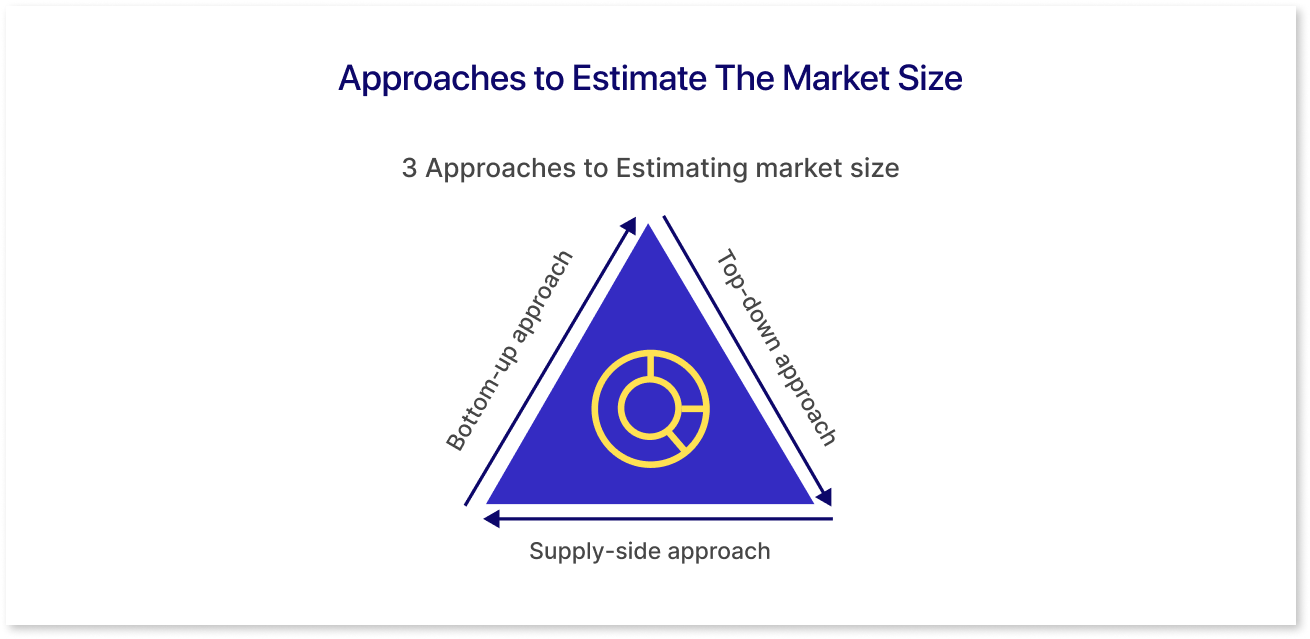
1. Top-down Approach
A strategic method to market sizing known as "top-down analysis" begins with a broad estimate of the total demand for a good or service. By dividing the initial estimate into individual components, this approach offers a formal framework for understanding market dynamics.
Top-down analysis sets up the structure for a more comprehensive look by starting with a wide view, usually the entire market size. This allows data to be refined depending on set parameters in the market sizing process.
Example:
In estimating smartphone demand for a country, a top-down analysis begins with the national population, determining smartphone users based on broad trends. This initial estimate is refined by dividing users according to factors like age, income, and geography.
2. Bottom-Up Approach
The bottom-up method, in contrast to top-down analysis, is a systematic approach to market sizing that begins with minute details and gradually develops into an overall estimate of market demand. With this approach, demand is determined by applying usage assumptions to particular metrics or data that are closely related to the good or service under consideration.
Unlike the broad perspective of top-down analysis, the bottom-up approach delves into particular consumption-related data points to obtain a thorough understanding of the market.
Example:
For the same smartphone market, a bottom-up analysis starts with specific data points, such as the number of users in a city. Demand per user is then calculated by usage estimates, and these numbers are then combined across regions to provide a thorough market estimate.
3. Supply-Side Approach
A supply-side approach in market analysis focuses on understanding and evaluating the production and supply elements within a market. Unlike demand-side analysis, which looks at customer behavior and preferences, supply-side analysis focuses on the factors influencing businesses, producers, and suppliers.
Example:
Analyzing the automotive industry from a supply-side perspective involves assessing production capacities, industry utilization rates, and supply chain efficiency. Factors such as manufacturing plants, technological developments, and regulatory impacts are considered to measure the industry's ability to meet market demand effectively.
What Does TAM, SAM, & SOM Stand For?
There are three terminologies that define different segments of your possible target market size: Total Addressable Market (TAM), Serviceable Addressable Market (SAM), and Serviceable Obtainable Market (SOM). These ideas help identify the particular segment of the market that is most likely to buy your goods or service.
1. Total Addressable Market (TAM):
- TAM represents the entire potential market for a product or service.
- It is the total demand that exists for a particular product in a specific industry or market.
2. Serviceable Addressable Market (SAM):
- SAM narrows down the TAM to the portion of the market that a business can realistically serve.
- It considers factors such as geography, demographics, or specific customer needs that make a segment attainable and functional.
3. Serviceable Obtainable Market (SOM):
- The aim is further tailored by SOM to the specific market share that a business can reasonably anticipate to get within the SAM.
- To determine the attainable share of the serviceable market, it considers the company's capabilities, the level of competition, and the possibility of market approval.
To put it simply, TAM offers an extensive view, SAM narrows it down to a realistic goal, and SOM focuses on the market share that can be achieved within the particular sector. These concepts are crucial for businesses to strategically approach their target audience and allocate resources effectively.
How to Effectively Present TAM, SAM, and SOM in a Pitch or Presentation?
Effectively presenting TAM, SAM, and SOM in a pitch or presentation is essential for conveying the market potential and the strategic positioning of your company. Here's a structured approach you can follow:
1. Start with TAM:
- Define the Market Size: Clearly describe the total addressable market, highlighting the vast potential your product or service offers.
- Support with Data: Use relevant industry trends, statistics, and market research to support your TAM estimation. This creates the general structure of the business you own.
2. Transition to SAM:
- Specify Serviceable Segments: Narrow down the focus to the serviceable addressable market. Target particular market segments that align with your product or service.
- Explain Reachability Factors: Talk about the reasons these segments can be reached, taking into account aspects like location, population, or particular requirements that make them accessible.
3. Conclude with SOM:
- Detail Achievable Market Share: Make a move to the serviceable obtainable market and describe the specific market share that your company might realistically be interested in gaining.
- Factors Influencing SOM: Explain the factors influencing your potential market share, such as competitive analysis, your business capabilities, and actual market adoption rates.
4. Visual Representation:
- Use Graphics: Using charts, graphs, and other visual representations improves the communication of complex market segments. These visuals provide a clear overview, helping in a more effective understanding of the diverse audience. Platforms like Mokkup.ai can further streamline this process by offering tools to create dynamic dashboards and a variety of other visual elements for accurate market representation.
- Comparison: Think about comparing the relative sizes of TAM, SAM, and SOM visually. This may help interested parties in understanding the scope and importance.
5. Address Questions Proactively:
- Anticipate Concerns: Address potential questions or concerns that may arise. Be prepared to explain the assumptions and the approach used in your market sizing.
- Highlight Growth Opportunities: Emphasize growth opportunities within SAM and SOM to highlight the flexibility of your business.
6. Storytelling and Impact:
- Craft a Narrative: Build a narrative around TAM, SAM, and SOM to make the information memorable and impactful.
- Connect to Business Goals: Point out how capturing the defined SOM adds to the success of your business by creating a clear connection between these market segments and your entire business goals.
By systematically presenting TAM, SAM, and SOM, you provide a thorough view of your market strategy, demonstrating a deep understanding of the market landscape and a clear path for your business's growth.
5 Steps for Calculating the Market Size
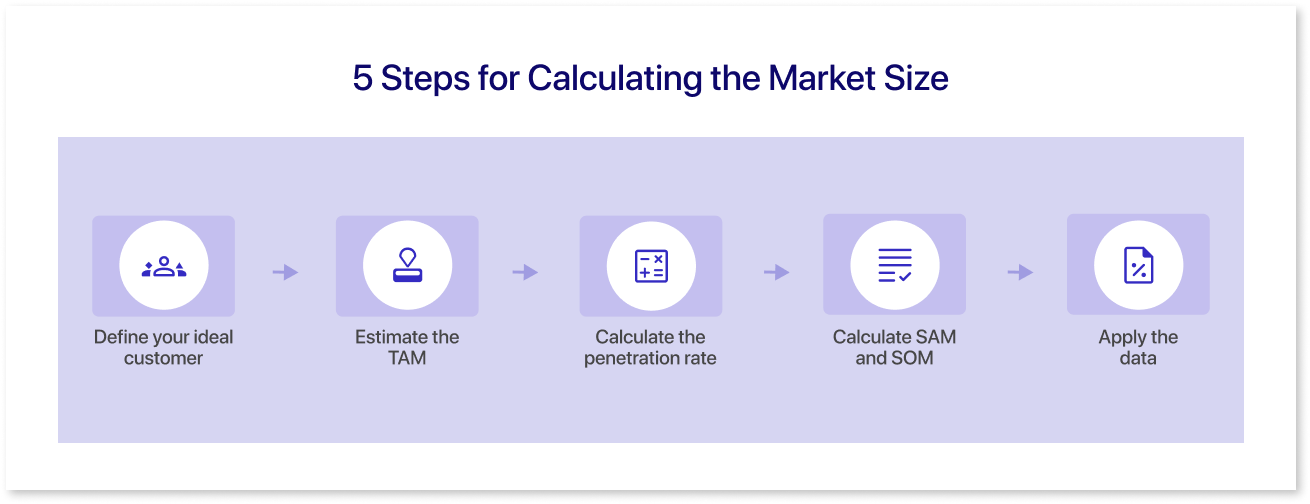
Determining the market size is essential when making strategic business choices. It involves figuring out a market's overall value, which is essential for allocating resources and seeing potential for growth. <source>
1. Identifying the Target Audience
For any new business, identifying the ideal customer is a foundational step. This essential information shapes every aspect of your business, from product design and marketing strategy to distribution channels and customer service. Your ideal customer is the one whose problems your product or service aims to solve. Understanding their needs and thought processes is key.
2. Determining the TAM
Start by determining the total potential market for your product or service in order to estimate the Total Addressable Market (TAM). TAM is the highest possible revenue potential when there are no rivals or limitations on the market.
3. Assessing Penetration Rate
Analyzing the penetration rate is essential to figuring out how much of the Total Addressable Market (TAM) your company can take. This means identifying the proportion of the TAM that your good or service can actually draw in and achieve.
4. Estimate Serviceable Market Size and Obtainable Share (SAM & SOM)
Attempting to target the entire Total Addressable Market (TAM) might be impractical for many companies. The logical solution is to focus on calculating the volume and value of your Serviceable Available Market, or SAM. These calculations provide you an estimate of the market share that your business can potentially achieve.
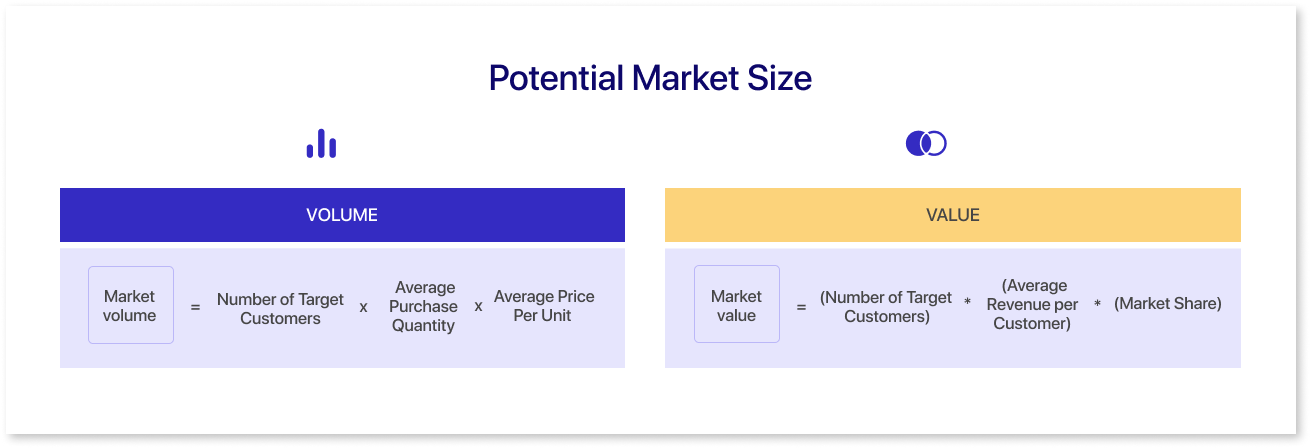
To determine the market size, multiply the penetration rate by the total number of potential customers. The cost is then determined by multiplying the market volume by the estimated average value per sale.
Example: For a software business with 100,000 potential users, assuming 20% adoption, they expect to have 20,000 users. The SAM value equals $2,000,000 if the average value of each transaction is $100.
5. Implement the Insights
Determine the size of your market to help shape business plans and draw in funding. Because market sizing processes are necessarily imperfect, it is important to frequently reevaluate assumptions. Remember that, particularly for startups and emerging technologies, the market size ranges from early adopters to those who are behind.
Example: In the case of the United States electric vehicle market, recognizing that the market size includes both early adopters in eco-conscious cities and slow adopters in more traditional regions is essential for a detailed strategy development.
Conclusion
In conclusion, using both top-down and bottom-up market sizing approaches is essential for gaining a comprehensive understanding of the market opportunity. Top-down market sizing provides a broad perspective, helping identify the overall customer base and number of potential customers. Meanwhile, bottom-up market sizing refines the analysis, allowing businesses to pinpoint specific segments and tailor strategies to effectively sell their products.
Informed decision-making is based on a combination of market size data obtained from these methodologies, which guarantees businesses can strategically navigate and take advantage of the variety of opportunities inside their target markets.
Prompt it. Wireframe it with Mokkup.ai.