In SaaS, the software model hosts apps in the cloud and provides them to customers online. SaaS allows users to access apps online without needing to download them on each device, unlike traditional software models. By letting people and companies subscribe to software, the SaaS approach provides a solution that is both flexible and affordable.
KPIs are like a map for SaaS companies to reach goals and meet customer standards. SaaS companies can track their success, make choices based on data, and improve their plans by understanding and evaluating KPIs. By looking at different measures and signs, businesses can figure out their operations' strengths, flaws, chances, and threats. This knowledge is important for responding to changes in the market and bringing customer satisfaction.
Table of Content
- What are KPIs?
- The Significance of KPIs in the SaaS environment
- Critical KPIs in a Saas Company
- Customized KPIs for Specific SaaS Companies
- Crafting Targeted KPIs for SaaS Success
- Implementing KPIs in a SaaS Company
- Final Thoughts
What are KPIs?
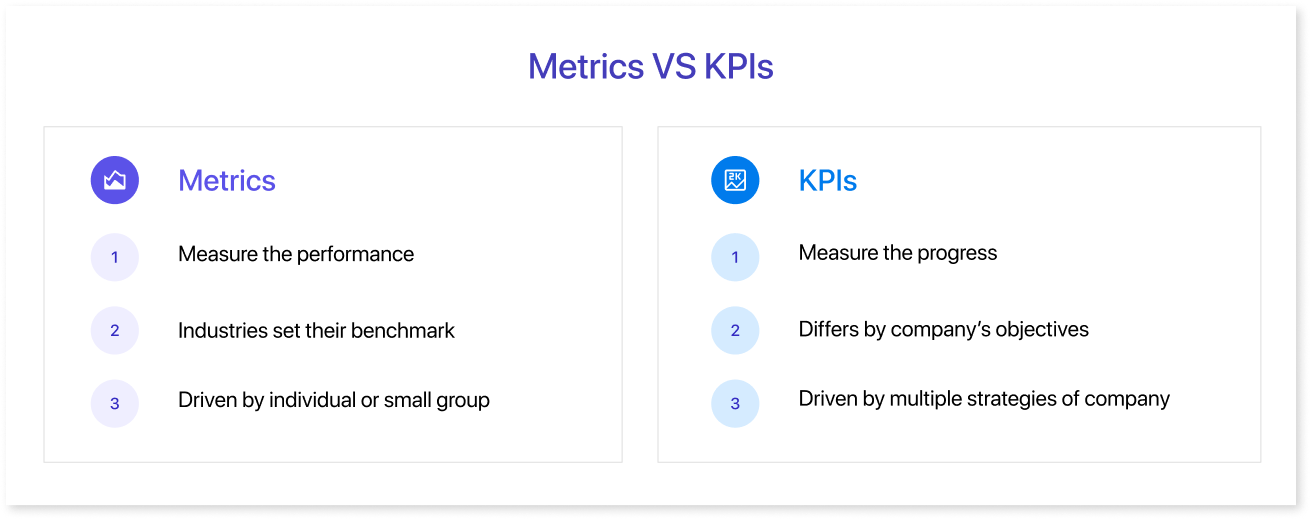
Key Performance Indicators
A set of quantifiable measurements used to gauge a company's overall long-term performance.
Consider the contrast between Company A, who used KPIs to guide their success, and Company B, who did not. Because Company A could quickly modify plans based on data insights, its cautious navigation resulted in wealth and delighted customers.
In contrast, Company B had greater difficulties and sporadic interruptions in customer satisfaction because it lacked a clear direction from KPIs. This emphasizes the critical part KPIs play in directing firms and ensuring a smooth voyage through the market's always-shifting waters.
KPIs measure customer engagement, product performance, financial stability, and operational effectiveness in Software as a Service (SaaS). They help measure and evaluate different parts of a SaaS company's operations, aiding in planning and decision-making.
The Significance of KPIs in the SaaS environment
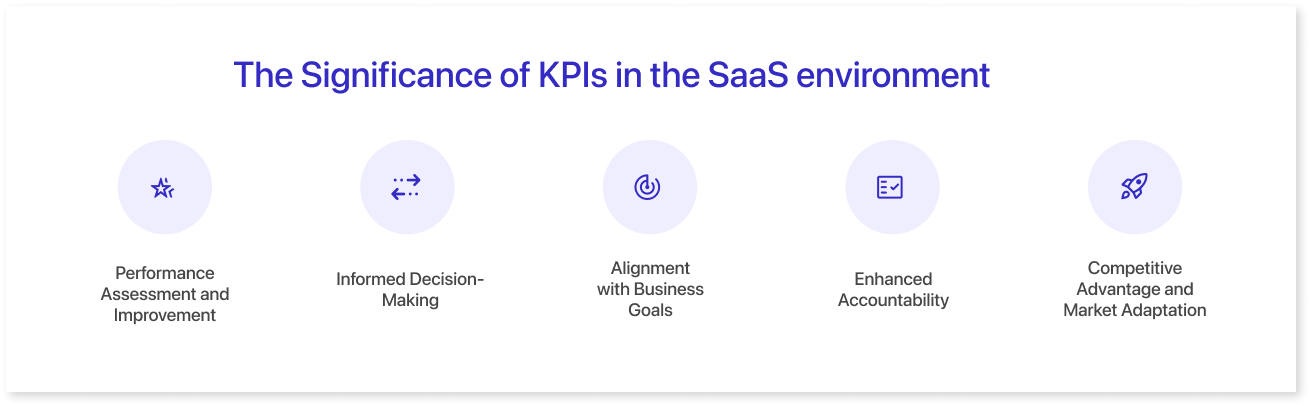
- Performance Assessment and Improvement: KPIs pinpoint strengths and weaknesses, driving focused improvements in critical areas like customer acquisition and SAAS user engagement metrics.
- Informed Decision-Making: KPIs empower decision-makers with data-driven insights, providing vital decisions in pricing, product features, and marketing strategies.
- Alignment with Business Goals: KPIs align daily operations with organizational objectives, fostering motivation and commitment to achieving success.
- Enhanced Accountability: Clear KPIs instill accountability, encouraging teams to meet performance expectations and take ownership of their roles.
- Competitive Advantage and Market Adaptation: Understanding KPIs helps SaaS companies anticipate market shifts, enabling proactive adaptation and maintaining a competitive edge.
Critical KPIs in a Saas Company
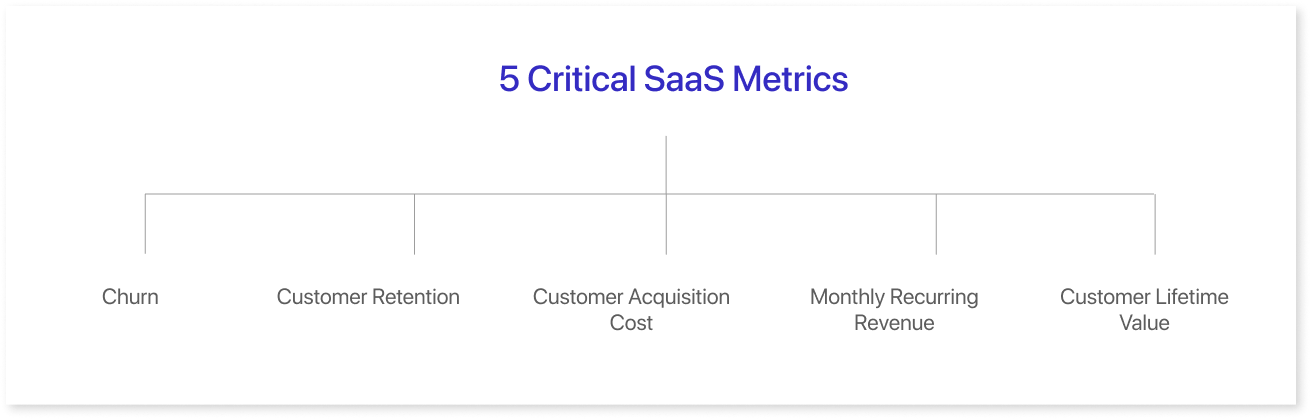
In a Software as a Service (SaaS) company, monitoring and evaluating performance through Key Performance Indicators (KPIs) is vital for growth, sustainability, and customer satisfaction. Here, we delve into some of the most critical KPIs for a SaaS business.
Customer Acquisition Cost (CAC)
Customer acquisition cost (CAC) represents the amount a company spends to acquire a new customer. It's a fundamental KPI because it directly impacts profitability and growth. A lower CAC indicates a more efficient customer acquisition process.
- Significance: It influences resource allocation, helps mitigate churn, and informs product development by revealing customer preferences, ultimately enhancing profitability and growth.
- How to Calculate: You can calculate CAC by summing up all the costs associated with acquiring customers (e.g., marketing and sales expenses) over a specific period and then dividing it by the number of customers acquired during that period.
- Formula: Customer Acquisition Cost = Cost of Sales and Marketing divided by the Number of New Customers Acquired.
- Interpretation and Analysis: Monitoring CAC over time allows a SaaS company to assess the efficiency and effectiveness of its marketing and sales strategies. A rising CAC may indicate inefficiencies or increased competition, necessitating strategic adjustments.
Customer Lifetime Value (CLV)
Customer lifetime value (CLV) is the estimated profit a company can make from a customer over their entire relationship. It's an important measure that helps understand customer value and make informed marketing and sales decisions.
- Significance: As a KPI, CLV provides insights into the long-term value of customers, guiding strategic marketing and sales decisions. Calculation methods vary, including average purchase value, frequency, and lifespan estimates, with variations accounting for customer segments and discount rates. Analyzing CLV is pivotal for SaaS companies, allowing tailored strategies that enhance customer retention and value, fostering sustainable business growth.
- Calculating CLV & its Variations: One can calculate CLV using various methods, but a simple approach involves estimating the average purchase value, purchase frequency, and customer lifespan. Different variations consider factors like customer segments and discount rates.
- Analyzing CLV: Analyzing CLV enables a SaaS company to tailor its marketing and product strategies to maximize saas retention metrics and increase customer value, ultimately leading to sustainable business growth.
Churn Rate
The churn rate represents the percentage of customers who leave a service during a certain time period. It's a critical KPI because it directly impacts a SaaS company's revenue and growth potential.
- Significance: Reduced revenue, eroded customer trust, and higher acquisition expenses are the results of a high churn rate. To reduce customer loss, keep customers, and achieve long-term success, it is important to use strategies. These strategies should involve customer feedback, improve products, and offer good customer service.
- Reasons and Consequences of a High Churn Rate: A high churn rate could be due to various reasons, such as poor product fit, inadequate customer support, or market competition. Consequences include reduced revenue, decreased customer trust, and additional customer acquisition costs.
- Strategies to Reduce the Churn Rate: Implementing customer feedback mechanisms, improving product features, and providing exceptional customer support are key strategies to reduce churn and retain customers, ultimately leading to sustainable growth.
Monthly Recurring Revenue (MRR)
Monthly recurring revenue (MRR) is the predictable revenue a SaaS company expects to receive every month from subscriptions. It's a fundamental KPI for assessing revenue stability and predicting future revenue streams.
- Significance: It offers a clear view of revenue streams and financial health, aiding informed decision-making to enhance business stability and growth. By using MRR and its variations, companies can understand subscription patterns and make strategies to increase their revenue.
- Calculating MRR & Its Variants: You calculate MRR by summing up the revenue generated from all active subscriptions within a month. Variants include new MRR, expansion MRR, contraction MRR, and churned MRR.
- Analyzing MRR: Tracking MRR growth and analyzing its components provide insights into the company's financial health, helping to make informed decisions to drive business growth and stability.
Customer Retention
Last but not least, a key component of every successful Software as a Service (SaaS) business is customer retention. Frequently, it is less expensive and more lucrative to keep current clients than to continually seek out new ones. It's an important measure in the SaaS industry as it shows how satisfied and valuable your product or service is.
Importance of Customer Retention as a KPI
- Cost-effectiveness: Acquiring new customers is more expensive than retaining existing ones. Focusing on customer retention can significantly reduce acquisition costs and increase revenue.
- Stability and predictability: A strong base of retained customers provides stability and predictability in your revenue streams, making it easier to forecast and plan for the future. Happy customers are more likely to recommend your product to others, becoming brand advocates and helping your business grow naturally.
- Feedback and Improvement: Retained customers frequently offer valuable feedback, enabling you to enhance your product or service and ultimately improve the customer journey.
Customized KPIs for Specific SaaS Companies
To successfully monitor and track progress, SaaS onboarding metrics must develop customized SAAS key performance indicators (KPIs). Particularly in the varied SaaS company market, one size does not fit all. KPIs need to match a SaaS company's goals, services, and model to ensure performance evaluations align with the company's strategic goals.
It's important to constantly measure KPIs and metrics in the SAAS industry. To create a SAAS metrics dashboard, begin with a Mokkup wireframe. It has ready-made templates and includes important KPIs for your company's success. To learn more, click here.
Crafting Targeted KPIs for SaaS Success
Developing KPIs that are in tune with a company's distinct goals and product offerings is crucial in the SaaS industry. The measurements will align with the goals of the SaaS company, thanks to a personalized approach to key performance indicators. It requires an in-depth knowledge of the specific needs of the firm, market dynamics, and long-term goals.
A SaaS company focused on getting more users quickly would look at customer acquisition cost (CAC) and SAAS conversion rate. A company focused on customer satisfaction would focus on customer net promoter score (NPS) and customer retention rate. This personalized performance measurement method offers a clear evaluation framework. It also helps allocate resources and efforts according to the company's growth path.
Every type of SaaS business needs specific metrics that show industry standards and user actions for certain KPIs. For instance, indicators like the average order value (AOV) and cart abandonment rate are very important in the e-commerce SaaS industry for data analysis of consumer behavior and improving the shopping experience.
On the other hand, KPIs like patient engagement rate and compliance rate with regulatory standards provide information on the efficacy of healthcare solutions and compliance with industry-specific rules in the healthcare SaaS market. By customizing KPIs, SaaS firms can better understand their operations, make smart choices, and ultimately succeed in their market.
Implementing KPIs in a SaaS Company
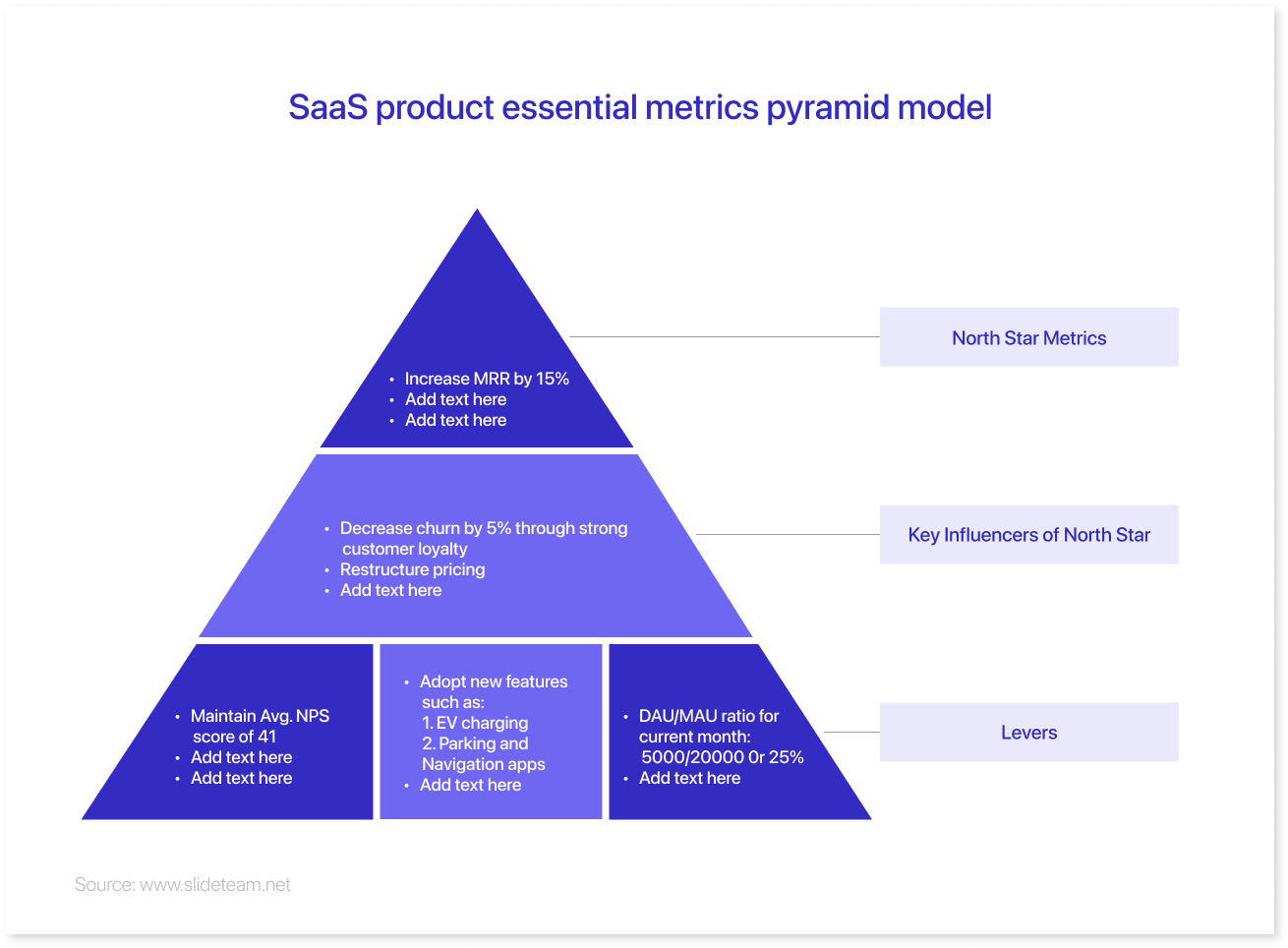
The SaaS product critical metrics pyramid model is a strategy framework. It boosts the performance of a Software as a Service (SaaS) product. The "North Star Metrics" are the main goal or indicator of success for a product and its benefits. These metrics capture the heart of what makes the SaaS solution successful.
The "Key Influencers," which include secondary measurements or activities that significantly affect reaching the North Star measurements, have a direct influence on the North Star Metrics. Achieving the intended results depends on comprehending and maximizing these factors.
"Levers" are elements that one can modify or utilize to positively impact significant individuals and primary objectives. The pyramid situates these levers lower. SaaS teams can focus on the metrics pyramid to prioritize and optimize efforts for success and growth.
KPI implementation is essential in a SaaS company for tracking and boosting the operation's efficiency and success. This process includes project ownership, objective definition, roll-out strategy development, adoption promotion and monitoring, and business effects evaluation and optimization.
Setting Up Project Management:
A clear definition of project management is a prerequisite for starting KPI implementation. Designate a specific group or person to be in charge of managing the KPI effort.
Goal-setting and developing an implementation strategy:
Establish measurable objectives that are in line with the overall strategy and vision of the business. These objectives must be quantifiable, time-limited, and related to the KPIs. Create a thorough roll-out strategy that details the actions, deadlines, resources, and roles necessary to properly execute the KPIs.
Promoting and monitoring adoption:
It's important to explain the benefits of using KPIs to everyone in order to encourage their use throughout the company. Train teams on KPIs and their role in firm success through sessions and workshops, providing necessary resources. Encourage a culture where teams proactively utilize and interact with KPIs in their day-to-day operations. Keep tabs on adoption rates and provide teams with continuous help to make sure they comprehend and use the KPIs properly.
Impact Measurement and Optimization for Business:
To monitor and evaluate the performance of KPIs, create a solid measurement framework. Analyze data points to see how KPIs affect different parts of the business, like revenue, client satisfaction, and efficiency. On the basis of the knowledge gathered from the KPI data, identify areas that need improvement and optimization. Improve the KPIs' efficiency in promoting organizational goals and company progress by continuously modifying and adapting the KPIs' tactics.
Final Thoughts
Key Performance Indicators (KPIs) help SaaS companies grow by allowing data-driven decision-making and assessing performance against objectives. SaaS organizations should adopt a KPI-focused approach to monitor outcomes, connect operations with strategic goals, and promote continuous improvement.
KPIs assist companies in adapting, growing, and succeeding in the fast-paced and competitive SaaS industry. They achieve this by meeting market needs and staying focused on their mission. To learn more, click here.
Prompt it. Wireframe it with Mokkup.ai.