
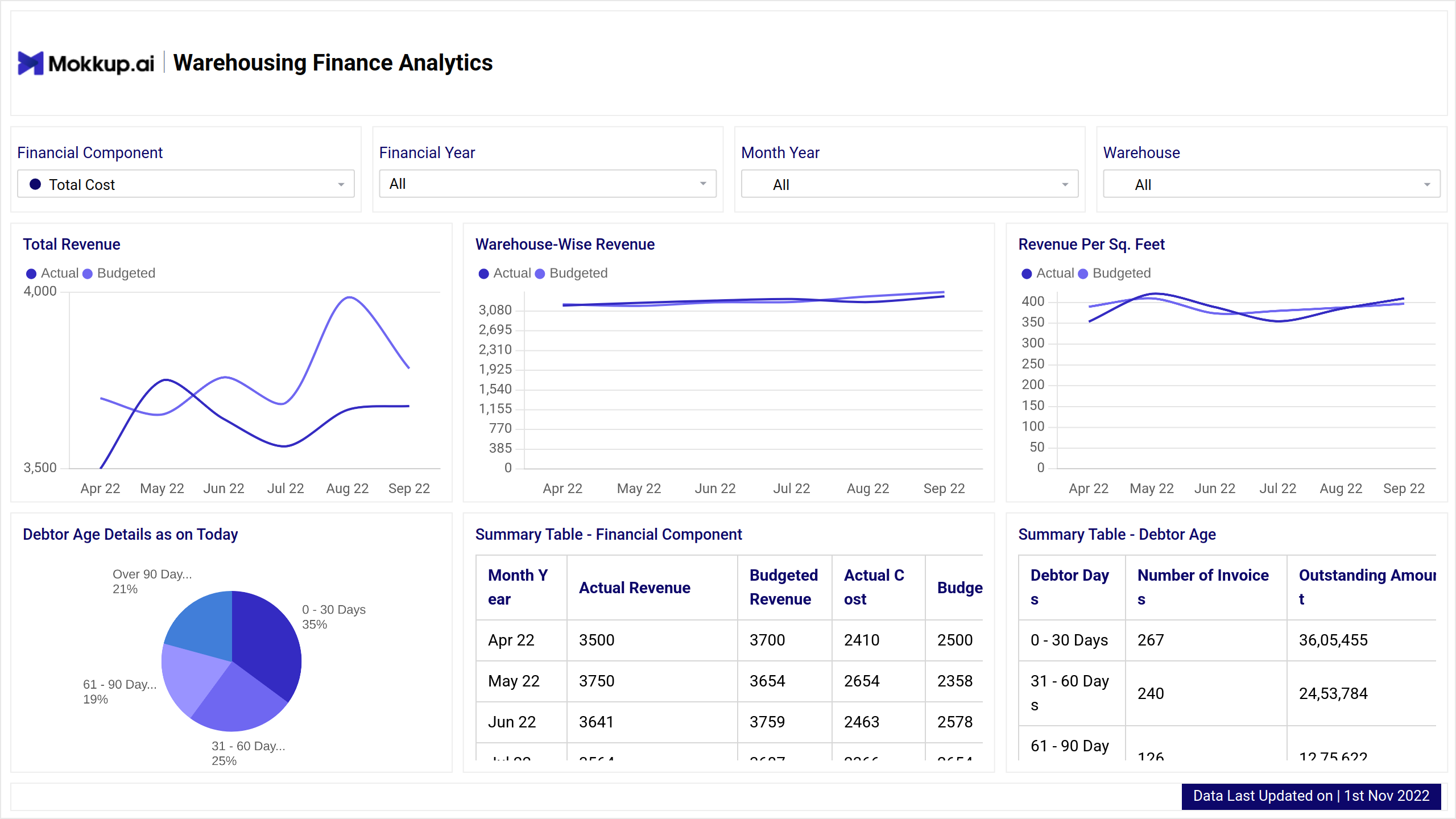
The Warehousing Finance Analytics Dashboard template provides detailed insights into various financial aspects of warehousing operations. It offers a thorough overview of key financial metrics such as revenue, costs, profitability, and cash flow specific to warehousing activities. It enables warehousing companies to monitor financial performance, identify cost-saving opportunities, and optimize revenue streams.
Key Terms to Know
- Total Revenue: Provides an overview of the total revenue generated by warehousing operations, comparing actual figures to budgeted values to assess financial performance.
- Warehouse-wise Revenue: Breaks down revenue figures by individual warehouses, enabling analysis of revenue generation across different locations and identifying high-performing or underperforming facilities.
- Revenue per Sq. Feet: Calculates revenue metrics on a per square feet basis, offering insights into the efficiency of space utilization and revenue generation potential of each warehouse.
- Debtor Age Details: Presents details on debtor age as of the current date, categorizing outstanding debts into different age brackets to track payment timelines and assess financial risk.
- Financial Components and Debtor Age Tables: Provides consolidated summaries of financial components such as costs, profits, and debtor age data such as outstanding amounts, invoices, etc., facilitating easy comparison and analysis of key financial metrics.
These components collectively offer a comprehensive view of the financial health of warehousing operations, enabling stakeholders to make informed decisions and implement strategies to drive profitability and financial stability.
Dashboard Template Insights
The dashboard wireframe offers a comprehensive view of revenue generation, debtor management, and financial performance.
- Analysis of total revenue, warehouse-wise revenue, and revenue per square foot provides valuable insights into revenue generation patterns and the efficiency of space utilization across warehouses. By breaking down revenue figures by individual warehouses and calculating revenue on a per square foot basis, businesses can identify high-performing locations and areas where space utilization can be improved.
- Understanding debtor age details helps in managing accounts receivable effectively, identifying overdue payments, and minimizing financial risks associated with outstanding debts. By categorizing outstanding debts into different age brackets, the dashboard enables businesses to track payment timelines and take proactive measures to ensure timely collections.
- Summary tables for financial components and debtor age offer a consolidated view of key metrics, enabling stakeholders to assess financial performance at a glance and make data-driven decisions. These summary tables provide an easy-to-understand snapshot of financial health, facilitating quick analysis and comparison of costs, profits, and outstanding debts.
Conclusion
The Warehousing Finance Analytics Dashboard template offers comprehensive insights into financial aspects of warehousing operations, empowering stakeholders to optimize revenue generation, manage accounts receivable efficiently, and mitigate financial risks.
By leveraging the detailed financial metrics provided by this dashboard wireframe, warehousing companies can enhance their financial performance, identify cost-saving opportunities, and implement strategies to achieve long-term profitability and stability.