
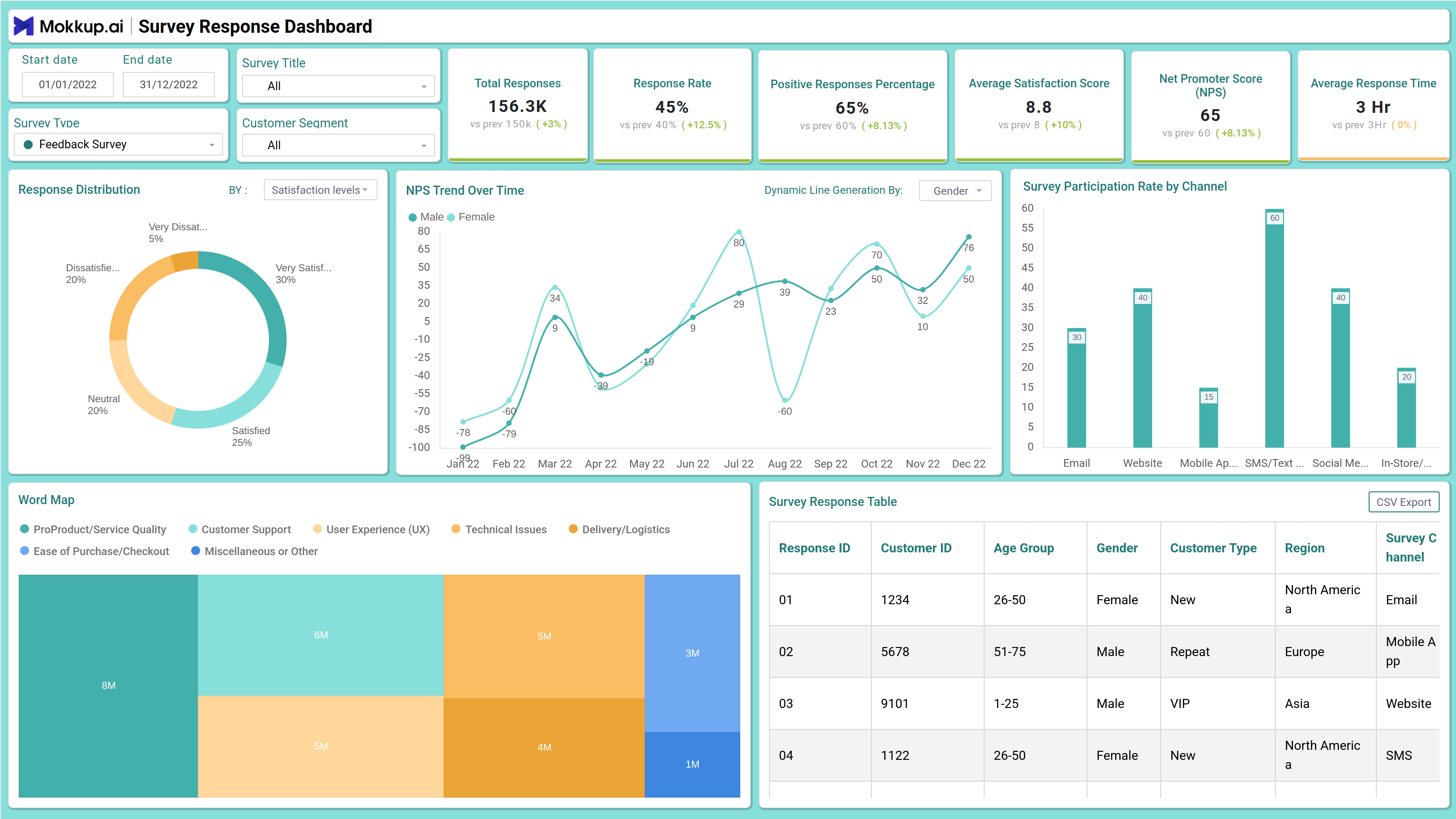
Survey Response Dashboard template provides insights into survey responses across different customer segments, channels, and time periods. It helps track key metrics like response rate, NPS, satisfaction scores, and feedback themes. The interactive visuals allow filtering by demographics, survey type, and participation channels to identify trends and areas for improvement.
Key Terms to Know
- Total Responses: Count of all survey responses.
- Response Rate: Percentage of surveys completed versus sent.
- Positive Response Percentage: Ratio of positive responses to total responses.
- Average Satisfaction Score: Mean satisfaction score across responses.
- Net Promoter Score (NPS): Measures customer loyalty.
- Average Response Time: Average time taken to complete the survey.
- Response Distribution: Shows distribution of responses, with a drop-down to filter by gender, age group, satisfaction score, and region.
- NPS Trend Over Time: Tracks changes in NPS over time, with drop-downs for gender, age group, region, customer segment, and all.
- Survey Participation Rate by Channel: Displays survey responses per channel, including email, website, mobile app, social media, and in-store surveys.
- Survey Response Table: A detailed table containing response ID, customer ID, age group, gender, channel, and additional details.
Dashboard Template Insights
Here are the key insights the dashboard wireframe provides:
- Visualizes survey results to show response distribution, helping identify patterns and trends.
- Tracks participation rates to assess overall survey effectiveness and respondent involvement.
- Highlights positive, neutral, and negative feedback for a quick understanding of public perception.
- Compares different question groups or demographics to uncover key insights for improvement.
Conclusion
This dashboard wireframe helps analyze collected feedback by presenting key insights in a clear format. It simplifies response tracking, identifies trends, and highlights areas for improvement. Structured data visualization enables better decision-making and enhances the effectiveness of survey-driven strategies.