
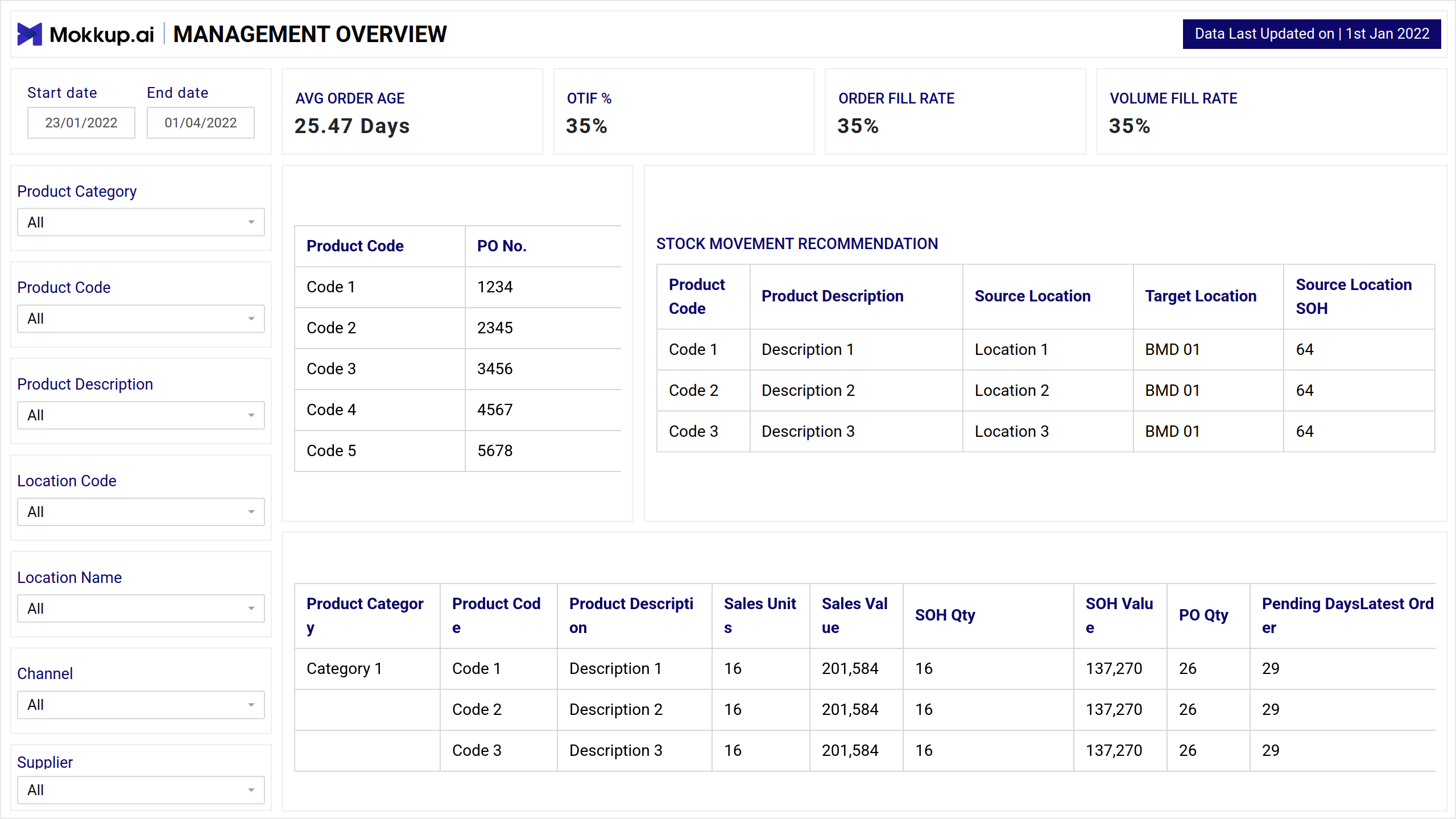
The Management Overview dashboard template helps identify the inventory status across the entire enterprise and assists in moving the inventory between the locations. This is crucial because it helps identify the available inventory, how soon businesses can fill their coffers, and the order fill rates. It can be used to achieve the following:
- Savings in costs
- Clear tracking of the stock movement
- Measuring vendor effectiveness, including vendor fulfillment success rate
- Inter-location stock movement
- Enterprise planning for OTIF, Order fulfillment rate, and age of inventory
Key Terms to Know:
- Average Order Age: The average time it takes for the business to sell off its inventory. It is calculated by dividing the inventory value by COGS and multiplying it by 365
- OTIF: It stands for On-Time, In-Full. This metric tracks whether the vendors can fulfill the order in full on time. This is a crucial metric because it tracks the vendor's performance, which, in turn, affects the production
- Order Fill Rate: It stands for the percentage of orders that the currently available stock can immediately fulfill. It affects customer satisfaction, retention, and the enterprise's ability to plan fulfillment
- Volume Fill Rate: It stands for the volume of orders that can be fulfilled by the available stock and how close the business has come to shipping the orders on time.
Dashboard Template Insights
The dashboard wireframe provides critical insights to enhance inventory management and operational efficiency:
- It offers a comprehensive view of inventory status across the entire enterprise, facilitating efficient management and movement between locations.
- Cost savings are achieved by tracking stock movement and vendor effectiveness, allowing businesses to identify opportunities to reduce costs and optimize inventory management processes.
- Vendor Performance Tracking includes metrics like OTIF (On-Time In-Full) and Order Fill Rate, enabling businesses to measure vendor effectiveness and ensure timely, complete order fulfillment, which enhances customer satisfaction.
- Inter-location stock movement allows businesses to track and manage the movement of stock between different locations, ensuring optimal inventory distribution and availability across the enterprise.
- Enterprise planning is supported by metrics such as Average Order Age, OTIF, and Order Fill Rate, helping businesses optimize order fulfillment, minimize inventory aging, and improve overall operational efficiency.
Conclusion
Stock management helps businesses optimize warehousing, storage, procurement, and movement costs. Since raw materials are the second highest cost for any business, saving here could result in significant savings for a business.