
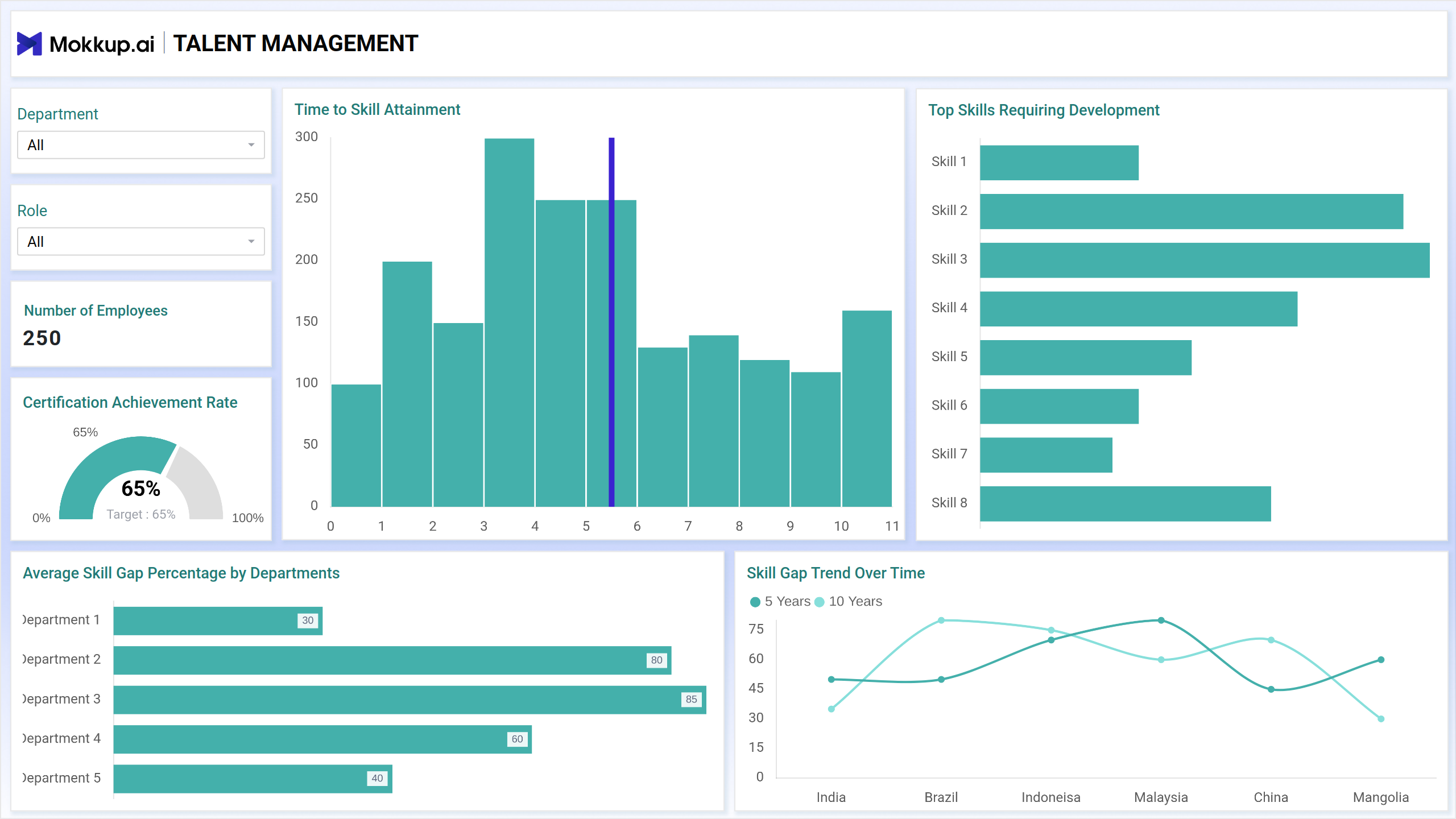
The talent management dashboard template gives an overview on the skill gap analysis and organization’s health. It offers insights into skill gap analysis, highlighting areas where there is a disparity between the skills required for roles and those possessed by employees.
The dashboard wireframe comprises three screens: Skill Gap, Succession Planning (Overview), & Succession Planning (Developmental Progress); each is explained briefly below.
Skill Gap
This view gives information on the overall number of workers, the time it takes to learn a skill, the most in-demand skills, the percentage of average skill gaps by department, and the trend of skill gaps over time. Skills gaps can be calculated using this formula.
Skill Gap = Required Skill Level − Current Skill Level
Skill Gap Percentage = ( Skill Gap/Required Skill level)*100%
Key Terms:
- Department: Categorizes employees based on their respective departments, facilitating targeted analysis and intervention strategies.
- Number of employees: Quantifies the total count of employees within each department or role, providing insights into workforce size and distribution.
- Certification achievement rate: Measures the percentage of employees who have successfully obtained relevant certifications, indicating progress in skill development and professional growth.
- Time to skill attainment: Calculates the average time taken by employees to acquire new skills or certifications, guiding training program effectiveness and resource allocation.
- Top skills requiring development: Identifies the most crucial skills gaps within the organization, guiding prioritization of training and development initiatives.
- Average skill gap% by departments: Calculates the average percentage difference between required skills and current employee skills within each department, aiding in targeted skill development efforts.
- Skill gap trend over time: Tracks changes in skill gaps across departments or roles over time, providing insights into skill development progress and areas needing improvement.
Succession Planning (Overview)
The second view provides an overview of the succession pipeline, showcasing data on employee age distribution, role coverage across departments, and the evaluation of the succession plan's effectiveness.
Key Terms:
- Succession pipeline overview: Provides a comprehensive view of potential candidates for key roles within the organization, facilitating succession planning and talent development.
- Employee vs age in years: Compares the distribution of employees across different age groups, offering insights into workforce demographics and potential retirement patterns.
- Succession plan effectiveness: Evaluates the efficiency and success of succession planning initiatives in identifying and developing future leaders within the organization.
- Coverage for role by department: Assesses the extent to which each department is adequately covered by employees capable of assuming key roles, ensuring organizational resilience and continuity.
- Critical position coverage: Determines the degree to which critical positions within the organization are filled or have potential successors identified, mitigating risks associated with talent shortages or turnover in key roles.
Succession Planning (Developmental Progress)
Offers specific details about roles, respective departments, departmental progress, potential successors, completion rates, and training performance, providing a comprehensive view of the succession process.
Key Terms:
- Role to succeed: Identifies the potential next role for employees based on their career aspirations and organizational needs, guiding succession planning efforts.
- Department: Categorizes employees based on their respective departments, facilitating targeted development initiatives and succession planning strategies.
- Progress in development: Measures the advancement of employees in acquiring new skills or competencies, guiding training and development interventions.
- Potential succession: Evaluates employees' readiness to assume higher-level roles within the organization, informing succession planning and talent management strategies.
- Completion rate: Calculates the percentage of employees who have successfully completed development programs or training initiatives, indicating program effectiveness and engagement levels.
- Performance in training: Assesses employees' performance and proficiency in training activities, providing insights into skill acquisition and training effectiveness.
- Employee: Specifies the individual employee undergoing development or training activities, allowing for personalized support and guidance.
- Role: Indicates the current position or job title of the employee, providing context for development and succession planning efforts.
- Department: Specifies the department or organizational unit to which the employee belongs, guiding targeted development initiatives and succession planning strategies.
Dashboard Template Insights
This dashboard wireframe delivers vital insights into workforce performance and development:
- Offering metrics such as productivity, efficiency, and goal attainment, the dashboard facilitates the assessment of individual and team performance.
- By analyzing skill proficiency and training data, it helps identify areas where additional development or training may be needed.
- Providing information on employee demographics and career progression, the dashboard aids in succession planning and talent pipeline development.
- Metrics related to diversity representation and inclusion initiatives enable organizations to track progress and ensure equitable opportunities for all employees.
Conclusion
The organizational health and skill shortages are monitored using the talent management template. It provides information on skill gaps, how well a succession plan works, and how the training is progressing to help make wise decisions for growth.