
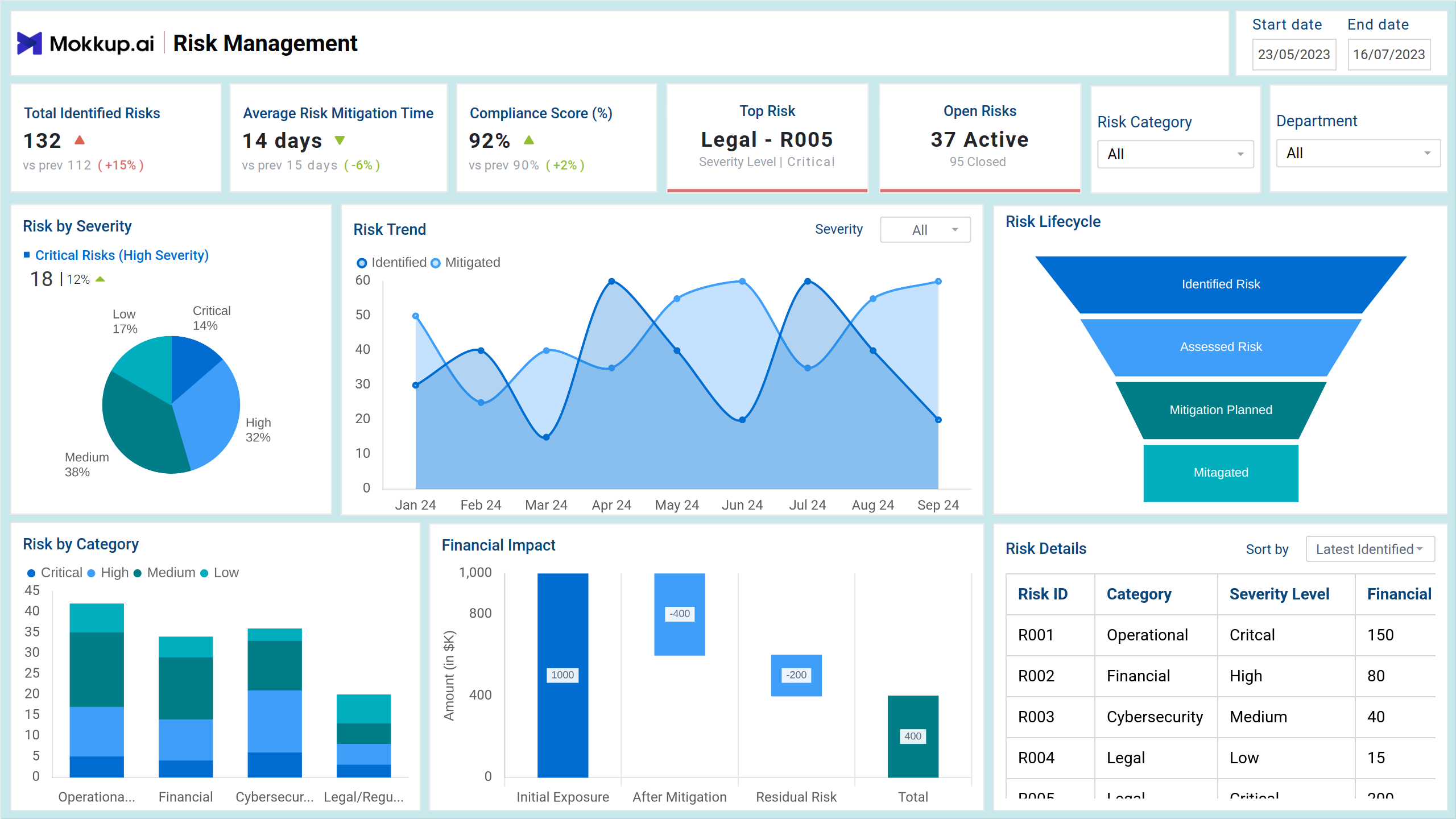
The Enterprise Risk Monitor dashboard template provides a comprehensive view of organizational risks, helping teams identify, assess, and mitigate potential threats effectively. By tracking key risk indicators, financial impact, and mitigation timelines, this dashboard wireframe enables proactive decision-making, enhances compliance, and ensures that risk management strategies align with business goals.
Key Terms to Know
- Total Identified Risks: The total number of risks recorded within a given period.
- Average Risk Mitigation Time: The average duration taken to resolve identified risks.
- Compliance Score (%): A metric indicating adherence to regulatory and internal risk policies.
- Top Risk: The most critical or high-impact risk currently affecting operations.
- Open Risks: The number of risks that remain unmitigated or unresolved.
- Risk by Severity: A pie chart categorizing risks based on their severity levels (low, medium, high).
- Risk Trend: A multi-line area chart showing risk fluctuations over time.
- Risk Lifecycle: A funnel chart illustrating the stages of risk from identification to resolution.
- Risk by Category: A stacked column chart categorizing risks based on different business areas.
- Financial Impact: A waterfall chart representing the monetary effect of risks on business operations.
- Risk Details: A table displaying essential information, including risk ID, category, severity level, and financial impact.
Dashboard Template Insights
A data-driven approach to risk management allows organizations to anticipate challenges and managing risks. This dashboard wireframe provides key insights to help organizations proactively manage and mitigate operational risks effectively.
- Risk trend analysis uncovers how risks evolve over time, supporting long-term mitigation planning and strategic adjustments.
- Severity-based risk categorization ensures that high-impact threats are addressed promptly, minimizing disruptions.
- Financial impact assessments help organizations allocate resources efficiently, balancing risk mitigation costs with business sustainability.
- Monitoring the risk lifecycle improves response times and resolution efficiency, preventing risks from escalating.
- Compliance tracking ensures that organizations meet regulatory requirements and avoid legal or financial penalties.
- Category-based risk segmentation helps organizations identify trends and patterns across different departments, improving cross-functional collaboration.
- Visualization of error-prone areas helps leadership teams take corrective actions before risks escalate into major incidents.
Conclusion
The Enterprise Risk Monitor dashboard template provides a structured, data-driven approach to financial risk management, helping organizations reduce potential threats, enhance compliance, and optimize operational resilience. By using advanced visual analytics and real-time tracking, businesses can adopt a proactive risk mitigation strategy, ensuring business continuity, financial stability, and regulatory adherence.