
What is an ENT Hospital & Institution Patient Engagement Dashboard?
An ENT Hospital & Institution Patient Engagement Dashboard is a specialized analytics tool designed to help healthcare providers track and improve every stage of the patient journey — from appointment scheduling to treatment completion and post-care feedback. This ENT hospital patient engagement analytics solution consolidates communication data, satisfaction surveys, and loyalty insights into a single, real-time interface.
By monitoring key indicators such as patient response time, satisfaction scores, and referral activity, hospitals can ensure patients receive timely, consistent, and high-quality care. In essence, it functions as a hospital patient satisfaction monitoring tool, empowering administrators and care teams to identify gaps in service delivery, improve communication workflows, and enhance patient loyalty across ENT and audiology departments.
How to Create an ENT Hospital & Institution Patient Engagement Dashboard
You don’t need to build your report from scratch—just start with a ready-to-use ENT hospital and institution patient engagement dashboard template from Mokkup. Add in your data and export it however you like. Here’s how to do it:
1. Create or Log in to Your Mokkup Account
Start by signing up on Mokkup.ai using your email. If you already have an account, just log in, and you’ll be good to go.
2. Choose and Customize Your Dashboard Template
Find the ENT Hospital and Institution Patient Engagement Dashboard template in the Templates section. Use the drag-and-drop editor to adjust KPIs, edit filters, or add elements based on your data.
3. Export to Your BI Tool
Once your dashboard wireframe is ready, use the BI Tool Export feature to send it directly to Power BI or Tableau for further analysis and enhancements. You can also download the dashboard as a PDF, PNG, or JPEG, embed it on a platform, or invite your team to collaborate.
Note: This is a Pro template. You’ll need a Pro subscription on Mokkup to use and customize this dashboard wireframe. Upgrade anytime to unlock full access.
ENT Hospital & Institution Patient Engagement Dashboard Example
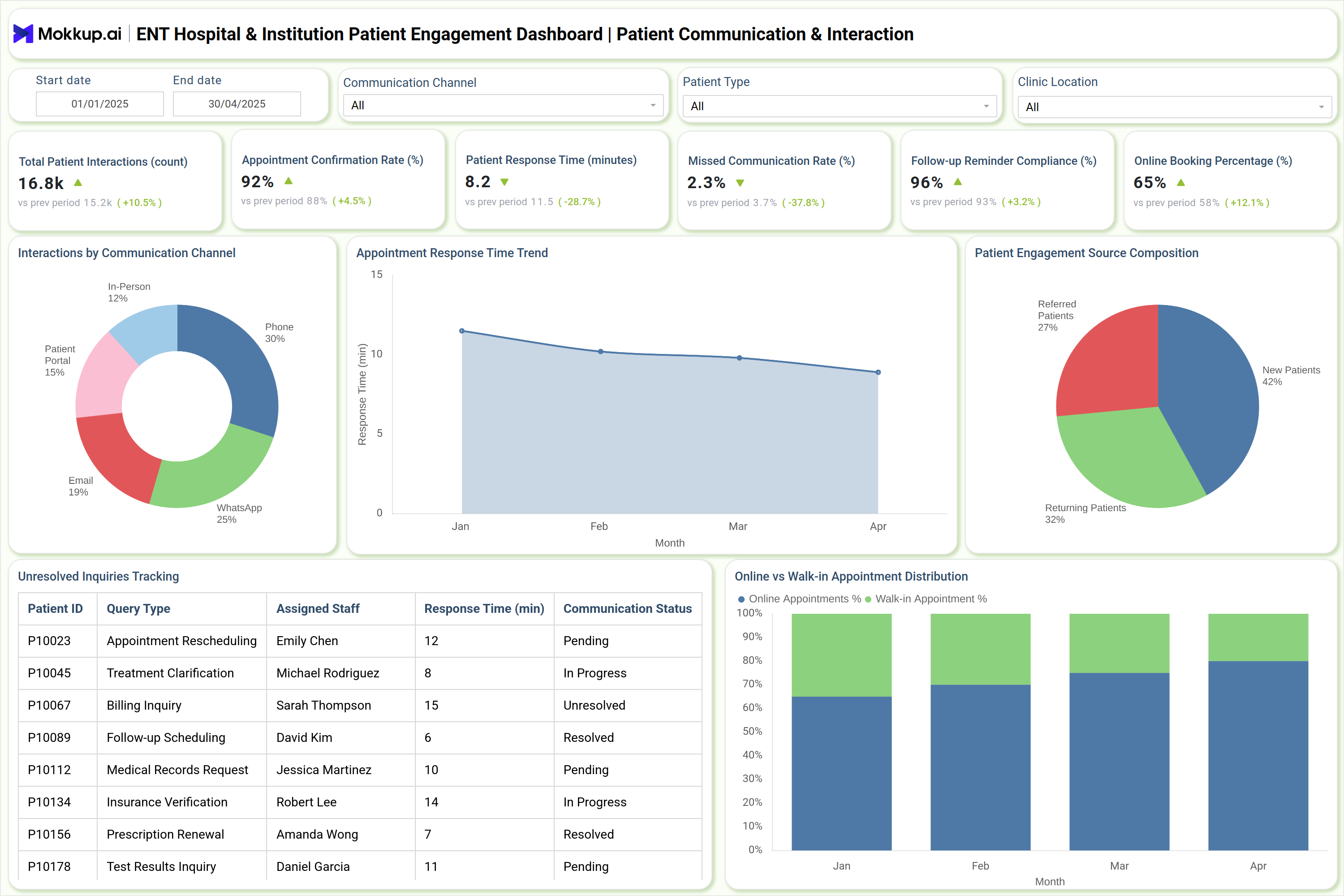
You can create your own hearing care patient engagement dashboard by combining three essential modules that provide a complete view of patient communication, satisfaction, and retention.
The Patient Communication & Interaction Dashboard tracks total patient interactions, response times, and online appointment rates, giving insights into how effectively clinics manage digital and offline touchpoints. The Patient Satisfaction & Feedback Dashboard functions as an audiology patient experience feedback dashboard, analyzing service quality, doctor communication, and complaint resolution trends to improve patient perception. The Patient Retention & Loyalty Dashboard monitors repeat visit rates, referral activity, and follow-up adherence, ensuring long-term engagement and loyalty. Together, these modules build a real-time clinic patient satisfaction tool that supports data-driven decision-making and consistent care delivery across ENT and audiology units.
How to Analyze Data in the ENT Hospital & Institution Patient Engagement Dashboard
Here’s how hospitals can make the most of the data available on the ENT hospital & institution patient engagement dashboard:
- Track Communication Volume: Review total patient interactions across channels like phone, WhatsApp, email, and patient portals.
- Monitor Appointment Metrics: Compare online vs. walk-in appointments to understand digital adoption trends.
- Evaluate Staff Response Time: Identify departments or staff with delayed query resolutions.
- Analyze Satisfaction Scores: Assess department-wise ratings to pinpoint service improvement areas.
- Review Feedback Sentiment: Classify positive, neutral, and negative feedback to gauge overall satisfaction.
- Measure Retention Rates: Track returning patients, follow-up adherence, and loyalty program participation.
- Identify Drop-Off Trends: Detect departments with higher lost-to-follow-up rates for targeted interventions.
- Correlate Referrals and Revenue: Study how referral sources contribute to new patient acquisition and engagement.
Benefits of the ENT Hospital & Institution Patient Engagement Dashboard
Here are the benefits of implementing this dashboard:
- Centralized tracking of all patient communication and feedback in one platform.
- Faster response times with real-time alerts for pending patient queries.
- Improved doctor-patient communication and reduced waiting times.
- Comprehensive visibility into satisfaction and loyalty trends.
- Enhanced efficiency in handling complaints and feedback resolution.
- Data-driven decisions for optimizing ENT and audiology care delivery.
- Increased patient retention through follow-up compliance and loyalty programs.
KPIs to Track in ENT Hospital & Institution Patient Engagement Dashboard
- Total Patient Interactions: Measures overall communication volume across channels.
- Appointment Confirmation Rate (%): Indicates efficiency in booking and scheduling.
- Patient Response Time (min): Tracks average time taken to respond to inquiries.
- Missed Communication Rate (%): Highlights unaddressed or delayed communications.
- Follow-up Reminder Compliance (%): Measures adherence to follow-up reminders.
- Online Booking Percentage (%): Reflects the digital adoption rate among patients.
- Patient Satisfaction Score (1–5): Represents overall service quality perception.
Frequently Asked Questions
1. What is the purpose of the ENT & Audiology Patient Engagement Dashboard?
It helps hospitals monitor and improve patient communication, satisfaction, and loyalty across ENT and audiology services.
2. How does it improve patient satisfaction?
By reducing communication delays, tracking feedback in real time, and optimizing doctor-patient interactions.
3. Who can use this dashboard?
Hospital administrators, ENT specialists, audiologists, and patient experience managers.
4. Can it be customized for different branches or clinics?
Yes, the dashboard supports multi-branch visibility, allowing comparisons between different locations or departments.