
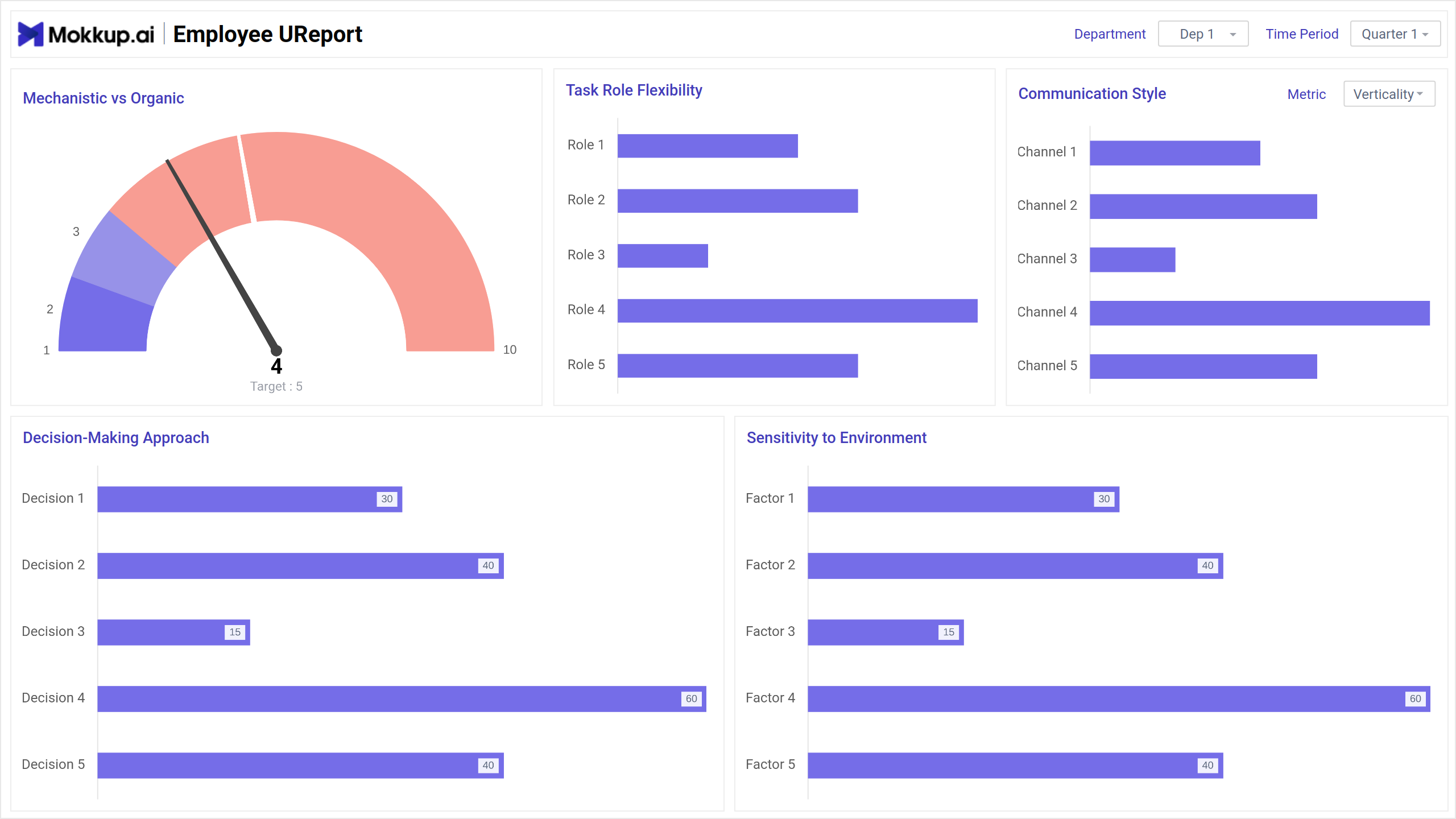
The employee utilization report template visualizes an organization's structure and communication style. It employs a hierarchical chart to depict departments, roles, and reporting structures. Key characteristics like decision-making approach, communication channels, and environmental sensitivity are displayed for each role. The template allows users to analyze how these factors influence departmental performance and overall organizational effectiveness.
Key Terms to Know
- Mechanistic vs Organic: Contrasts the organizational structure between mechanistic (rigid, hierarchical) and organic (flexible, decentralized) models.
- Task Role Flexibility: Evaluates the degree of flexibility in task assignments within the organization.
- Communication Style: Analyzes the predominant communication methods and channels used within the organization.
- Decision-Making Approach: Examines how decisions are made within the organization, whether top-down or participatory.
- Sensitivity to Environment: Assesses the organization's responsiveness to external factors and environmental changes.
Dashboard Template Insights
Through thoughtful design and strategic layout, this dashboard wireframe presents key insights seamlessly:
- Provides a visual representation of organizational structure, aiding in understanding the hierarchy and relationships between departments and roles.
- Enables comparison between mechanistic and organic structures, facilitating assessment of organizational flexibility and adaptability.
- Evaluates communication styles within the organization, identifying potential areas for improvement in information flow and collaboration.
- Analyzes decision-making approaches, guiding organizations in adopting strategies that align with their goals and environment.
Conclusion
In conclusion, the employee utilization report wireframe embodies simplicity, strategic focus, & comprehensive insight. By distilling complex data into easily understandable visuals, it enables stakeholders to identify key trends and make informed decisions swiftly. This not only enhances organizational clarity but also fosters agility and proactive strategies, driving continuous improvement and success.