
What is a Dialysis Healthcare Finance Dashboard?
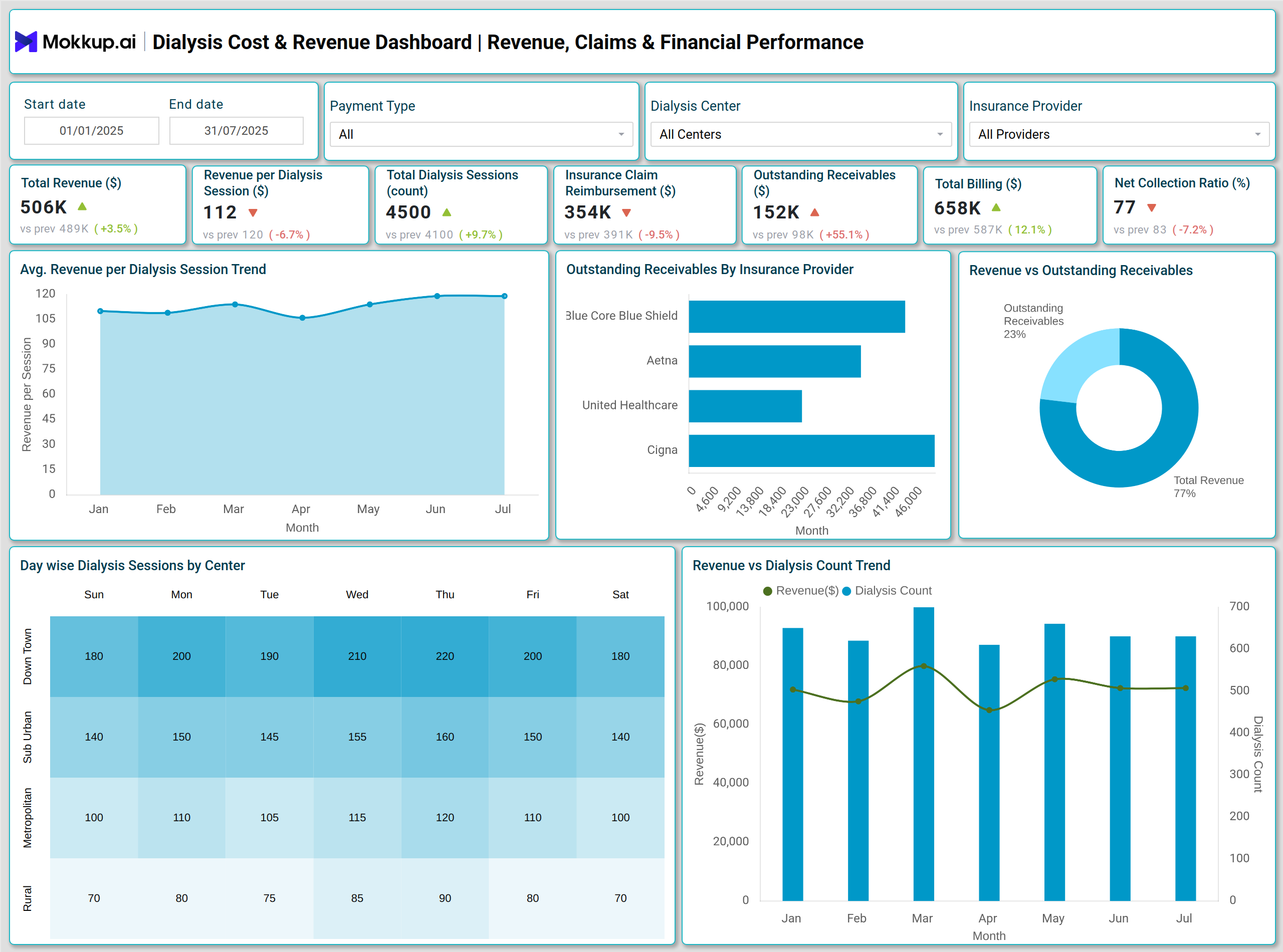
A Dialysis Healthcare Finance Dashboard is a centralized platform designed to monitor financial performance, patient session efficiency, and operational costs across dialysis centers. It allows administrators, finance managers, and executive directors to track revenue, insurance claim reimbursements, outstanding receivables, and treatment costs. By combining patient session data, billing, funding sources, and departmental efficiency, the dashboard enables cost management & profitability analysis, revenue optimization in dialysis centers, and improved decision-making.
How to Create a Dialysis Healthcare Finance Dashboard
You don’t need to build your report from scratch-just start with a ready-to-use dashboard template from Mokkup. Add your data and export it as needed. Here’s how to do it:
1. Create or Log in to Your Mokkup Account
Start by signing up on Mokkup.ai using your email. If you already have an account, simply log in, and you’ll be all set.
2. Choose and Customize Your Dashboard Template
Find the Dialysis Healthcare Finance Dashboard template in the Templates section. Use the drag-and-drop editor to adjust KPIs, edit filters, or add elements based on your data.
3. Export to Your BI Tool
Once your dashboard wireframe is ready, use the BI Tool Export feature to send it directly to Power BI or Tableau for further analysis and enhancements. You can also download the dashboard as a PDF, PNG, or JPEG, embed it on a platform, or invite your team to collaborate.
Note: This is a Pro template. You’ll need a Pro subscription on Mokkup to use and customize this dashboard wireframe. Upgrade anytime to unlock full access.
Dialysis Healthcare Finance Dashboard Example
It helps in tracking revenue, patient sessions, insurance claims, and collection efficiency. Highlights outstanding receivables and trends in revenue per dialysis session. Helps identify which sessions generate higher cash flow versus insurance-dependent revenue, supporting revenue optimization in dialysis centers. Dialysis Healthcare Finance Dashboard also monitors operational costs, profit margins, and resource allocation efficiency. Tracks treatment cost trends and funding/grant utilization. Helps identify high-cost centers and optimize departmental efficiency, reinforcing cost management & profitability.
How to Analyse Data in a Dialysis Healthcare Finance Dashboard
- Start with KPIs: Evaluate total revenue, revenue per dialysis session, operational margin, and net collection ratio to gain a deeper understanding of financial performance.
- Assess Cost Efficiency: Compare operational costs, cost per patient, and average treatment cost across centers to identify inefficiencies and improve dialysis operational efficiency.
- Track Profit Trends: Monitor profit per dialysis session, operational margin, and funding utilization to identify high-performing centers and areas of cost pressure.
- Patient & Billing Insights: Analyze dialysis session counts, claim reimbursements, and outstanding receivables to optimize collections and ensure accurate insurance claim tracking.
- Identify Patterns & Anomalies: Apply filters by treatment type, center, or time period to detect high-cost areas, low-performing units, or unusual trends for better cost management & profitability.
Benefits of a Dialysis Healthcare Finance Dashboard
- Provides real-time insights on revenue, costs, and patient sessions
- Enables data-driven decisions for financial and operational efficiency
- Optimizes resource allocation and cost management
- Enhances billing, claims tracking, and collection efficiency
- Highlights high-value treatments and underperforming areas
- Improves transparency for stakeholders
KPIs to Track in Dialysis Healthcare Finance Dashboard
- Total Revenue & Revenue per Dialysis Session -Shows overall income and efficiency per session
- Total Dialysis Sessions & Net Collection Ratio -Tracks patient throughput and collection effectiveness
- Insurance Claim Reimbursement & Outstanding Receivables -Measures insurer payments and pending revenue
- Operational Margin % & Profit per Session- Indicates financial profitability per session
- Cost per Patient & Funding Utilization % -Tracks spending efficiency and grant/funding usage
Frequently Asked Questions
1. Why monitor operational margin in conjunction with treatment costs?
A low margin despite high revenue highlights inefficiencies in resource utilization or cost control, supporting effective cost management & profitability.
2. How does analyzing supply cost distribution help?
It identifies high-cost consumables to reduce wastage and improve profitability.
3. Why track outstanding receivables by payer type?
This can help prioritize collections and manage cash flow more effectively, enabling efficient insurance claim tracking.
4. How can funding utilization trends guide strategic decisions?
Ensures optimal use of grants, government funds, or private funding to avoid dependency or underutilization.