
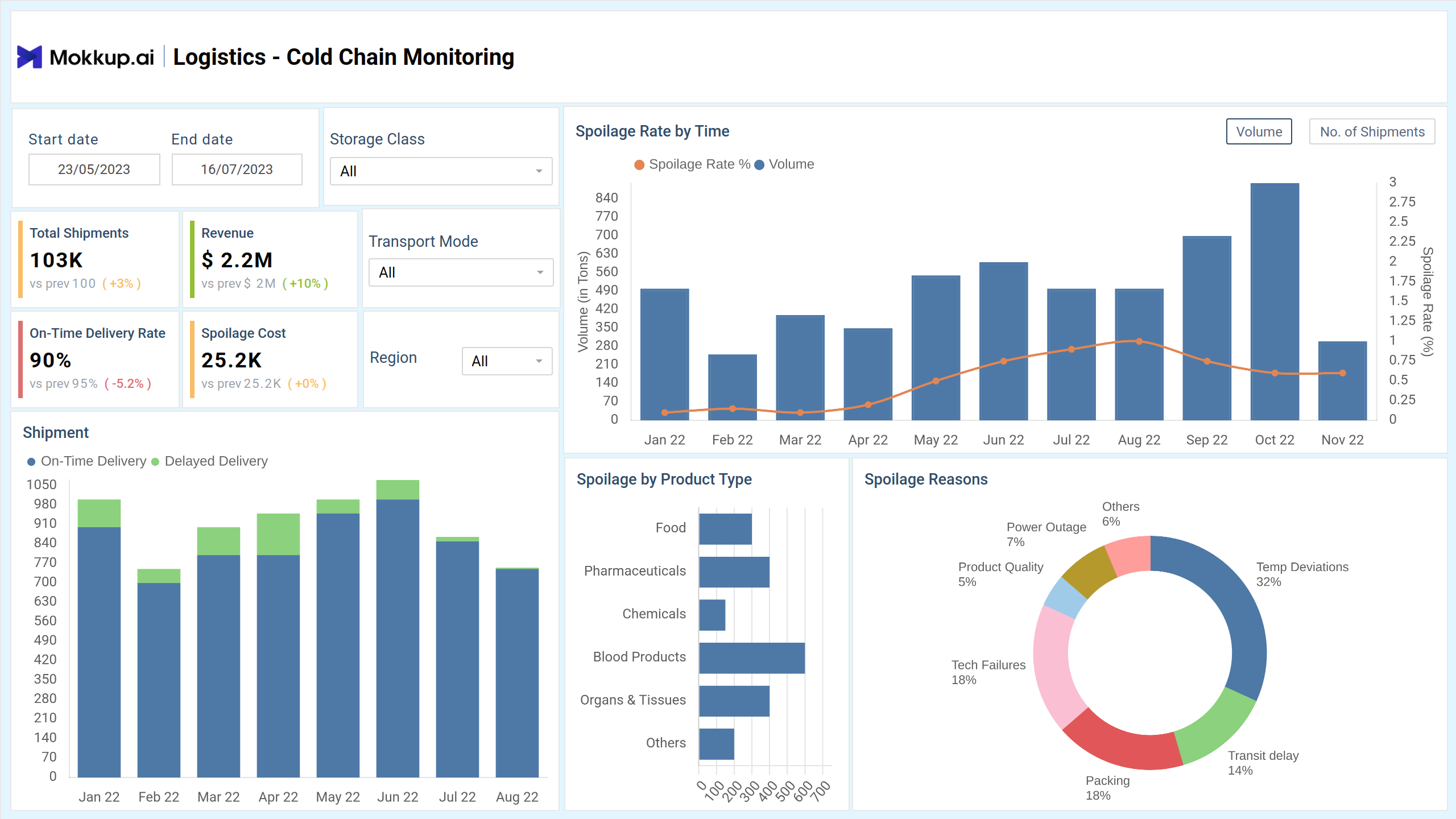
The Cold Storage Insights dashboard template helps businesses monitor long-term data storage usage, ensuring efficient space utilization and cost management. It provides a detailed view of storage consumption, retrieval trends, and underutilized resources. By analyzing usage patterns, organizations can optimize storage allocation, reduce expenses, and improve data accessibility without unnecessary overhead.
Key Terms to Know
- Total Shipments: Tracks the total number of shipments handled during the selected period.
- Revenue: Shows the total revenue generated, helping to assess financial performance over time.
- On-Time Delivery Rate: Reflects the percentage of shipments delivered on time, providing insight into delivery efficiency.
- Spoilage Cost: Indicates the financial impact of spoilage during transit, highlighting areas for cost optimization.
- Shipment Performance: A bar chart that compares on-time vs. delayed deliveries, revealing trends in delivery efficiency.
- Spoilage Rate by Time: Combines volume and spoilage rate trends to identify seasonal fluctuations or operational inefficiencies.
- Spoilage by Product Type: A bar chart that identifies which product categories are most affected by spoilage, guiding quality control efforts.
- Spoilage Reasons: A donut chart categorizes the causes of spoilage, such as temperature deviations or transit delays, to pinpoint operational issues.
Dashboard Template Insights
Here are the key insights the dashboard wireframe provides:
- Monitors long-term data storage usage, ensuring efficient space allocation.
- Identifies underutilized or redundant storage to optimize costs.
- Tracks retrieval frequency to assess access patterns and storage efficiency.
- Provides visibility into storage health, helping prevent data loss or degradation.
Conclusion
The Cold Storage Insights dashboard provides a clear overview of long-term data storage usage, helping businesses optimize costs and manage space efficiently. By identifying underutilized storage and monitoring retrieval trends, it ensures data accessibility while preventing unnecessary expenditures, making it a valuable tool for effective storage management.