
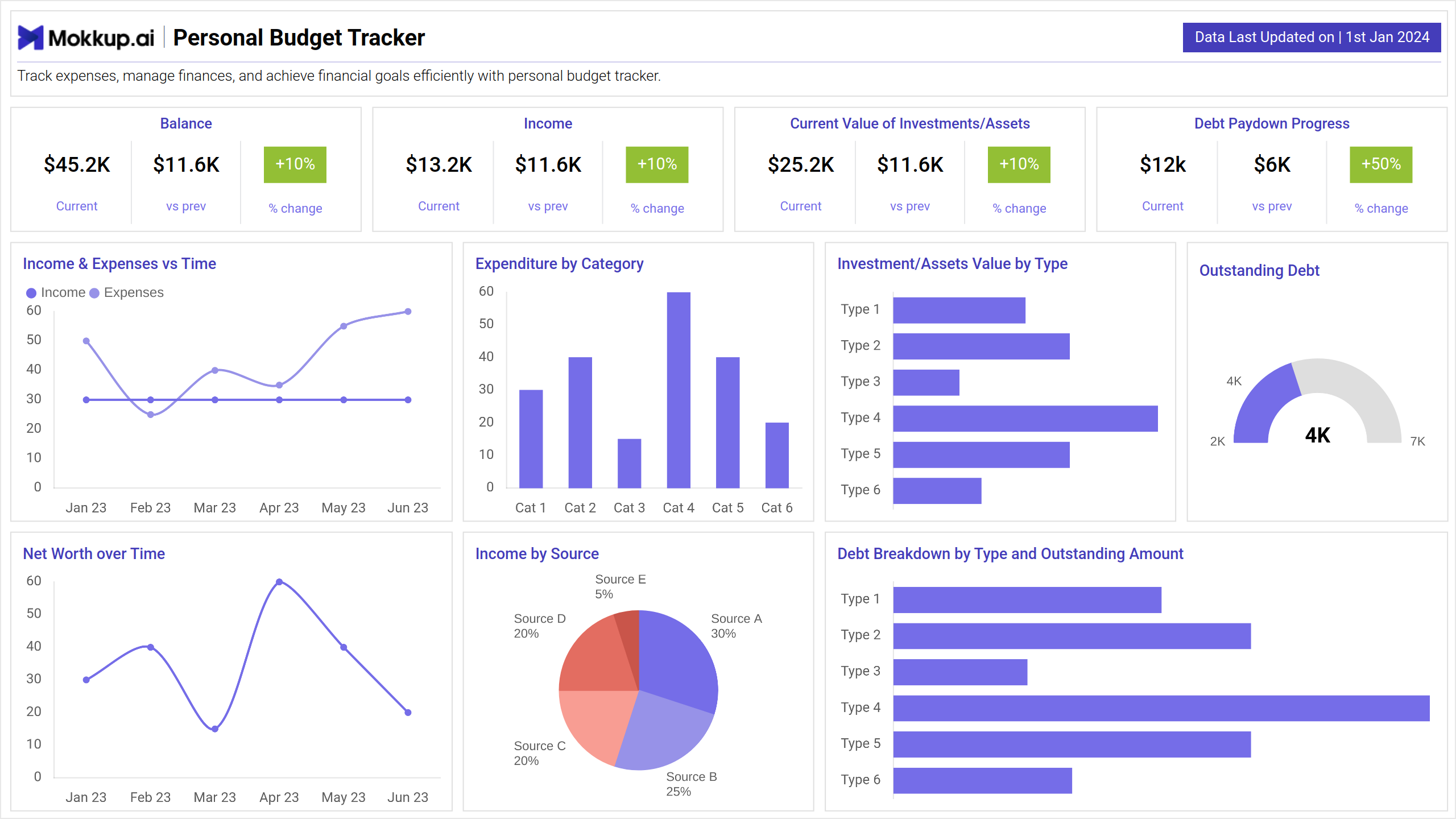
This template is designed to streamline decision-making and enhance operational oversight. It offers a centralized hub for accessing key business metrics and performance indicators. With its user-friendly interface and comprehensive data presentation, it empowers business managers to gain actionable insights into various aspects of operations, enabling effective planning and resource allocation for organizational success.
The dashboard wireframe comprises three screens: Overview, Operations & Customer Satisfaction; each is explained briefly below.
Overview
This screen displays a collection of charts and graphs that summarize key performance indicators (KPIs) relevant to various areas of a business. These include sales, profit margins, customer satisfaction, and cash flow. The dashboard also allows users to filter data by factors such as date range, region, and product.
Key Terms to Know
- Total Revenue: Displays the overall income generated from all sales.
- Profit Margin: Shows the percentage of revenue that exceeds the costs of goods sold.
- Total Orders: Indicates the total number of orders placed within a specific period.
- Avg. Order Value: Calculates the average revenue per order.
- Conversion Rate: Measures the percentage of visitors who complete a desired action, such as making a purchase.
- Cash Flow Analysis: Provides an overview of cash inflows and outflows to assess liquidity.
- Expense Breakdown: Details the distribution of expenses across different categories.
Operations
This view focuses on metrics that can help improve operational efficiency and identify areas for improvement. It includes sections for inventory management, order fulfillment, and lead time. Inventory management tracks stock on hand, reorder value and quantity, and stockout rate. Order fulfillment shows the on-time fulfillment rate (OTIF) by product. Lead time displays the average time it takes to complete an order.
Key Terms to Know
- Inventory Turnover Ratio: Measures how often inventory is sold and replaced over a period.
- Stock on Hand: Indicates the current quantity of inventory available.
- Reorder Value & Quantity: Specifies the value and amount of inventory that need to be reordered to maintain stock levels.
- Stockout Rate: Calculates the frequency at which items run out of stock.
- Lead Time: Represents the time taken from placing an order to receiving the inventory.
- OTIF by Product: Measures the percentage of orders delivered on time and in full for each product.
- Product Summary: Provides a comprehensive overview of key metrics and performance indicators for each product.
Customer Satisfaction
This screen helps businesses monitor and analyze customer sentiment. It tracks key metrics such as customer satisfaction score (CSAT), net promoter score (NPS), customer effort score (CES), and churn rate. The dashboard also allows users to drill down into specific customer segments and product areas, identify trends over time, and view verbatim feedback from surveys. Overall, this Customer Satisfaction Business Management Dashboard seems designed to empower businesses to understand customer satisfaction and identify areas for improvement.
Key Terms to Know
- CLTV: Estimates the total revenue expected from a customer over their entire relationship with the company.
- CAC: Indicates the average cost incurred to acquire a new customer.
- NPS: Measures customer loyalty and satisfaction by calculating the Net Promoter Score based on customer feedback.
- Customers by Sentiment: Analyzes customer feedback to categorize sentiments as positive, negative, or neutral.
- Complaint Resolution Time: Tracks the average time taken to resolve customer complaints.
- Customer Churn vs Retention Rate: Compares the rate of customers who stop using the product with those who continue to stay over a given period.
- Survey Responses by Cohort: Breaks down survey responses based on specific customer groups or segments.
Dashboard Template Insights
This template offers crucial insights into operational performance and financial health:
- Providing metrics such as total revenue, profit margin, and cash flow analysis, the dashboard offers a comprehensive view of the organization's financial performance.
- With features like inventory turnover ratio and stock on hand, it facilitates effective inventory planning and control.
- Metrics like CLTV, CAC, and NPS enable businesses to gauge customer satisfaction and loyalty, guiding strategies for customer retention and acquisition.
- By including metrics such as complaint resolution time and stockout rate, the dashboard helps businesses monitor and improve operational efficiency.
Conclusion
In conclusion, this wireframe empowers organizations with critical insights into financial performance, inventory management, customer experience, and operational efficiency. By providing comprehensive metrics and analytics, it enables informed decision-making and strategic planning.