
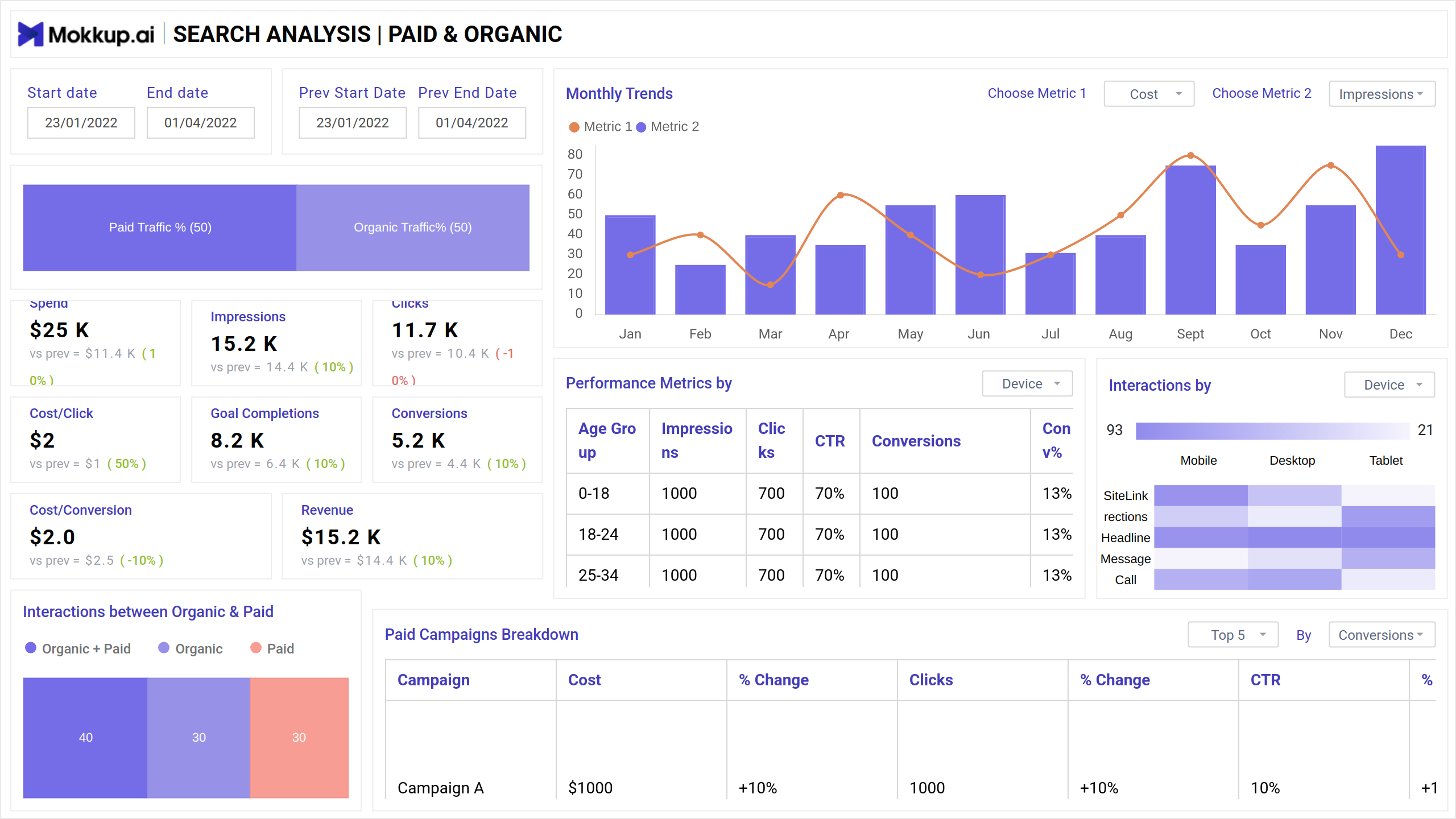
Online searches enable businesses to uncover valuable insights into customer interactions and preferences through the analysis of social media participation, views, and follower data. Proficiently gauging the impact of diverse social media platforms and campaigns empowers the optimization of marketing plan, ultimately leading to an enhanced return on investment (ROI).
By ascertaining emergent conversations as soon as they arise, brands can remain one step ahead of rivals and increase brand recognition. Social media analytics are a powerful tool for developing successful social media marketing plan example, helping businesses connect with their customers and gain a competitive edge.
Screen 1: Executive Summary
This perspective allows firms to assess user preferences and trends by providing a high-level overview of consumer sentiment across social platforms. Businesses can discover more about client wants and preferences by studying influencers and postings based on sentiment.
Key Terms to consider:
- Cost/Click - Evaluate the cost per click to assess the efficiency and cost-effectiveness of paid advertising efforts.
- Impressions - Measure the total number of times an ad is displayed, providing insights into its visibility and reach.
- CTR - Examine the Click-Through Rate to gauge the percentage of users who click on an ad after seeing it, indicating its effectiveness.
- Paid Campaigns Breakdown - Analyze the performance and expenditure breakdown of various paid campaigns to optimize resource allocation.
- Cost/Conversion - Calculate the cost per conversion to understand the financial efficiency of acquiring desired actions from users.
Screen 2: Detailed Summary
This view thoroughly studies key website search metrics, including sponsored and organic results, and gives a concise snapshot of the search's development. Awareness - The effectiveness of search tactics requires an awareness of keywords like organic versus paid, impressions, clicks, and conversions.
Key Terms to consider:
- Keyword Summary - Summarize the performance and relevance of keywords in driving traffic and achieving campaign objectives.
- Competitor Breakdown - Evaluate the strategies and performance of competitors to identify opportunities and refine your own approach.
- Landing Page - Assess the effectiveness of landing pages in converting visitors, ensuring alignment with campaign objectives.
- Keywords by Avg. Position - Understand the average position of keywords in search results to refine and improve organic and paid search strategies.
- Traffic Type - Categorize and analyze the type of traffic, distinguishing between organic, paid, direct, and referral sources.
- Authority Score - Evaluate the authority score to gauge the credibility and influence of a website in search engine rankings.
- Backlinks - Examine the number and quality of backlinks to understand the website's link profile and influence on search engine rankings.
Dashboard Template Insights
Business success depends on translating consumer needs into actions that generate income. Businesses can stay updated about hot subjects and competitive positions by having a solid understanding of the search summary, which enables them to take strategic measures for ongoing improvement.
Conclusion
Businesses can take advantage of online search possibilities and maintain an edge in the ever-changing digital environment with the help of the Search Summary Dashboard.