
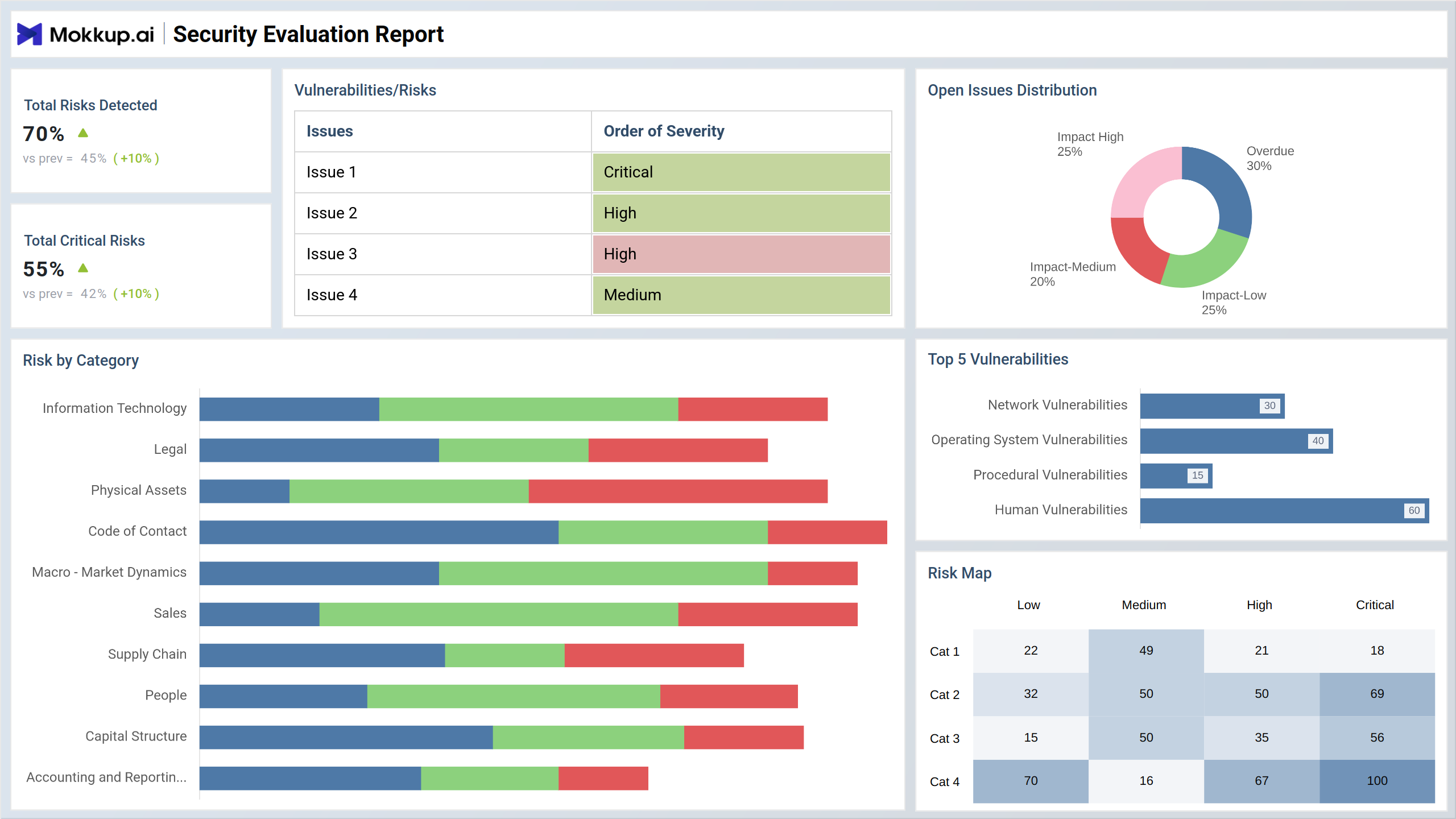
A security testing template visually represents your organization's most important security metrics and KPI (key performance indicator). It provides a quick and easy way to track the results of security tests, identify vulnerabilities, and prioritize remediation efforts. It can help you identify areas where your security testing could be improved. It can also help users track your progress and see how your security posture is improving.
Screen 1:
This screen provides an at-a-glance view of critical aspects such as the overall risk landscape, prioritized critical risks demanding immediate attention, categorized risks for targeted management, a visual representation of risk distribution through the risk map, the dispersion and status of open issues for transparent resolution tracking, and an evaluation of vulnerabilities within the context of overall risk, highlighting potential weaknesses in the system or processes. This screen is valuable for monitoring progress, identifying testing gaps, and enhancing the organization's overall security posture.
Key Terms to Consider:
- Total Risk Detected - Assessing the overall risk landscape and identifying the cumulative extent of potential threats.
- Total Critical Risks - Highlighting and prioritizing the most severe and impactful risks that demand immediate attention and mitigation efforts.
- Risk by Category - Categorizing identified risks based on their nature, origin, or specific domains to facilitate targeted risk management strategies.
- Risk Map - Visualizing the distribution of risks across the organization, providing a comprehensive overview of the threat landscape.
- Open Issues Distribution - Displaying the dispersion and status of unresolved issues, ensuring transparency and enabling focused resolution efforts.
- Vulnerabilities/Risk - Evaluating and quantifying vulnerabilities in the context of overall risk, emphasizing potential points of weakness in the system or processes.
Screen 2:
This screen is a focal point for understanding the organization's security strength, responsiveness, and commitment to continuous improvement. It includes the Security Rating, offering a quantified assessment of the overall security posture.
Key Terms to Consider:
- Security Rating - Quantifying the overall security posture and effectiveness of protective measures.
- Mean Time Taken to Detect/Resolve - Measuring the average duration required to identify and address security issues indicates the incident response's efficiency.
- Issues Found/Patched - Tracking the number of security issues discovered and successfully patched, reflecting the organization's commitment to proactive risk management.
- No. of Action Plans - Enumerating the total count of strategic plans devised to enhance security measures and address identified vulnerabilities.
- Top Critical Action Plans - Identifying and prioritizing the most crucial action plans to mitigate high-impact security risks and vulnerabilities.
Dashboard Template Insights
- The security testing template serves as a critical wireframe for organizations.
- It visually represents key security metrics and facilitates efficient tracking of test results and vulnerability identification.
- Screen 1 offers a comprehensive view, highlighting risk aspects. It aids in progress monitoring.
- Screen 2 acts as a focal point for critical performance indicators. This includes Security Rating and action plans.
- This emphasizes the dashboard wireframe's role in bolstering an organization's security posture.
- It enhances responsiveness to cyber threats.
Conclusion
The Security Testing dashboard wireframe is a vital template for organizations to assess and enhance their security posture. It is a valuable wireframe for tracking the results of security tests, identifying vulnerabilities, and prioritizing remediation efforts. This dashboard wireframe comprehensively offers an organization's security landscape by consolidating data from various security tests and assessments. It empowers security teams to prioritize remediation efforts, track progress, and bolster their defenses against evolving cyber threats.