
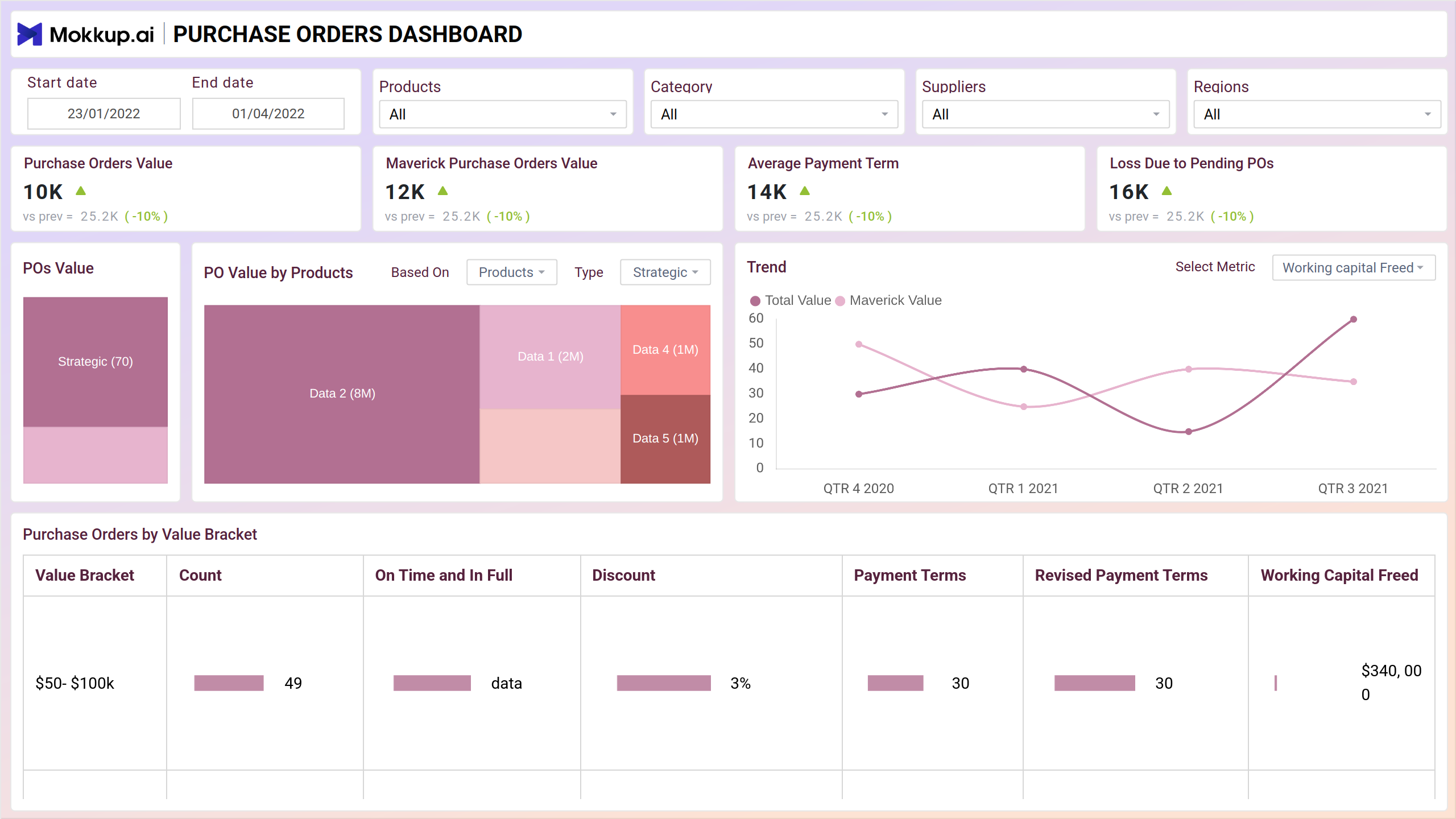
An official document known as a purchase order, or PO, is one that a buyer issues to commit payments to a seller for particular products or services that will be delivered later. The PO gives buyers the benefit of postponed payment by allowing them to place orders without paying immediately.
Sellers use purchase orders to provide customers with credit, reducing risks as they are required by law to pay for goods and services when delivered. The tracking of payments and quantities related to various items is made easier by this dashboard wireframe.
Key Terms to Know:
- Purchase Order Value: The collective sum of all purchase orders placed with different suppliers.
- Maverick Purchase Order Value: The combined value of orders made with suppliers not aligned with established procurement policies.
- Average Payment Term: The average time purchase order payments are anticipated.
- Loss due to Pending POs: Financial loss resulting from incomplete purchase orders.
- PO Value by Products: A visual representation and trend analysis of products categorized under regular and Maverick suppliers.
- Purchase Orders by Value Bracket: Presents the count of purchase orders within various value ranges.
Purchase Orders - Screen 2
This screen provides insights into pending purchase orders, including the monetary value awaiting fulfillment from Maverick suppliers, strategic PO value, and average PR to PO time. Additionally, it visualizes the distribution of reasons behind pending purchase orders through a pie chart for comprehensive analysis.
Key Terms to Know
- Pending Maverick PO Value: The monetary value of purchase orders awaiting fulfillment from Maverick suppliers.
- Strategic PO Value: The value of purchase orders in progress but yet to be executed.
- Average PR to PO Time: The average duration between generating a Purchase Requisition and raising a Purchase Order.
- Distribution of Reasons: Illustrated through a pie chart, this showcases the reasons behind pending purchase orders.
Purchase Orders - Screen 3
This screen offers a comprehensive overview of purchase orders and purchase requisitions, providing insights into procurement processes and inventory management.
Key Terms to Know
- Purchase Orders Overview: Displays detailed information about purchase orders, including time beyond Turnaround Time (TAT), PR number, product details, shipment quantity, and other relevant data.
- Purchase Requisitions Analysis: Offers insights into purchase requisitions, presenting PR numbers, shipment quantities, delays, reasons for delays, and additional details for analysis.
Dashboard Template Insights
The Procurement Purchase Orders dashboard wireframe provides key insights to enhance procurement processes and supplier management:
- It tracks purchase orders, highlights Maverick orders, and monitors payment terms and pending orders to ensure efficient order management.
- The dashboard helps monitor supplier compliance, identifying non-compliant orders and mitigating associated risks.
- By offering insights into pending orders, lead times, and procurement trends, it aids in streamlining procurement processes and improving inventory management.
- Visual representations provide comprehensive analysis, facilitating informed decision-making and effective performance tracking.
- Screen 3 supports inventory optimization by enhancing inventory management and procurement processes for greater operational efficiency.
Conclusion
A Procurement Purchase Orders dashboard template provides a comprehensive view of all purchase orders, from creation to fulfillment. This information can be used to track performance, identify areas for improvement, and make informed decisions about procurement processes.
In addition to tracking key metrics, procurement purchase order dashboards can also be used to track supplier performance and identify potential risks. For example, a business may see that a particular supplier is consistently late with deliveries.
This information can be used to take corrective action, such as finding a new supplier or negotiating better terms with the current supplier.