
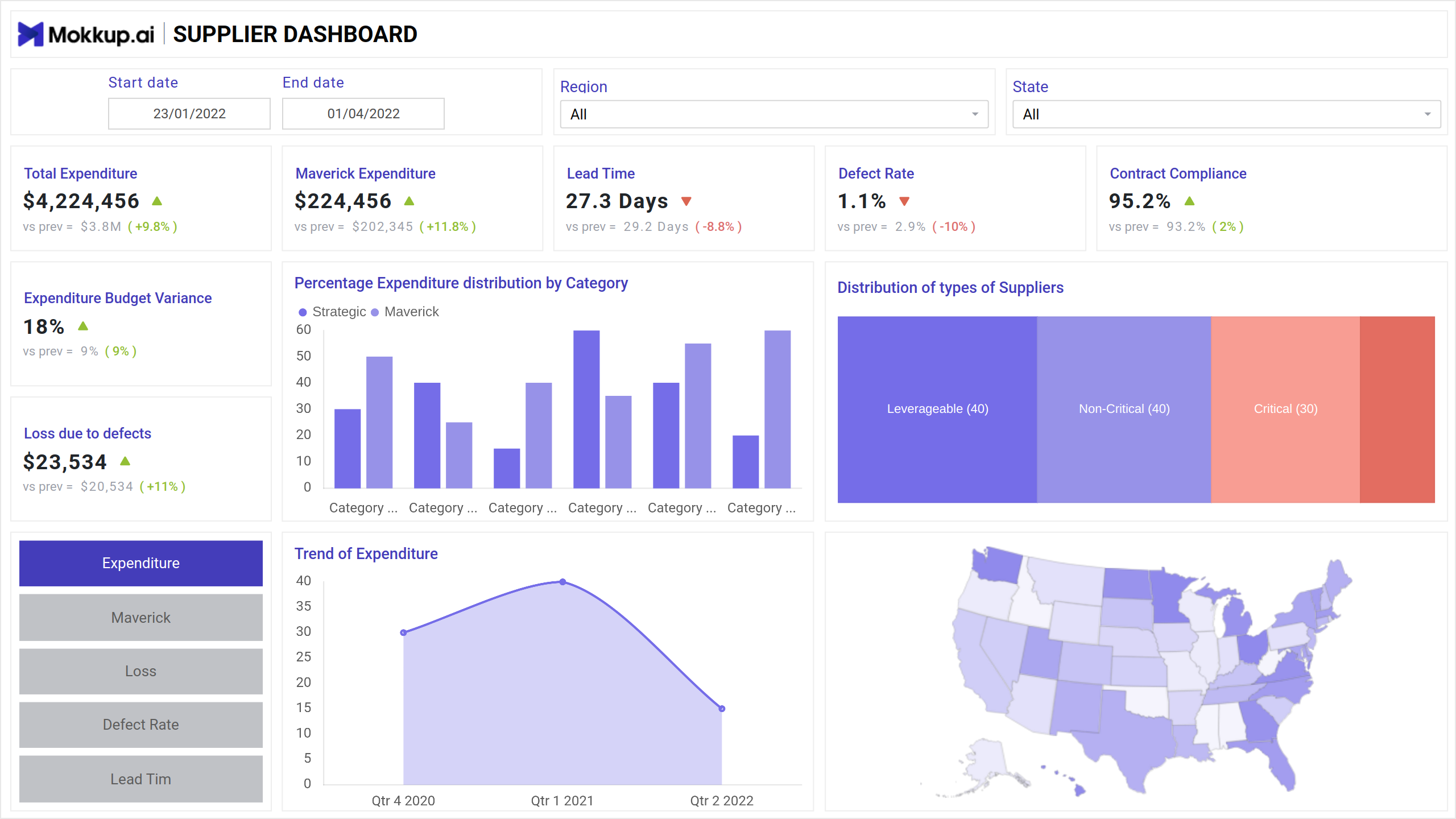
Supplier management has been critical for modern businesses to maintain their top line and increase stability. Most of the working capital is used to procure goods and services, making it vital for every business to focus on strategic procurement to achieve the best product reliability, quality, and effectiveness.
The Supplier dashboard template monitors the performance of the suppliers and tries to identify the most efficient suppliers while reducing over-dependence:
- Increase revenue by reducing costs
- Identifying the maverick suppliers
- Evaluating the suppliers for selection
- Comparing the existing suppliers currently employed
The values corresponding to the above goals are measured across all regions and product categories, making it critical for planning the future marketing strategies of the company.
Key Terms to Know:
- Total Expenditure: The total amount of money that has been spent on products to build inventory
- Maverick Expenditure: This is the amount of money spent on products bought from suppliers without adhering to the company's established procurement policy
- Lead Time: The time spent between when the order is received and when the products are delivered
- Defect Rate: Defect Rate is the percentage of products that turned out to be defective in the inventory
- Contract Compliance: Percentage of occasions where a contract established with the supplier has been adhered to with strict compliance Loss due to defects - The amount lost by the business because of defective articles
Category View
The category view of the supplier dashboard provides a focused analysis of procurement-related metrics, offering insights into procurement cycle time, expenditure trends, and supplier distribution.
Key Terms to know:
- Procurement Cycle Time: Measures the time taken to complete the procurement process for each category.
- Trend of Expenditure: Visualizes expenditure trends over time for different procurement categories.
- Supplier Distribution: Displays the distribution of expenditure among different suppliers within each category.
This view enables stakeholders to evaluate procurement efficiency, track expenditure patterns, and assess supplier performance within specific categories, facilitating informed decision-making and strategic supplier management.
Dashboard Template Insights
The Supplier Dashboard wireframe provides key insights to enhance supplier management and optimize procurement processes:
- Strategic supplier management is essential for businesses to optimize costs, improve product reliability, and stay competitive in the market.
- A focus on procurement efficiency allows the dashboard to monitor supplier performance, helping businesses identify efficient suppliers to reduce costs and boost revenue.
- Mitigating Maverick Spending ensures that businesses adhere to procurement policies, optimizing their expenditure and preventing unauthorized spending.
- Supplier evaluation and selection enables businesses to assess current suppliers, compare performance, and make informed decisions about supplier selection and retention.
- A comprehensive performance analysis through category views allows stakeholders to examine procurement cycle time, expenditure trends, and supplier distribution, supporting strategic supplier management.
Conclusion
In conclusion, a procurement-supplier dashboard template is used to track the on-time delivery performance of its suppliers. The dashboard wireframe shows that one supplier has a consistently low on-time delivery rate. It can also be used to communicate supplier performance to stakeholders within the business. The dashboard wireframe can also identify improvement areas, such as reducing maverick spending or improving contract utilization.